


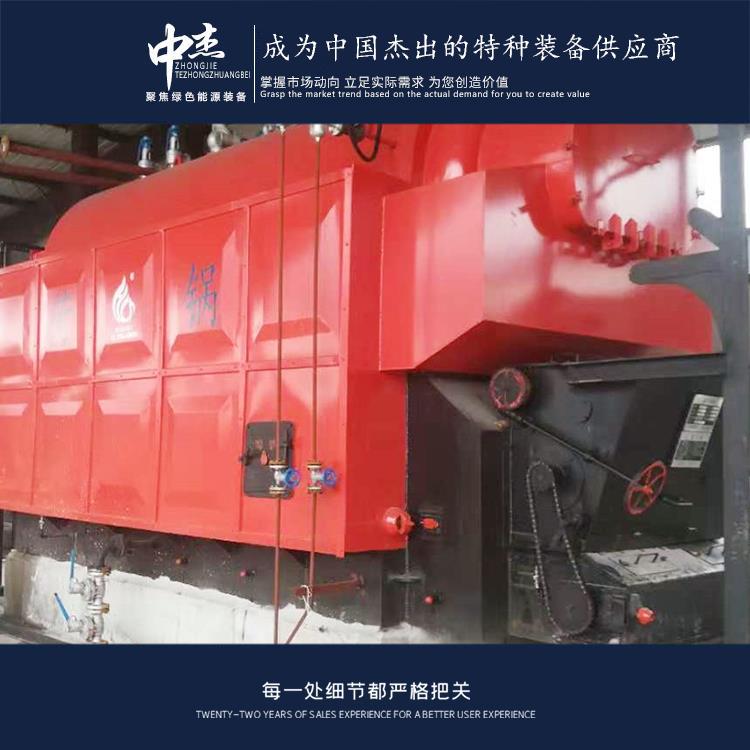
Shandong Zhongjie Special Equipment (formerly Heze Boiler Factory Co., Ltd.) holds an A-grade boiler manufacturing license, an A2-grade pressure vessel manufacturing license, an A2-grade pressure vessel design license, a B-grade boiler installation license, as well as GB2 and GC2 pressure pipeline installation licenses and a mechanical and electrical equipment installation contracting qualification. It is a member of the China Boilers and Water Treatment Association, the China Chemical Equipment Association, and the理事 unit of the Shandong Equipment Manufacturing Association. The company has also passed certifications for the ISO9001 Quality Management System, ISO14001 Environmental Management System, OHSAS18001 Occupational Health and Safety Management System, and the American ASME/U2 certification.
Several advantages come with choosing biomass boilers:
Renewable Energy: Fuel for biomass boilers comes from organic materials such as plants, animals, and microorganisms, making it a renewable energy source. Compared to traditional fossil fuels, biomass fuel has lower carbon emissions and environmental impact, helping to reduce greenhouse gas emissions and is more environmentally friendly.
Diverse Fuel Sources: Biomass fuel sources are extensive, including wood, straw, waste crops, food scraps, and municipal solid waste. This diversity in fuel sources allows biomass boilers to be flexible and adaptable, utilizing waste and by-products from plants and animals, thereby reducing resource waste.
Environmental friendliness: The carbon dioxide produced during the combustion of biomass boilers can be absorbed by plants, forming a cycle that reduces air pollution. Additionally, the emissions and ash produced during the combustion process of biomass boilers are relatively low, causing minimal environmental impact.
Energy Security: Biomass, as a local renewable energy source, can reduce dependence on imported energy and enhance energy security. In regions with scarce resources, the use of biomass boilers can provide a reliable energy supply.
Economic Efficiency: Biomass fuel is relatively cost-effective and can reduce energy costs. Additionally, the technology and equipment for biomass boilers are continuously evolving and maturing, making them even more economically viable.
A biomass boiler safety valve is a device designed to ensure the safety of the boiler system. Its primary function is to automatically open and release excessive pressure when the internal pressure of the boiler exceeds the set value, preventing the boiler from exploding or causing other safety incidents.
Biomass boiler safety valves typically consist of the valve body, valve cover, spring, valve core, and seals. When the internal pressure of the boiler exceeds the set value, the spring is subjected to pressure, lifting the valve core to allow pressure to escape through the valve body. Once the pressure drops below the set value, the spring re-closes the valve core, preventing further pressure release.
The set pressure of safety valves is typically determined by the design pressure of the boiler and usage requirements. They should be selected and installed according to relevant standards and specifications, and regularly inspected and maintained to ensure proper operation and reliability.
The presence of a biomass boiler safety valve effectively safeguards the boiler system's safety, preventing hazardous situations caused by excessive pressure. It is one of the crucial safety devices in the biomass boiler system.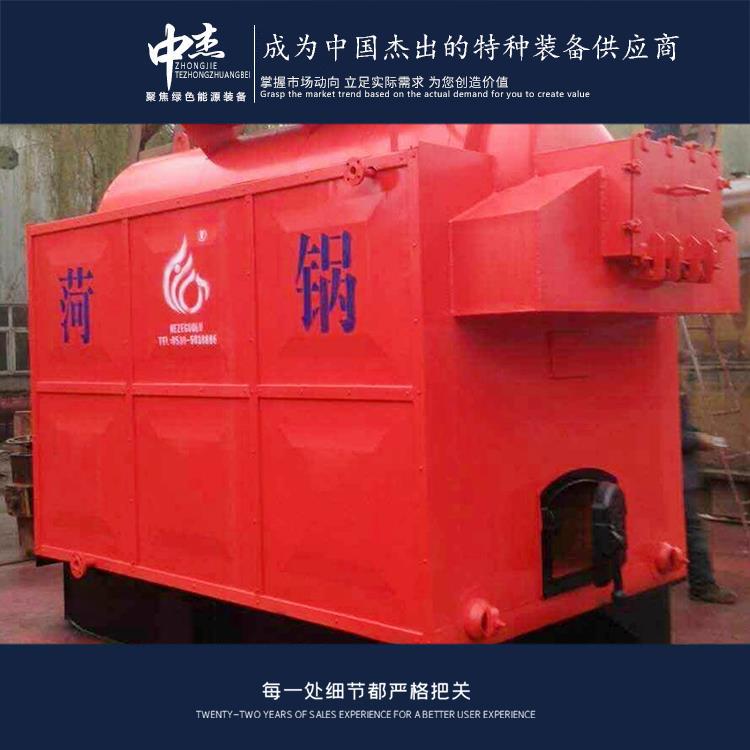
Possible reasons for the black smoke produced by biomass boiler combustion may include:
Incomplete Combustion: Inadequate oxygen supply or insufficient combustion temperature in biomass fuel can lead to incomplete combustion, resulting in a large amount of smoke and black smoke. This may be caused by poor combustion chamber ventilation, poor fuel quality, or incorrect combustion parameter settings, among other reasons.
High moisture content: Excessive water content in biomass fuel leads to the evaporation of a large amount of steam during combustion, lowering the combustion temperature and thereby affecting the combustion efficiency, resulting in black smoke.
Fuel Quality Issue: If biomass fuel contains impurities, ash, or uneven moisture content, it can affect the combustion process, leading to incomplete combustion and the production of black smoke.
Combustion Equipment Issues: If there are malfunctions or wear in the combustion equipment of biomass boilers, such as slagging in the combustion chamber or clogging of the burners, it can affect the combustion efficiency and lead to the production of black smoke.
To reduce the emission of black smoke, the following measures can be taken:
Ensure adequate oxygen supply: Adjust the ventilation system of the combustion equipment to ensure sufficient oxygen supply, enhance combustion efficiency, and reduce the production of black smoke.
Control combustion temperature: Adjust combustion parameters such as combustion temperature and duration to ensure complete fuel combustion and reduce the production of black smoke.
Optimize Fuel Quality: Select a sufficient quantity of biomass fuel, ensuring even dryness and quality, reducing moisture content and impurities, and enhancing combustion efficiency.
Regular Maintenance: Perform regular maintenance on biomass boilers, clean the combustion chamber, burners, and other components to ensure proper equipment operation and reduce the emission of black smoke.
Install Pollutant Control Equipment: As required, install flue gas purification equipment such as dust collectors and desulfurization devices, effectively removing particles generated during the combustion process.
The pressure maintenance methods for biomass hot water boilers mainly include the following:
Natural Circulation Pressure Regulation: Natural circulation pressure regulation refers to the circulation of hot water to the heating system through natural convection within the boiler. Under the natural circulation pressure regulation method, there is a significant difference in elevation between the supply and return water pipes of the boiler, achieving natural circulation through the density differences of the hot water. This method is suitable for small-scale biomass hot water boilers, characterized by simplicity and economy.
Forced Circulation Constant Pressure: Forced circulation constant pressure is achieved by using a circulation pump to force hot water to circulate through the heating system. Under this method, the boiler provides sufficient water pressure through the circulation pump, ensuring smooth flow of hot water. This approach is suitable for large-scale biomass hot water boilers and is characterized by stability.
Micropositive Pressure Constant Pressure: Micropositive pressure constant pressure maintains a slight positive pressure in the boiler system to ensure stable circulation of hot water. Under this method, the pressure within the boiler system is slightly higher than atmospheric pressure, driving the circulation of hot water through the pressure difference. This approach is suitable for situations requiring higher heating temperatures and longer heating distances.
Above are the common methods of setting pressure for biomass hot water boilers. Depending on specific usage requirements and system design, the appropriate pressure setting method can be chosen to ensure the normal operation and heating effect of the hot water boiler.
Shandong Zhongjie Special Equipment, welcome customers to visit our factory for business discussions.
Nagqu Biomass Boiler Customization - Years of Industry Experience
