


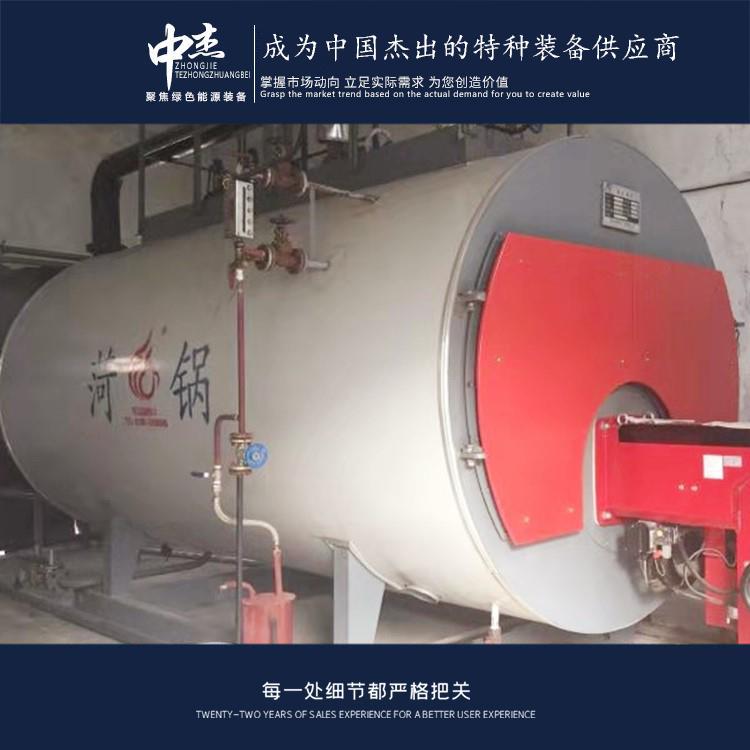

Shandong Zhongjie Special Equipment (formerly Heze Boiler Factory Co., Ltd.) holds an A-grade boiler manufacturing license, an A2-grade pressure vessel manufacturing license, an A2-grade pressure vessel design license, a B-grade boiler installation license, and GB2/Class and GC2/Class pressure pipeline installation licenses, as well as a mechanical and electrical equipment installation contracting qualification. It is a member of the China Boiler and Water Treatment Association, the China Chemical Equipment Association, and the council member of the Shandong Equipment Manufacturing Association. The company has also passed the ISO9001 Quality Management System, ISO14001 Environmental Management System, OHSAS18001 Occupational Health and Safety Management System certifications, and the American ASME/U2 certification.
WNS Low-Nitrogen Condensing Hot Water Boilers offer the following advantages:
- Low Nitrogen Emissions: Utilizing low-nitrogen combustion technology, these boilers significantly reduce NOx emissions by optimizing the combustion process and burner design. This helps minimize environmental pollution.
- High Thermal Efficiency: With condensing technology, these boilers enhance energy utilization by recovering heat from flue gases. The thermal efficiency typically exceeds 90%, surpassing that of traditional hot water boilers, thus contributing to energy savings and lower operating costs.
- Safety and Reliability: Equipped with a control system and safety devices, these boilers offer excellent safety performance. They come with multiple safety features such as overheat protection, overpressure protection, and water level protection, which automatically monitor and control the boiler's operation to ensure safe operation.
- Flexibility: WNS Low-Nitrogen Condensing Hot Water Boilers are suitable for various applications including industrial, commercial, and residential settings. They can accommodate different thermal load requirements, offering strong flexibility. Additionally, they can be integrated with other systems like solar hot water systems and ground-source heat pump systems to further improve energy efficiency.
- Easy Operation and Maintenance: The operation and maintenance of WNS Low-Nitrogen Condensing Hot Water Boilers are straightforward.
A thermal oil furnace is a device that uses thermal oil as a heat medium, transferring heat energy produced by combustion or electric heating to the equipment or process that requires heating. The working principle of a thermal oil furnace involves heating the thermal oil to a certain temperature and then circulating it through a pump to the heated equipment or process, transferring the heat energy to the heated object. The thermal oil exchanges heat with the heated object in the heat exchanger, raising the object's temperature while cooling down the thermal oil, which then returns to the furnace for reheating. The heat transfer process in a thermal oil furnace primarily relies on the thermal conductivity of the thermal oil. Thermal oil has a high thermal conductivity, enabling rapid transfer of heat energy to the heated object, achieving effective heating. Additionally, thermal oil has high thermal stability, allowing it to operate stably at high temperatures and is not easily decomposed or oxidized.
A thermal oil furnace typically consists of the furnace body, combustion system, flue gas system, heat exchanger, circulating pump, and control system. The furnace body is the main part of the thermal oil furnace, used to contain the thermal oil and the combustion system. The combustion system is responsible for burning fuel to produce heat energy and heat the thermal oil. The flue gas system is used to exhaust the combustion gases. The heat exchanger is the equipment where the thermal oil exchanges heat with the heated object. The circulating pump is responsible for circulating the thermal oil back to the furnace for reheating. The control system is used to monitor and control the operation of the thermal oil furnace, ensuring safe and stable operation.
Thermal oil furnaces offer advantages such as high temperature control accuracy, fast heating speed, low energy consumption, and simple operation, and are widely used in industrial fields such as chemicals, textiles, food processing, and papermaking, as well as in some special heating processes.
Potential operational issues with the fuel system of a thermal oil furnace include:
- Inadequate fuel quality: Using low-grade or contaminated fuel can lead to problems in the fuel system. For instance, the presence of impurities, water, or excessive amounts can cause clogs in the fuel pump, nozzle, and burner, affecting fuel supply and combustion efficiency.
- Unregular cleaning or replacement of the fuel filter: The fuel filter's purpose is to filter out impurities and particles from the fuel to prevent them from entering the fuel system. If the fuel filter is not cleaned or replaced regularly, it can become clogged, impacting fuel flow and supply.
- Improper adjustment of the fuel pump: Proper adjustment of the fuel pump is crucial for maintaining stable fuel supply volume and pressure. Incorrect adjustment can result in either excessive or insufficient fuel supply, leading to incomplete combustion or insufficient fuel supply, affecting the furnace's temperature and thermal efficiency.
- Clogging or wear of the fuel nozzle: The fuel nozzle is a critical component that atomizes and injects fuel into the furnace. If the nozzle is clogged or worn, it can cause uneven or incorrect fuel injection, impacting combustion efficiency and thermal output.
- Inadequate fuel preheating: Fuel needs to be preheated before entering the burner to enhance combustion. Insufficient preheating can increase fuel viscosity, affecting its flow and injection performance.
- Fuel system oil leakage: The sealing integrity of the fuel system is essential for stable fuel supply. Any oil leakage in the fuel system can lead to fuel supply instability.
The inspection of heat-conducting oil boiler tube plates is to ensure the safe operation of the boiler and prevent potential issues. The following are general steps for inspecting heat-conducting oil boiler tube plates:
Visual Inspection: Conduct a visual inspection to check for any obvious corrosion, cracks, deformation, or other anomalies on the surface of the tube plate. Pay special attention to checking for cracks or leaks at the welds and joints.
Cleaning the Tube Plate: Clean the surface of the tube plate thoroughly to remove dirt and deposits for proper inspection.
Ultrasound Testing: Use an ultrasound testing device to inspect the tube plate to detect any possible cracks or other defects. Ultrasound testing can help determine the integrity and reliability of the tube plate.
Pressure Test: Perform a pressure test to verify the sealing and pressure resistance of the tube plate. Gradually increase the pressure during the test, observe for any leakage, and ensure the tube plate can withstand the designed pressure.
Tube Plate Thickness Measurement: Use an ultrasonic thickness gauge to measure the thickness of the tube plate to ensure it meets design requirements. Pay particular attention to the corrosion condition of the tube plate, ensuring it is within a safe range.
Weld Inspection: Inspect the welds of the tube plate to ensure the quality of the welds meets relevant standards and specifications. Check the integrity of the welds, the quality of the weld, and whether the welding process meets requirements.
Documentation and Reporting: Document and report the inspection results of the tube plate, including any issues found, corrective measures, and recommendations. These records and reports can serve as references for future maintenance and management.
It is important to note that the inspection of heat-conducting oil boiler tube plates should be carried out by qualified personnel and strictly in accordance with relevant standards and specifications. If any issues or anomalies are found, appropriate repair and maintenance measures should be taken promptly to ensure the safe operation of the boiler.
Shandong Zhongjie Special Equipment, welcome customers to our factory for business discussions.
Taizhou 25-ton gas boiler
