



Shandong Zhongjie Special Equipment specializes in: fuel (gas) boilers, organic heat carrier boilers, biomass boilers, waste heat boilers, and other boiler products; vacuum insulation cryogenic pressure vessels such as LNG tanks, oxygen/nitrogen/argon tanks, and CO2 tanks; pressure vessel products including denitrification engineering equipment, heat storage and energy storage equipment, and complete chemical equipment; central air conditioning and HVAC equipment such as ground (water) source heat pumps, air source units, water-cooled screw units, and air-cooled modular units. Planned products include large-scale thermal energy centers, LNG transport vehicles, LNG tank containers, and other green energy equipment.
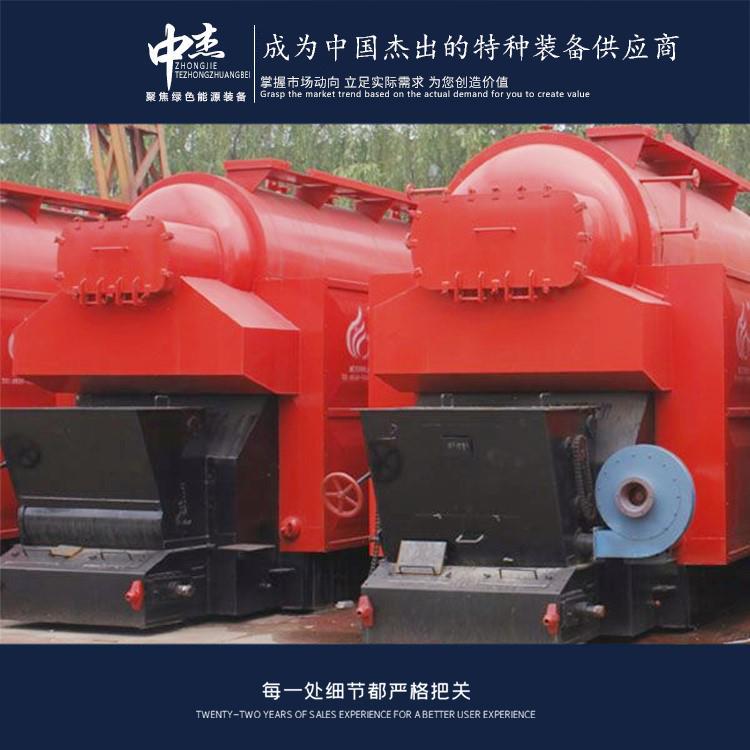
Horizontal biomass steam boilers have the following performance advantages:
Compact footprint: The horizontal design of the boiler results in a lower overall height, occupying less space, making it suitable for use in limited spaces.
High thermal efficiency: The horizontal biomass steam boiler utilizes advanced combustion technology and heat exchange design, maximizing the thermal energy of biomass fuel, enhancing thermal efficiency, and reducing energy consumption.
Combustion Stability: The horizontal biomass steam boiler utilizes a combustion system that ensures even and stable fuel combustion, minimizing fluctuations and instability during the burning process.
Operation and maintenance are user-friendly: The horizontal biomass steam boiler is designed with ease of operation and maintenance in mind, featuring manholes and inspection doors for easy access to the interior of the boiler for inspection, cleaning, and maintenance.
Environmental Protection & Energy Efficiency: Biomass fuel is a renewable energy source. The use of horizontal biomass steam boilers can reduce dependence on traditional fossil fuels and decrease emissions of carbon dioxide and other pollutants, boasting excellent environmental performance.
Adaptable: Horizontal biomass steam boilers are suitable for various biomass fuels such as sawdust, straw, etc., demonstrating strong fuel adaptability.
In summary, the horizontal biomass steam boiler boasts a small footprint, high thermal efficiency, stable combustion, and easy operation and maintenance.
Possible reasons for incomplete combustion in biomass boilers may include the following aspects:
Poor fuel quality: Low-quality biomass fuel, such as high moisture content and uneven particle size, can affect the combustion process. Fuel with high moisture content will reduce combustion temperature and lead to incomplete combustion.
Insufficient air supply: Air is essential during the combustion process. If there is insufficient air supply, the fuel cannot react fully with oxygen, leading to incomplete combustion. Possible causes include blocked air intake, fan failure, etc.
Unstable combustion system: Instability in the combustion system may also result in incomplete combustion. For instance, improper adjustment of the burner or an unreasonable design of the combustion chamber can both affect the stability of the combustion process.
Insufficient combustion temperature: Low combustion temperature can lead to incomplete combustion. Possible causes include improper adjustment of the burner and unstable fuel supply.
Ash Accumulation in Combustion Chamber: Ash buildup in the combustion chamber can affect the combustion process, hindering the contact between fuel and oxygen, leading to incomplete combustion.
Burning Time Insufficient: Insufficient burning time can also lead to incomplete combustion. If the fuel stays in the combustion chamber for too short a time, it cannot be burned fully, resulting in unburnt fuel residue.
Inadequate combustion chamber design: An unreasonably large or small combustion chamber hinders the thorough mixing of fuel and oxygen, resulting in incomplete combustion.
Above are some possible causes of incomplete combustion in biomass boilers, which require analysis and resolution based on specific situations. Regular maintenance, reasonable fuel selection, and optimization of the combustion system, etc.
Possible reasons for the black smoke produced by biomass boiler combustion may include:
Incomplete Combustion: Inadequate oxygen supply or insufficient combustion temperature of biomass fuel can lead to incomplete combustion, producing a large amount of smoke and soot. This may be due to poor combustion chamber ventilation, poor fuel quality, or incorrect setting of combustion parameters.
High moisture content: Excessive water content in biomass fuel leads to the evaporation of a large amount of steam during combustion, reducing the combustion temperature and thereby affecting the combustion efficiency, resulting in the production of black smoke.
Fuel Quality Issue: If biomass fuel contains impurities, ash, or uneven moisture content, it can affect the combustion process, leading to incomplete combustion and the production of black smoke.
Combustion Equipment Issues: If there are malfunctions or wear in the combustion equipment of biomass boilers, such as slagging in the combustion chamber or clogging of the burners, it can affect the combustion efficiency and lead to the production of black smoke.
To reduce the emission of black smoke, the following measures can be taken:
Ensure adequate oxygen supply: Adjust the ventilation system of the combustion equipment to ensure sufficient oxygen supply, enhance combustion efficiency, and reduce the production of black smoke.
Control combustion temperature: Adjust combustion parameters such as combustion temperature and duration to ensure complete fuel combustion, reducing the production of black smoke.
Optimize fuel quality: Select biomass fuel in appropriate quantities, ensuring consistent dryness and quality, reducing moisture content and impurities, and enhancing combustion efficiency.
Regular Maintenance: Perform regular maintenance on biomass boilers, including cleaning the combustion chamber, burners, and other components, to ensure proper equipment operation and reduce the emission of black smoke.
Install Pollutant Control Equipment: As required, install flue gas purification equipment such as dust collectors and desulfurization devices, effectively removing particles generated during the combustion process.
Biomass boilers are prone to corrosion at high temperatures, mainly due to the following reasons:
Fuel Composition: Biomass fuel contains certain ash and elements like chlorine, which, during combustion, form corrosive substances at high temperatures, such as chlorides and salts. These substances react with the metal surface, leading to corrosion.
Combustion Conditions: Factors such as combustion temperature, oxygen content, and combustion rate during biomass combustion can affect corrosion. High temperatures, excessive oxygen, and rapid combustion rates can accelerate corrosion.
Smoke Composition: The smoke produced by biomass combustion contains certain acidic substances, such as... These acidic substances can react with metal surfaces, causing corrosion.
Flue Gas Condensation: During the flue gas condensation process in biomass boilers, water vapor in the flue gas condenses into liquid water, forming acidic condensate. This acidic condensate comes into contact with the metal surface, causing corrosion.
Material Selection for Metal: The resistance of the metal materials used in biomass boilers to corrosion also affects their performance. Different metal materials exhibit varying corrosion resistance to different corrosive mediums.
In summary, the causes of high-temperature corrosion in biomass boilers primarily include fuel composition, combustion conditions, flue gas composition, flue gas condensation, and the selection of metal materials. To alleviate corrosion issues,
Our company attaches great importance to technological innovation and research and development, boasting one municipal-level enterprise technology center in Heze City. We have established testing facilities for non-destructive testing, physical and chemical testing, welding testing, hydrostatic testing, and more. Equipped with over 600 pieces of equipment, including CNC machine tools, X-ray flaw detectors, digital ultrasonic flaw detectors, mechanical property testing machines, chemical analyzers, spectrometers, tensile testing machines, plasma welding machines, and more, our R&D of key products such as temperature and pressure vessel welding, biomass boiler emission reduction, and waste heat recovery has been selected for multiple Shandong Provincial Department of Industry and Information Technology scientific and technological innovation projects, Shandong Provincial key projects, and Heze City innovative and excellent projects. We have cumulatively obtained 27 authorized utility model patents, 16 authorized invention patents, participated in drafting 2 standards, 2 industry standards, and registered 15 trademarks. Our technical team, in collaboration with Professor Yajiang Li from Shandong University, has developed deep cryogenic container processing technology using the internationally recognized plasma arc + filler wire tungsten inert gas (PAW-GTAW) welding technology. After being appraised as a provincial-level scientific and technological achievement, our technology level in deep cryogenic container manufacturing has reached international standards. Choose Zhongjie Special Equipment, and let's create brilliance together!
Foshan 25-ton biomass boiler, real manufacturer
