


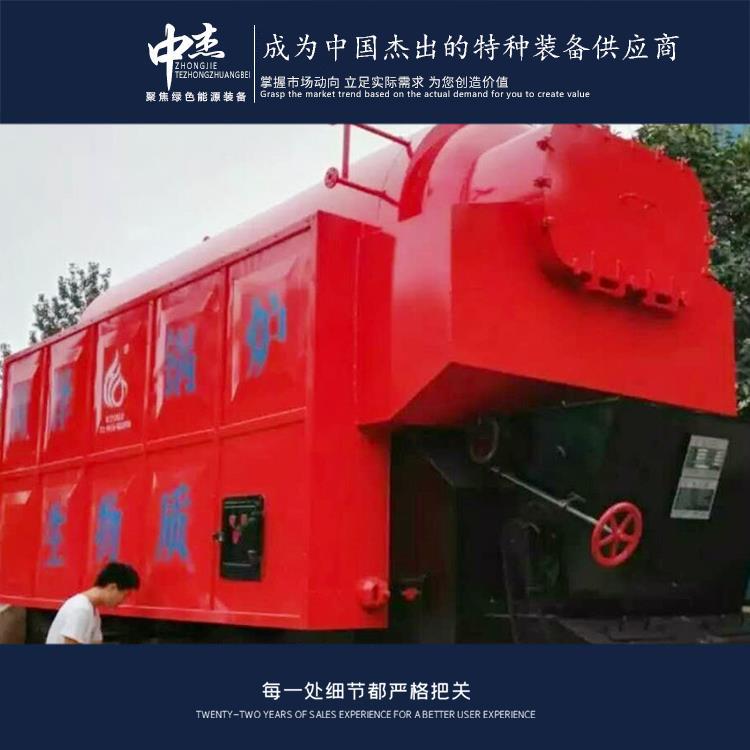


Shandong Zhongjie Special Equipment (formerly Heze Boiler Factory Co., Ltd.) holds an A-grade boiler manufacturing license, A2-grade pressure vessel manufacturing license, A2-grade pressure vessel design license, B-grade boiler installation license, and GB2/Class, GC2/Class pressure pipeline installation license, as well as an equipment and machinery installation contracting qualification. It is a member of the China Boiler and Water Treatment Association, the China Chemical Equipment Association, and the Council Member of the Shandong Equipment Manufacturing Association. The company has also passed the ISO9001 Quality Management System, ISO14001 Environmental Management System, OHSAS18001 Occupational Health and Safety Management System certifications, and the American ASME/U2 certification.
The air control door of biomass hot water boilers can be improved in terms of the following structural aspects to enhance its performance:
Material Selection: The construction of the air regulating door should be made of materials that can withstand high temperatures and corrosion, such as stainless steel or heat-resistant alloys. This ensures the long-term stable operation of the air regulating door under high-temperature and corrosive environments.
Structural Design: The structural design of the air gate should be reasonable, including the arrangement and connection methods of the door panels, bearings, and transmission devices. The door panels should have good sealing performance to effectively control the flow of combustion air. The transmission device should be flexible and reliable, easy to operate and adjust.
Airflow Regulation: The design of the wind control door should enable airflow regulation. Designs with adjustable blade angles or openings can be used, modifying the position or angle of the blade to adjust the air flow for combustion. Additionally, consider adding airflow regulation devices, such as airflow meters or pressure sensors, for real-time monitoring and adjustment of the air flow for combustion.
Temperature Control: For biomass hot water boilers, consider installing a temperature sensor near the air control door to monitor the combustion chamber temperature in real-time. Connected to the air control door's control system, the opening of the air control door can be automatically adjusted according to temperature changes to maintain a stable temperature inside the combustion chamber.
Safety Protection: The design of the air control door should incorporate safety measures, such as overloading protection devices or limit switches, to prevent excessive opening or closing of the air control door, which may lead to unstable combustion or other safety issues.
Through the above structural improvements, the performance and reliability of the biomass hot water boiler's air regulating door can be enhanced, achieving better combustion air adjustment, and improving the boiler's thermal efficiency and stability.
Several factors should be considered when selecting a suitable biomass boiler:
Fuel Type: First, determine the available biomass fuel types, such as sawdust, straw, etc. Different biomass fuels have varying characteristics, including moisture content, ash content, calorific value, etc., and a boiler suitable for the fuel type should be selected.
Boiler Capacity: Select the appropriate boiler capacity based on the actual steam or hot water output required. Over-sizing leads to energy waste, while undersizing fails to meet demand.
Combustion Efficiency: Focus on the boiler's combustion efficiency, which is the ratio of fuel converted to thermal energy. High combustion efficiency enhances energy utilization and reduces operating costs.
Equipment Quality and Reliability: Choose biomass boilers and suppliers with excellent quality and reliability to ensure long-term stable operation and the convenience of maintenance.
Environmental Performance: Focus on the environmental performance of the boiler, including emission standards and reduction of pollutant emissions. The selected biomass boiler is beneficial for environmental protection and compliance with relevant regulations.
Economic Efficiency: Choose a cost-effective biomass boiler by considering the total purchase, operation, and maintenance costs of the boiler.
Adaptability and Flexibility: Select biomass boilers with high adaptability and flexibility based on actual needs and application scenarios, which can accommodate various fuel and operating conditions.
When selecting biomass boilers, consult boiler suppliers or engineers to conduct technical evaluations and economic analyses based on specific circumstances, and choose the appropriate type and specification of biomass boiler.
Biomass boilers can be broadly categorized into the following two types based on their applications:
Biomass Hot Water Boilers: Primarily used for heating and hot water supply, biomass hot water boilers transfer heat energy to water by burning biomass fuel, producing hot water. This type of boiler is widely used in heating and hot water systems in residential, office, school, and hotel settings.
Biomass Steam Boilers: Biomass steam boilers are primarily used for steam supply in industrial production processes. They generate high-pressure steam at high temperatures by burning biomass fuel, which is utilized to power machinery, heating, and processing in various industrial applications. This type of boiler is commonly found in industries such as pulp and paper, food processing, and chemicals.
These two types of biomass boilers differ in principle and design, making them suitable for various application scenarios. Whether they are hot water boilers or steam boilers, they utilize the thermal energy of biomass fuel to achieve the utilization of renewable energy, featuring environmental protection and energy-saving characteristics.
Biomass boilers have certain characteristics that give them an advantage in energy conservation and environmental protection:
Renewable Energy: The fuel used in biomass boilers is renewable energy, such as wood chips, straw, waste, etc. Compared to fossil fuels, the use of biomass fuel can reduce reliance on finite resources and lower energy consumption.
Low carbon emissions: The amount of carbon dioxide released during the combustion of biomass fuel is roughly equivalent to the amount absorbed during its growth, forming a closed carbon cycle. Compared to the combustion of fossil fuels, biomass boilers emit less carbon dioxide, playing a cumulative role in reducing greenhouse gas emissions.
Combustion: The biomass boiler utilizes advanced combustion technology and control systems to achieve combustion. By optimizing the combustion process, it enhances thermal energy efficiency and reduces energy waste.
Waste Utilization: Biomass boilers can use waste materials as fuel, such as crop straw, wood waste, etc.
Shandong Zhongjie Special Equipment, welcome customers to visit our factory for business discussions.
Hangzhou 6-ton biomass boiler - High cost-performance
