


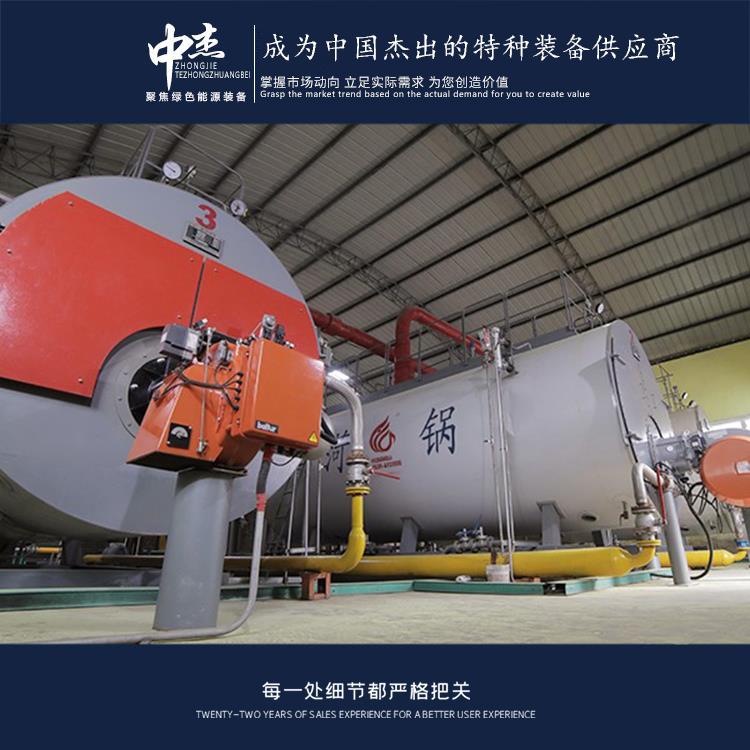

Shandong Zhongjie Special Equipment (formerly Heze Boiler Factory Co., Ltd.) holds an A-grade boiler manufacturing license, an A2-grade pressure vessel manufacturing license, an A2-grade pressure vessel design license, a B-grade boiler installation license, and GB2/Class, GC2/Class pressure pipeline installation licenses, as well as a mechanical and electrical equipment installation contracting qualification. It is a member of the China Boiler and Water Treatment Association, the China Chemical Equipment Association, and the理事 member of the Shandong Equipment Manufacturing Association. The company has also passed the ISO9001 Quality Management System, ISO14001 Environmental Management System, OHSAS18001 Occupational Health and Safety Management System certifications, and the American ASME/U2 certification.
Clean and environmentally friendly gas boilers offer several advantages:
- Low emissions: Gas combustion produces lower exhaust emissions with reduced pollutants such as nitrogen oxides and particulates. Compared to coal or oil-fired boilers, gas boilers have lower emission levels and cause less environmental pollution.
- High thermal efficiency: Gas combustion has a higher thermal efficiency, fully utilizing the energy of the fuel and minimizing energy waste. Compared to other traditional fuels like coal and oil, gas combustion offers more heat energy.
- Clean combustion: Gas combustion does not produce ash and soot, reducing carbon and dirt accumulation inside the boiler and in the flue. This reduces cleaning and maintenance efforts, extending the boiler's lifespan.
- Stable combustion: Gas combustion has stable performance, eliminating the risk of significant flame fluctuations and explosions. This makes gas boilers safer and more reliable in operation.
- Fast start-up and shutdown: Gas boilers have quicker and more flexible start-up and shutdown processes compared to other fuels. This makes them suitable for frequent start-stop scenarios, such as seasonal heating and hot water needs.
- Renewable energy integration: As a clean fuel, gas can be combined with renewable energy sources, like solar hot water systems and biomass fuels. This integration can further enhance energy efficiency and environmental friendliness.
A condensing steam boiler is an energy-saving boiler equipment with the following working principle and features:
Working Principle:
- Steam Generation: The condensing steam boiler produces high-temperature flue gas by burning gas, which then exchanges heat with the water pipes inside the boiler, heating the water into steam.
- Steam Condensation: After steam is generated, it enters the condenser where it exchanges heat with the condensing medium (usually cold water or recycled water), releasing heat from the steam and condensing it into water.
- Flue Gas Reuse: The flue gas after condensation still contains some heat, which can be recovered and reused by the flue gas reuse system, improving the boiler's thermal efficiency.
Features:
- Energy-saving: The condensing steam boiler utilizes the principle of steam condensation to fully utilize the heat in the steam, enhancing the efficiency of heat utilization and saving energy consumption.
- Low Emission: Due to the recovery of most heat during the flue gas condensation process, the flue gas temperature is lower, resulting in relatively low emissions of pollutants, with minimal environmental impact.
- Compact Structure: The condensing steam boiler typically features a compact design, occupying less space, making it suitable for places with limited space.
- Quick Start-up: The condensing steam boiler has the characteristics of quick start-up and shutdown, allowing for flexible adjustments and operations based on actual needs.
- Wide Application Range: The condensing steam boiler is suitable for heating and steam requirements in industrial production processes, such as power plants, chemical factories, textile mills, etc.
It should be noted that maintenance and regular maintenance of the condenser and flue gas reuse system are necessary during the operation of the condensing steam boiler to ensure its normal operation and performance.
The management system for gas heat-conducting oil furnace equipment mainly includes the following aspects:
1. Equipment Safety Management System: Establish and improve the safety management system for gas heat-conducting oil furnace equipment, clarify responsibilities and authorities, and ensure the safe operation of the equipment. This includes safety operation procedures, emergency response plans, equipment inspection and maintenance schedules, etc.
2. Equipment Maintenance Management System: Establish an equipment maintenance management system, clarify maintenance responsibilities and plans. This includes regular equipment inspections, maintenance, and repairs to ensure the normal operation and safety of the equipment.
3. Equipment Operation Management System: Establish an equipment operation management system, clarify operation procedures and requirements. This includes start-up, shutdown, adjustment, and monitoring processes to ensure the safety and operation of the equipment.
4. Equipment Accident Management System: Establish an equipment accident management system, clarify reporting, investigation, and handling procedures for accidents. This includes reporting requirements for equipment accidents, responsibility追究, analysis of causes, and improvement measures to reduce accidents and minimize losses.
5. Equipment Training and Assessment System: Establish an equipment training and assessment system to ensure operators possess the necessary skills and knowledge. This includes equipment operation training, safety training, and technical training, as well as regular assessments and evaluations of operators.
6. Equipment Inventory and Record Management System: Establish an equipment inventory and record management system to record equipment operation, maintenance, and accident records. This includes inventory management, maintenance record completion and preservation, and accident record organization and analysis for equipment management and issue traceability.
The above are some basic contents of the management system for gas heat-conducting oil furnace equipment incidents. Specific management systems need to be formulated and improved based on actual circumstances. At the same time, relevant laws, regulations, and standards must be observed to ensure the safety and environmental performance of the equipment.
Regular inspections of industrial boilers are crucial for ensuring safe operation, improving efficiency, and extending their service life. Here are the key reasons for the importance of regular inspections:
Safety Assurance: Industrial boilers are high-temperature, high-pressure equipment. Without regular inspections, there could be safety hazards. Regular inspections can identify and rectify potential issues within the boiler, such as problems with the combustion system, water level control failure, and malfunctioning safety valves, ensuring safe boiler operation.
Efficiency Enhancement: Regular inspections can detect dirt and sediment inside the boiler, maintaining the cleanliness of heat exchangers and thermal conductivity efficiency, which in turn improves the boiler's thermal and energy efficiency. This helps reduce energy consumption and operating costs.
Extended Service Life: Regular inspections can promptly detect and address corrosion, wear, and fatigue issues within the boiler, preventing further damage and faults, and extending the boiler's service life. Regular maintenance can also prevent and reduce damage and faults in the boiler.
Legal and Regulatory Requirements: Many regions have enacted laws and regulations and standards for boiler safety management, requiring regular inspections and maintenance of industrial boilers. Regular inspections are a crucial aspect of fulfilling legal and regulatory requirements.
Insurance Requirements: Some insurance companies have specific requirements for the insurance of industrial boilers, mandating regular inspections and maintenance. Regular inspections can meet these requirements and protect the insurance rights of the enterprise.
In summary, regular inspections of industrial boilers are essential for ensuring safety, improving efficiency, extending service life, complying with legal and regulatory requirements, and meeting insurance demands. Regular inspections should be conducted by qualified institutions or individuals, adhering to relevant laws, regulations, and standards. Timely inspections and maintenance can ensure the safe operation of industrial boilers.
Shandong Zhongjie Special Equipment, welcome customers to our factory for business talks.
Huaihua 8-ton gas boiler
