


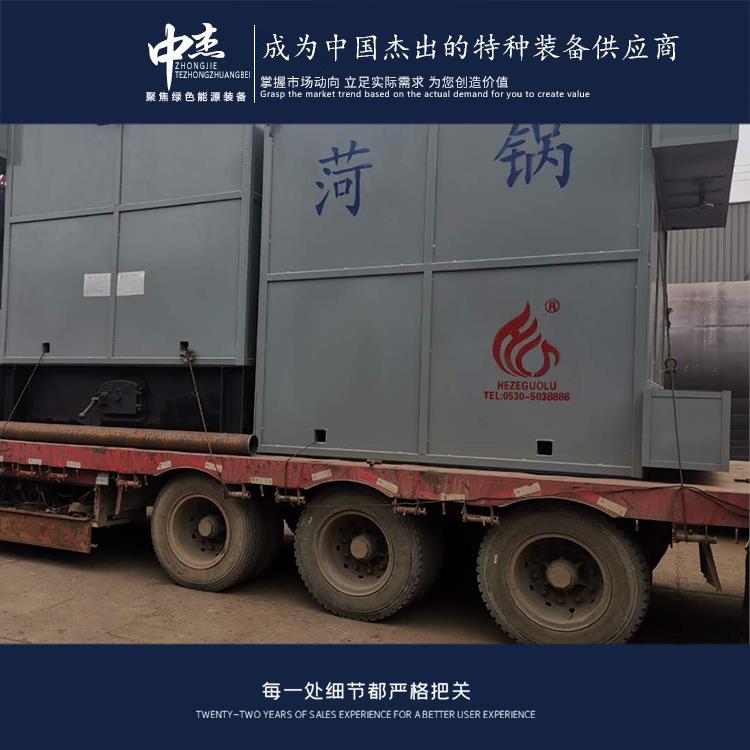

Shandong Zhongjie Special Equipment (formerly Heze Boiler Factory Co., Ltd.) was established in 2001, located at No. 2218 Jinnan Road, Development Zone, Heze City. With a registered capital of 50 million yuan and total assets of 500 million yuan, the company has seven business centers: boilers, deep-freeze containers, pressure vessels, central air conditioning, engineering installation, international trade, and the Internet of Things. It has three factory sites on Jinnan Road, East Changjiang Road, and Bohai Road, covering a total of 200,000 square meters. The main workshop spans 83,000 square meters. It currently employs 710 people, including 247 engineers and technicians and 82 intermediate-level technicians. In December 2016, it was recognized as a "High-tech Enterprise" by the Science and Technology Department. In June 2021, it was identified as a "Specialized and New Enterprise in Shandong Province" by the Ministry of Industry and Information Technology. In June 2022, it was recognized as a "Gazelle Enterprise in Shandong Province" and in August 2022, as a "Specialized and New Small Giant Enterprise" by the Ministry of Industry and Information Technology.
Steam boilers produce a certain amount of wastewater during operation, which requires effluent treatment. Here are the general steps for steam boiler effluent discharge:
Preparation: Before discharging, ensure the steam boiler is turned off and the pressure inside the boiler has been reduced to a safe level.
Open the Drain Valve: Locate the appropriate drain valve according to the steam boiler's design and open it. The drain valve is typically found on the bottom or near the bottom of the boiler's drain pipe.
Discharge Wastewater: Once the drain valve is open, wastewater will flow out of the drain pipe. Depending on the need, use a drain pump or gravity to expel the wastewater.
Observe the Wastewater: During the discharge process, monitor the wastewater's color, turbidity, and odor to determine if there are any abnormalities, such as sediment, impurities, or strange smells.
Close the Drain Valve: Close the drain valve once the wastewater has been fully discharged or the predetermined effluent target has been reached.
Clean the Drain System: Regularly clean the drain system to prevent blockages or buildup, ensuring the system remains clear.
Note that the specific steps and frequency of steam boiler effluent discharge may vary depending on the boiler model, usage conditions, and operational requirements. Therefore, it is advisable to refer to the boiler's operation manual or consult with experts for proper and safe operation.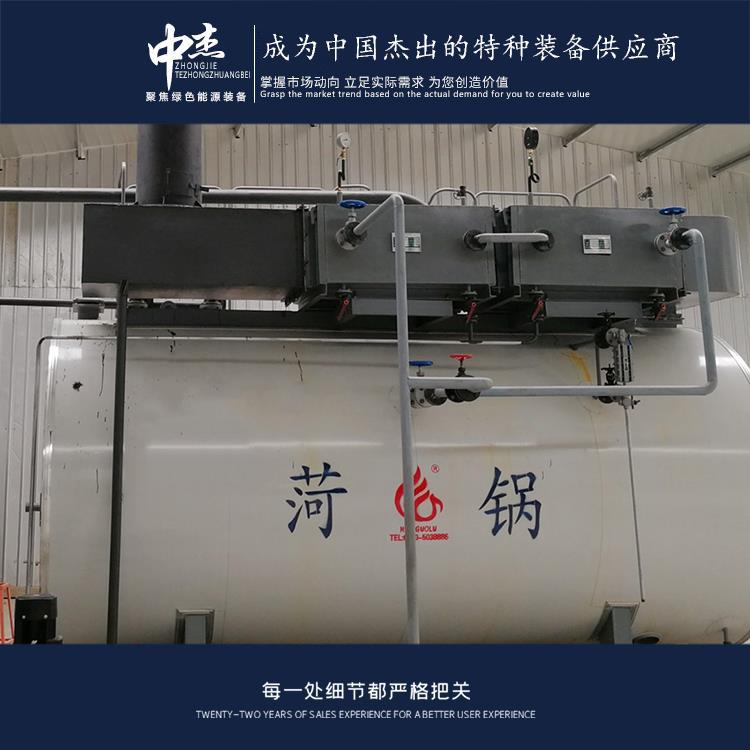
The management system for gas heat transfer oil furnace equipment incidents primarily includes the following aspects:
1. Equipment Safety Management System: Establish and improve the safety management system for gas heat transfer oil furnace equipment, clarify responsibilities and authorities, and ensure the safe operation of the equipment. This includes safety operation procedures, emergency response plans for accidents, and equipment inspection and maintenance schedules.
2. Equipment Maintenance Management System: Establish a maintenance management system for equipment, clarifying maintenance responsibilities and plans. This includes regular equipment inspections, maintenance, and repairs to ensure the normal and safe operation of the equipment.
3. Equipment Operation Management System: Establish an operation management system for equipment, clarifying operation procedures and requirements. This includes start-up, shutdown, adjustment, and monitoring processes, ensuring the safety and operation of the equipment.
4. Equipment Incident Management System: Establish an incident management system for equipment, clarifying reporting, investigation, and handling procedures for incidents. This includes incident reporting requirements, responsibility追究, root cause analysis, and improvement measures to reduce incidents and minimize loss.
5. Equipment Training and Assessment System: Establish a training and assessment system for equipment to ensure operators possess the necessary skills and knowledge. This includes operation training, safety training, and technical training, with regular assessments and evaluations of operators.
6. Equipment Inventory and Record Management System: Establish an inventory and record management system for equipment, recording operating conditions, maintenance records, and incident records. This includes equipment inventory management, maintenance record completion and preservation, and incident record organization and analysis for equipment management and issue tracing.
The above is some basic content of the management system for gas heat transfer oil furnace equipment incidents. Specific management systems should be formulated and improved based on actual circumstances. At the same time, relevant laws and regulations and standards must be observed to ensure the safety and environmental performance of the equipment.
The inspection contents and requirements for gas-fired boilers typically include the following aspects:
Safety valve and pressure gauge: Check the installation and fixation of the safety valve and pressure gauge to ensure proper operation and accurate pressure display.
Combustion system: Inspect the operational status of the burner, including ignition, combustion, and combustion stability. Check the connections of the gas supply pipeline and valves to ensure no leaks.
Flue and heat exchanger: Examine the cleanliness of the flue and heat exchanger, including accumulated dust and dirt, to ensure heat exchange efficiency and smoke emissions meet requirements.
Water level control system: Check the operational status of the water level controller and gauge to ensure accurate and reliable water level control, preventing excessive or insufficient water levels.
Gas supply system: Inspect the installation and connections of the gas supply pipeline and valves to ensure normal gas supply and no leaks.
Electrical system: Check the wiring and connections of the electrical system, including power supply, controllers, and sensors, to ensure normal operation of electrical equipment and avoid electrical faults.
Safety devices: Inspect the operational status of safety devices, including safety valves, pressure switches, and temperature controllers, to ensure proper operation and ensure safe boiler operation.
Records and documents: Review the boiler's operating records, maintenance records, and inspection reports, ensuring the completeness and accuracy of the operation and maintenance records.
The inspection of gas-fired boilers should be conducted by an institution or personnel with the relevant qualifications, following relevant laws, regulations, and standards. The frequency and specific requirements for inspections can be determined based on the boiler's usage and local regulations. Timely inspections and maintenance ensure safe and efficient operation of gas-fired boilers.
A gas thermal oil boiler is a device that uses gas as fuel to heat thermal oil by converting the heat energy produced from combustion. Here are some basic facts about gas thermal oil boilers:
Working Principle: The operating principle of a gas thermal oil boiler involves mixing gas with air, burning it to produce high-temperature flue gas. This flue gas then passes through the flue and heat exchanger to exchange heat with the thermal oil, transferring heat energy to the oil and raising its temperature. The thermal oil circulates within the boiler, transferring heat to the equipment or process that requires heating.
Thermal Oil: The thermal oil used in gas thermal oil boilers is typically an organic heat carrier, such as mineral oil or synthetic oil. It has high thermal conductivity and stability, allowing it to operate stably at high temperatures and transfer heat energy to the heated equipment.
Gas Combustion System: Gas thermal oil boilers are equipped with a gas combustion system, including burners, gas supply systems, and control systems. The burners mix and burn gas with air to produce heat energy. The gas supply system provides gas and adjusts the gas flow as needed. The control system monitors and controls the combustion process to maintain a stable operating state.
Safety Protection Devices: Gas thermal oil boilers are equipped with various safety protection devices to ensure safe operation of the equipment. Common safety devices include overheat protection, overpressure protection, and water level protection. These devices monitor and control the boiler's operating status to prevent equipment damage and accidents.
Application Fields: Gas thermal oil boilers are widely used in industrial sectors such as chemicals, textiles, food processing, and papermaking. They can provide stable high temperatures for various applications.
Shandong Zhongjie Special Equipment, welcome clients for factory negotiations and cooperation.
Jinhua 15-ton gas boiler
