


Shandong Zhongjie Special Equipment (formerly Heze Boiler Factory Co., Ltd.) was established in 2001, located at No. 2218 Jinnan Road, Economic and Technological Development Zone, Heze City. With a registered capital of 50 million yuan and total assets of 500 million yuan, the company has 7 business centers: boilers, deep-freezing containers, pressure vessels, central air conditioning, engineering installation, international trade, and Internet of Things. It has three factory sites on Jinnan Road, East Changjiang Road, and Bohai Road, covering a total area of 200,000 square meters, with the main workshop spanning 83,000 square meters. The company currently employs 710 people, including 247 engineers and technicians and 82 intermediate-level technical personnel. In December 2016, it was recognized as a "High-tech Enterprise" by the Science and Technology Department. In June 2021, it was identified as a "Specialized and New Enterprise in Shandong Province" by the Ministry of Industry and Information Technology. In June 2022, it was recognized as a "Gazelle Enterprise in Shandong Province" and in August 2022, as a "Specialized and New Small Giant Enterprise" by the Ministry of Industry and Information Technology.
Under China's "Regulations for the Safety Supervision of Pressure Vessel Technologies," carbon dioxide storage tanks are classified as Category II pressure vessels. According to these regulations, pressure vessels are categorized as follows:
- Category I pressure vessels: Those with working pressures of 10 MPa (megapascals) or higher, such as steam boilers and pressure vessels.
- Category II pressure vessels: Those with working pressures between 0.1 MPa and 10 MPa, such as air compressors and liquefied gas storage tanks.
- Category III pressure vessels: Those with working pressures between 0.05 MPa and 0.1 MPa, such as storage tanks.
- Category IV pressure vessels: Those with working pressures below 0.05 MPa, such as gas cylinders.
Based on this classification, carbon dioxide storage tanks typically have working pressures above 0.1 MPa, thus falling under Category II pressure vessels. It's important to note that specific classification criteria may vary by region or country due to different regulations and standards. When using and managing carbon dioxide storage tanks, it is necessary to comply with the corresponding legal and standard requirements.
The reasons for not allowing a CO2 storage tank to be left empty for long periods are mainly as follows:
1. Safety Risks: CO2 is a high-pressure gas and must maintain a certain pressure within the tank to remain in liquid form. Releasing CO2 from the tank into the atmosphere over a long period can lead to a decrease in tank pressure, potentially causing structural failure or explosions, posing safety hazards.
2. Resource Wastage: CO2 is a valuable resource with extensive applications in industry and other sectors. Leaving a CO2 storage tank empty for long periods is wasteful and does not align with sustainable development principles.
3. Environmental Impact: CO2 is a greenhouse gas, and long-term emptying of CO2 storage tanks increases atmospheric CO2 concentrations, exacerbating climate change and environmental issues.
Therefore, to ensure safety, conserve resources, and protect the environment, CO2 storage tanks should be used and managed according to established procedures and requirements, avoiding long-term idleness. When CO2 in the tank is no longer needed, appropriate disposal methods such as recycling, reuse, or safe discharge should be employed.
CO2 flooding is a commonly used增产 technology to enhance oil recovery in oilfields. It involves injecting CO2 gas into reservoirs to alter their physical and chemical properties, thereby promoting flow and increasing recovery rates. The working principle of CO2 flooding is as follows:
Solubility Principle: CO2 has a high solubility in oil. When CO2 gas is injected into the reservoir, it dissolves within the oil, reducing viscosity and surface tension, making it more fluid.
Expulsion Drive Principle: After CO2 gas is injected into the reservoir, it expands into a gas phase, increasing the reservoir's internal pressure and pushing the oil towards the wellbore. Additionally, CO2's high permeability can improve reservoir permeability, enhancing flowability.
Chemical Reaction Principle: CO2 reacts with certain components in the oil, forming soluble substances that further reduce viscosity and increase fluidity.
CO2 flooding technology offers certain advantages in oilfield development, such as:
Environmental Friendliness: CO2 is a clean, non-toxic, and renewable gas. Using CO2 for flooding can reduce environmental pollution.
Economic Viability: CO2 flooding can increase oil recovery rates and production, thereby improving economic returns.
Sustainability: CO2 can be separated from the atmosphere or captured and stored from industrial flue gases, allowing for the recycling of CO2, which is sustainable.
It is important to note that the application of CO2 flooding technology requires consideration of reservoir characteristics, geological conditions, and economic feasibility. Prior to implementing CO2 flooding, thorough reservoir evaluation and engineering design must be conducted to ensure the effectiveness and safety of the technology.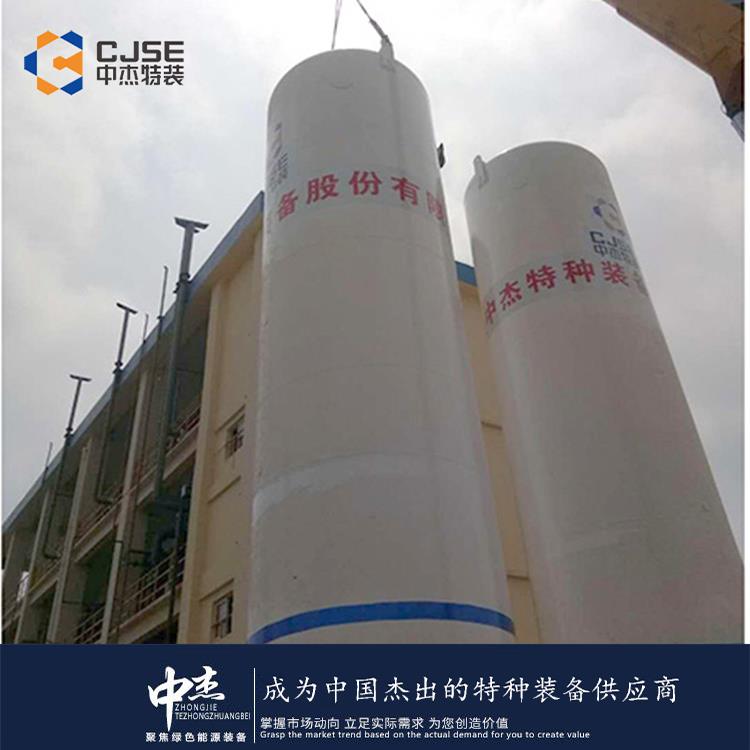
The testing and maintenance of liquid oxygen storage tanks are crucial for ensuring safe operation and extending their service life. Below is a general outline of the testing and maintenance procedures for liquid oxygen storage tanks:
- Visual Inspection: Conduct regular visual inspections of the liquid oxygen storage tank to check for corrosion, wear, and cracks on the tank surface. In case of any anomalies, promptly repair or replace the affected parts.
- Internal Cleaning: Regularly clean the interior of the liquid oxygen storage tank to remove accumulated impurities and dirt. Pay attention to using appropriate cleaning agents and tools to avoid damaging the tank.
- Level Measurement: Regularly measure the level within the liquid oxygen storage tank to ensure it remains within a safe range. Use a level gauge or other measuring equipment, and record the results.
- Pressure Testing: Conduct regular pressure tests to verify the tank's pressure resistance. Be mindful of controlling pressure and time during testing to ensure safety and accuracy.
- Leak Detection: Regularly perform leak detection to ensure the tank's sealing integrity. Utilize leak detection instruments such as gas detectors or foam leak detection agents.
- Valve and Pipeline Inspection: Regularly inspect the valves and pipeline connections of the liquid oxygen storage tank to ensure proper sealing and no leakage. If issues are found, promptly repair or replace them.
- Maintenance Records: Keep records of the testing and maintenance activities, including inspection dates, contents, and results. These records help track the tank's maintenance history and issue resolution.
- Scheduled Maintenance: Develop a regular maintenance plan based on the tank's usage and requirements. Maintenance includes lubrication, bolt tightening, and replacement of seals to ensure normal operation.
Our company attaches great importance to technological innovation and R&D design, boasting 1 municipal-level enterprise technology center in Heze City. We have established testing facilities for non-destructive testing, physical and chemical testing, welding testing, hydrostatic testing, etc., and are equipped with over 600 various instruments and equipment such as CNC machine tools, X-ray flaw detectors, digital ultrasonic flaw detectors, mechanical property testing machines, chemical analyzers, spectrometers, tensile testing machines, plasma welding machines, and more. The key products and technologies we have developed, such as welding of temperature-pressure vessels, emissions reduction in biomass boilers, and waste heat utilization, have successively been selected for multiple Shandong Provincial Department of Industry and Information Technology scientific and technological innovation projects, key projects in Shandong Province, and Heze City innovative and excellent projects. In total, we have obtained 27 authorized utility model patents, 16 authorized invention patents, participated in drafting 2 standards, 2 industry standards, and registered 15 trademarks. Our technical team, in collaboration with Professor Yajiang Li of Shandong University, has developed deep cryogenic container processing technology using the internationally recognized plasma arc + wire filling tungsten inert gas arc welding (PAW-GTAW) technique. After provincial-level scientific and technological achievement assessment, the technology level has reached international standards in the field of deep cryogenic container manufacturing. Choose Zhongjie Special Equipment, and let's create brilliance together!
Handan 30 cubic CO2 storage tank, manufacturer
