


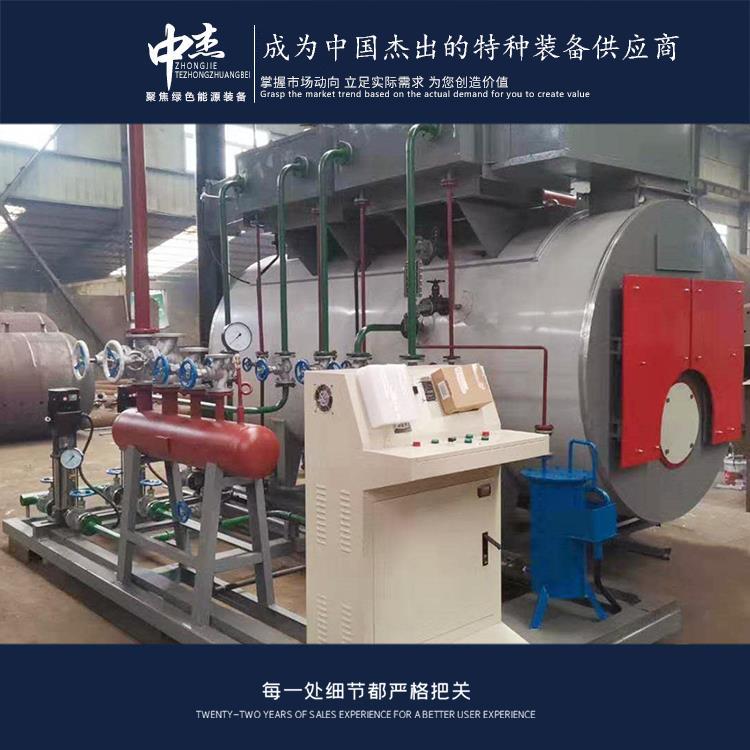
Shandong Zhongjie Special Equipment Co., Ltd. (formerly Heze Boiler Factory Co., Ltd.) was established in 2001, located at No. 2218 Jinnan Road, Development Zone, Heze City. With a registered capital of 50 million yuan and total assets of 500 million yuan, the company has 7 business centers: boilers, deep-freezing vessels, pressure vessels, central air conditioning, engineering installation, international trade, and Internet of Things. It operates three factories on Jinnan Road, East Changjiang Road, and Bohai Road, covering a total area of 200,000 square meters, with the main workshop spanning 83,000 square meters. The company currently employs 710 staff, including 247 engineers and technicians, and 82 intermediate-level technical personnel. In December 2016, it was recognized as a "High-Tech Enterprise" by the Science and Technology Department. In June 2021, it was identified as a "Specialized and New Enterprise in Shandong Province" by the Department of Industry and Information Technology. In June 2022, it was named a "Gazelle Enterprise in Shandong Province" and in August 2022, it was recognized as a "Specialized and New Small Giant Enterprise" by the Ministry of Industry and Information Technology.
To ensure the safe operation of industrial boilers, attention should be given to the following aspects:
- Adhere to laws and regulations: Understand and comply with relevant laws, regulations, and standards, including those governing boiler safety management and standards for boiler use and maintenance. Ensure compliance with legal requirements throughout the operation process.
- Establish a sound management system: Develop a comprehensive industrial boiler safety management system, define responsibilities and authorities, and standardize operational procedures and safety measures. Formulate operational guidelines and emergency response plans to ensure orderly operation of safety management tasks.
- Training and education: Provide training and education for personnel involved in the safe operation of industrial boilers to enhance their safety awareness and skill levels. This includes training for boiler operators, maintenance staff, and management personnel.
- Regular inspections and maintenance: Conduct regular inspections and maintenance of industrial boilers to ensure the normal operation and safety performance of equipment. This includes checking and maintaining key components such as the combustion system, water level control, safety valves, and pressure gauges.
- Safety equipment and facilities: Equip necessary safety equipment and facilities, such as safety valves, pressure gauges, water level indicators, and burners. Ensure the proper operation and effectiveness of these facilities and equipment.
- Regular inspections and assessments: Conduct regular inspections and assessments of industrial boilers to ensure compliance with safety requirements. This includes regular pressure tests, water quality inspections, and combustion efficiency evaluations.
- Safety records and document management: Establish a comprehensive system for safety records and document management, recording the operation, maintenance, and accident records of industrial boilers. Update and preserve relevant safety information promptly.
- Regular drills and emergency response training: Organize regular safety drills and emergency response training to improve the ability to respond to emergencies and the efficiency of emergency handling.
These are some basic points for ensuring the safe operation of industrial boilers. Specific operations should be conducted according to actual conditions and relevant requirements.
Common issues and troubleshooting for gas boiler burners are as follows:
- No flame or unstable flame: Check if the gas supply is normal and ensure the gas valve is open. Clean the burner nozzle to ensure the passage is clear. Inspect the ignition electrode for cleanliness, carbon buildup, or dirt. Adjust the gas-to-air ratio to ensure proper mixing.
- Incomplete combustion or black smoke: Check if the gas supply is sufficient and adjust the gas pressure. Clean the burner nozzle and combustion chamber to ensure the passage is clear. Adjust the gas-to-air ratio to ensure proper mixing. Check for carbon buildup or dirt in the burner and clean or replace damaged parts.
- Difficulty or failure to ignite: Inspect the ignition electrode for cleanliness, carbon buildup, or dirt. Adjust the position and gap of the ignition electrode to ensure normal spark generation. Check if the ignition transformer or controller is functioning properly and repair or replace damaged parts.
- Abnormal noise from the burner: Check if the gas supply is normal and ensure the gas valve is open. Inspect for loose parts in the burner and combustion chamber and tighten or replace damaged parts. Clean the burner and combustion chamber to ensure there is no carbon buildup or dirt.
If the above methods do not resolve the issue, it is recommended to contact a gas boiler maintenance technician for inspection and maintenance. Additionally, to ensure safety, follow the relevant safety operating procedures when using a gas boiler.
Before ignition, the preparation of a steam boiler involves the following steps:
1. Clean the boiler: First, clean the internal and external dirt and impurities from the boiler. Remove ash, sediment, and dirt inside the boiler to ensure the efficiency of combustion and heat exchange.
2. Check fuel supply: Inspect the fuel supply system to ensure a smooth fuel supply. Check the fuel storage, transport pipelines, and filters, clearing blockages and replacing damaged parts.
3. Inspect the burner: Check the operational status and cleanliness of the burner. Clean the burner's nozzle and flame sensor to ensure proper burner operation.
4. Check the gas system: If it's a gas boiler, inspect the gas supply system. Check the gas pipelines, valves, and pressure regulators to ensure safe and stable gas supply.
5. Check water level and pressure: Inspect the boiler's water level and pressure. Ensure the water level is within the normal range, and the pressure is stable and meets requirements. Add water and adjust pressure if necessary.
6. Check safety devices: Inspect the boiler's safety devices such as safety valves, pressure switches, and water level controllers. Ensure these devices operate normally to ensure the safe operation of the boiler.
7. Prepare ignition tools: Prepare the tools and equipment needed for ignition, such as ignition rods, igniters, etc. Ensure these tools work properly and are safe.
When performing these preparation tasks, follow relevant operational procedures and safety requirements to ensure the safety and effectiveness of the work. If unsure about how to proceed, consult with experts or the boiler manufacturer for advice.
1-ton gas-fired steam boiler's gas consumption over a year is influenced by various factors, including the efficiency of the boiler, the load conditions, and operating hours. Generally, it can be estimated using the following formula: Gas Consumption (m) = Boiler Efficiency × Boiler Rated Thermal Power × Operating Hours. Here, boiler efficiency refers to the boiler's energy utilization efficiency, typically expressed as a percentage; boiler rated thermal power is the boiler's rated thermal output, usually in kilowatts (kW); operating hours are the time the boiler is in operation, typically measured in hours.
It should be noted that the boiler's efficiency and rated thermal power can be determined based on the specific model and parameters of the boiler, while operating hours need to be estimated based on actual usage. Therefore, for an accurate calculation of the 1-ton gas-fired steam boiler's annual gas consumption, it is recommended to refer to the technical specifications and operating records of the boiler, or consult the boiler manufacturer or engineer.
Shandong Zhongjie Special Equipment, welcome customers to visit our factory for business discussions.
Quzhou 20-ton gas boiler
