


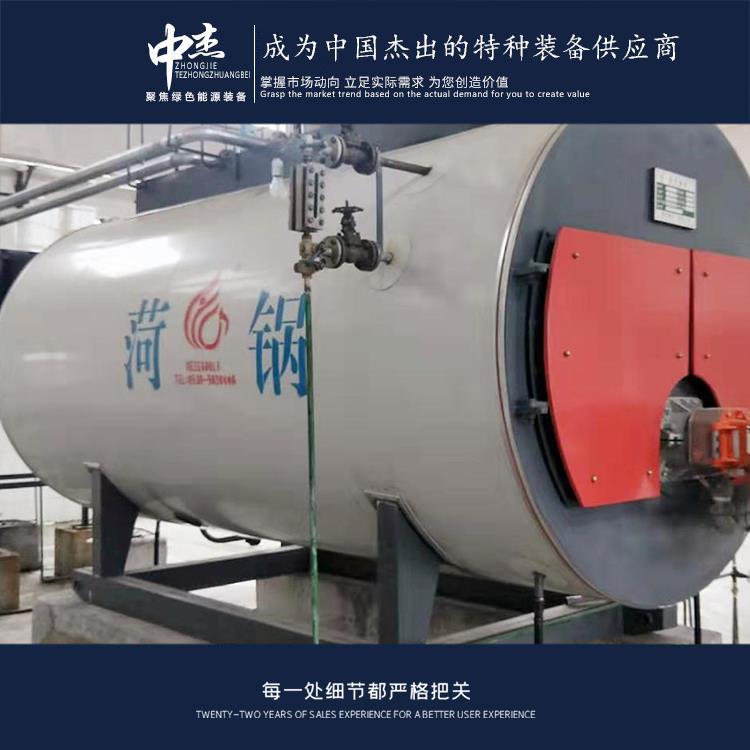
Shandong Zhongjie Special Equipment (formerly Heze Boiler Factory Co., Ltd.) was established in 2001, located at No. 2218 Jinnan Road, Economic and Technological Development Zone, Heze City, with a registered capital of 50 million yuan and total assets of 500 million yuan. The company has 7 business centers: boilers, deep-freeze containers, pressure vessels, central air conditioning, engineering installation, international trade, and Internet of Things. It has three factory sites on Jinnan Road, East Yangtze Road, and Bohai Road, covering a total of 200,000 square meters, with the main workshop spanning 83,000 square meters. It currently employs 710 people, including 247 engineering and technical staff and 82 intermediate-level technicians. In December 2016, it was recognized as a "High-Tech Enterprise" by the Science and Technology Department. In June 2021, it was identified as a "Specialized and New Enterprise in Shandong Province" by the Ministry of Industry and Information Technology. In June 2022, it was recognized as a "Gazelle Enterprise in Shandong Province" and in August 2022, as a "Specialized and New Small Giant Enterprise" by the Ministry of Industry and Information Technology.
When a gas steam boiler experiences overpressure, the following immediate actions must be taken:
1. Shut off the gas supply: First, immediately close the gas supply to cut off the source of fuel, stopping the combustion process to prevent further increase in steam pressure.
2. Release pressure: Open the boiler's pressure relief device, typically a safety valve. The safety valve is a critical safety feature of the boiler, which automatically opens when the internal pressure exceeds the set value, releasing excess pressure steam to reduce the boiler pressure.
3. Decrease burner load: If the overpressure is caused by an excessive burner load, reduce the burner load to decrease steam generation and thereby lower the boiler pressure. This can be achieved by adjusting the gas supply to the burner or the burner's adjustment method to accommodate the current load requirements.
4. Inspection and maintenance: After an overpressure event, the boiler should be inspected and maintained to identify the cause of the overpressure and make necessary repairs. Possible causes include burner malfunctions, control system failures, valve failures, etc. If necessary, a boiler repair technician can be called in for inspection and maintenance.
It is important to note that overpressure is a dangerous condition during boiler operation and must be addressed promptly. When dealing with overpressure, operators should remain calm and follow safety procedures to ensure their own safety. If unsure of how to handle an overpressure situation, contact a boiler repair technician or relevant technical support personnel immediately for assistance.
Regular inspections of industrial boilers are crucial for ensuring safe operation, improving efficiency, and extending service life. Here are the importance of regular inspections for industrial boilers:
Safety Assurance: Industrial boilers are high-temperature, high-pressure equipment. Without regular inspections, potential safety hazards may exist. Regular inspections can identify and eliminate potential issues within the boiler, such as combustion system failures, water level control failures, and malfunctioning safety valves, ensuring safe boiler operation.
Efficiency Enhancement: Regular inspections can detect dirt and deposits inside the boiler, maintain the cleanliness of heat exchangers, and improve thermal conduction efficiency, thereby increasing the boiler's thermal and energy utilization efficiency. This helps reduce energy consumption and operating costs.
Extended Service Life: Regular inspections can promptly identify and address issues like corrosion, wear, and fatigue within the boiler, preventing further damage and faults, and extending the boiler's service life. Regular maintenance and care can also prevent and reduce boiler damage and faults.
Legal and Regulatory Requirements: Many regions have established laws, regulations, and standards for boiler safety management, requiring regular inspections and maintenance of industrial boilers. Regular inspections are a critical aspect of fulfilling legal and regulatory requirements.
Insurance Requirements: Some insurance companies have specified insurance requirements for industrial boilers, mandating regular inspections and maintenance. Regular inspections can meet insurance company requirements and protect the insurance rights of the enterprise.
In summary, regular inspections of industrial boilers are important for ensuring safety, improving efficiency, extending service life, complying with legal and regulatory requirements, and meeting insurance requirements. Regular inspections should be conducted by qualified institutions or personnel, following relevant laws, regulations, and standards. Timely regular inspections and maintenance can ensure the safe and efficient operation of industrial boilers.
To ensure proper safety procedures for industrial boilers, attention should be given to the following aspects:
- Adhere to laws and regulations: Understand and comply with relevant laws, regulations, and standards, including those governing boiler safety management and boiler operation and maintenance standards. Ensure compliance with legal requirements throughout the process.
- Establish a robust management system: Develop a comprehensive industrial boiler safety management system, clearly define responsibilities and authorities, and standardize operational procedures and safety measures. Create operational guidelines and emergency response plans to ensure orderly safety procedures.
- Training and education: Train and educate personnel involved in industrial boiler safety procedures to enhance their safety awareness and skill levels. This includes boiler operators, maintenance staff, and managers, all of whom should receive appropriate training.
- Regular inspections and maintenance: Conduct regular inspections and maintenance on industrial boilers to ensure proper operation and safety performance. This includes checking and maintaining critical components such as the combustion system, water level control, safety valves, and pressure gauges.
- Safety equipment and facilities: Equip necessary safety equipment and facilities, such as safety valves, pressure gauges, water level indicators, and burners, ensuring their proper operation and effectiveness.
- Regular inspections and assessments: Conduct regular inspections and assessments of industrial boilers to ensure compliance with safety requirements. This includes periodic pressure tests, water quality inspections, and combustion efficiency evaluations.
- Safety records and documentation: Establish a comprehensive system for safety records and documentation management, recording the operation, maintenance, and accident records of industrial boilers. Update and preserve relevant safety information promptly.
- Regular drills and emergency response training: Organize regular safety drills and emergency response training to improve the ability to respond to emergencies and the efficiency of emergency handling.
These are some basic points to consider for effective industrial boiler safety procedures. Specific operations should be tailored to actual conditions and relevant requirements.
A thermal oil heater is a device that uses thermal oil as a heat medium, transferring heat energy generated by combustion or electric heating to the equipment or process that requires heating. The working principle of a thermal oil heater involves heating the thermal oil to a certain temperature and then circulating it through a pump to the heating equipment or process, where it transfers heat to the heated object. The thermal oil exchanges heat with the heated object in a heat exchanger, raising the object's temperature while cooling the oil, which then returns to the furnace for reheating in a continuous cycle. The heat transfer process in a thermal oil heater primarily relies on the thermal conductivity of the oil. Thermal oil has high thermal conductivity, allowing it to quickly transfer heat to the heated object, achieving effective heating. Additionally, it has high thermal stability, enabling stable operation at high temperatures and is resistant to decomposition or oxidation. A thermal oil heater typically consists of the furnace body, combustion system, flue gas system, heat exchanger, circulating pump, and control system. The furnace body is the main part of the thermal oil heater, used to contain the thermal oil and the combustion system. The combustion system is responsible for burning fuel to produce heat and heat the thermal oil. The flue gas system is used to exhaust the combustion gases. The heat exchanger is the equipment where the thermal oil exchanges heat with the heated object. The circulating pump is responsible for circulating the thermal oil back to the furnace for reheating. The control system monitors and controls the operation of the thermal oil heater to ensure safe and stable operation. Thermal oil heaters offer advantages such as high temperature control accuracy, fast heating speed, low energy consumption, and easy operation, and are widely used in industries such as chemicals, textiles, food processing, papermaking, and in special heating processes.
Zhongjie Special Equipment upholds the grand vision of "realizing employees' dreams, creating value for customers, and striving for the prosperity and strength of our motherland," and is dedicated to the development of the green energy equipment industry. We offer society high-quality products and services at competitive prices!
25-ton gas boiler in Suzhou, long lifespan
