




Shandong Zhongjie Special Equipment (formerly Heze Boiler Factory Co., Ltd.) was established in 2001, located at No. 2218 Jinnan Road, Economic and Technological Development Zone, Heze City. With a registered capital of 50 million yuan and total assets of 500 million yuan, the company has 7 business centers: boilers, deep-freeze containers, pressure vessels, central air conditioning, engineering installation, international trade, and Internet of Things. It has three factory sites on Jinnan Road, East Changjiang Road, and Bohai Road, covering a total of 200,000 square meters, with the main workshop spanning 83,000 square meters. It currently employs 710 staff, including 247 engineers and technicians, and 82 intermediate-level technicians. In December 2016, it was recognized as a "High-tech Enterprise" by the Science and Technology Department. In June 2021, it was identified as a "Specialized and New Enterprise in Shandong Province" by the Ministry of Industry and Information Technology. In June 2022, it was recognized as a "Gazelle Enterprise in Shandong Province" and in August 2022, it was identified as a "Specialized and New Small Giant Enterprise" by the Ministry of Industry and Information Technology.
Types of carbon dioxide storage tanks include:
- Atmospheric Pressure Tanks: These are containers for storing carbon dioxide at pressures close to atmospheric pressure. They are suitable for low-pressure applications such as the beverage industry and gas fire suppression systems.
- High Pressure Tanks: High pressure tanks store carbon dioxide at pressures above atmospheric pressure. They are commonly used in industrial fields like chemicals and refrigeration.
- Liquid Storage Tanks: Liquid storage tanks are designed for storing liquid carbon dioxide at temperatures below room temperature. They are typically used for large-scale storage needs, such as food freezing and pharmaceutical manufacturing.
- Gas Storage Tanks: Gas storage tanks are for storing gaseous carbon dioxide. They are suitable for applications requiring the conversion of liquid carbon dioxide to gas, such as carbonation in beverages and welding.
- Insulated Tanks: Insulated tanks have excellent thermal insulation properties, reducing heat transfer and liquid evaporation. They are usually used for long-term storage of liquid carbon dioxide, such as in scientific research and refrigeration.
It's essential to choose the appropriate type of carbon dioxide storage tank based on specific application requirements and scenarios, and to operate and manage them in accordance with relevant regulations and standards.
Carbon dioxide cylinder hydrostatic testing is a common quality inspection method used to verify the cylinder's sealing and pressure resistance. Below are the general steps for conducting a hydrostatic test on a carbon dioxide cylinder:
Preparation: Ensure the cylinder interior is clean and the cylinder is empty. Check the cylinder's valves, pipes, and connections to ensure they are sealed properly.
Filling with Water: Fill the cylinder with water, using tap water or another clean water source. Ensure the water is evenly filled to avoid air bubbles or dead spots.
Applying Pressure: Use a pressure pump or another pressure device to gradually increase the water pressure until it reaches the predetermined test pressure. The test pressure is typically determined based on the cylinder's design requirements and relevant standards.
Pressure Holding: After reaching the test pressure, maintain it for a period, usually 15-30 minutes. During this time, observe for any leakage from the cylinder, and check for leaks at the valves and connections.
Pressure Release: Release the water pressure inside the cylinder, ensuring it is done slowly and evenly to avoid sudden pressure release causing shock.
Inspection and Evaluation: After pressure release, inspect the cylinder's exterior and interior for any leakage. Evaluate the test results to ensure the cylinder's sealing and pressure resistance meet the requirements.
It is important to note that when conducting hydrostatic tests, safety operating procedures and standards should be followed to ensure safety and reliability during the testing process. Additionally, based on the cylinder's design and usage requirements, other types of tests can be conducted, such as pneumatic testing, ultrasonic inspection, etc., to comprehensively assess the cylinder's quality and performance. Seek advice and guidance from a consulting expert.
Installation and operation of low-temperature carbon dioxide storage tanks must comply with the following requirements:
Installation Location Selection: When selecting the installation location for the tank, consider the tank's weight and dimensions to ensure a solid and stable foundation. Also, keep the tank away from flammable and explosive materials and high-temperature sources to ensure safety.
Safety Distance: Maintain a certain safety distance around the tank for routine inspections, maintenance, and emergency responses. The safety distance should meet relevant safety regulations and standards.
Connection Pipes: The connection between the tank and the pipes should be made using an appropriate method to ensure a tight and reliable connection with no leaks. The connection pipes should comply with relevant standards and specifications.
Pressure Relief Devices: The tank should be equipped with pressure relief devices, such as safety valves, to control the internal pressure of the tank. The set pressure of the pressure relief devices should meet relevant requirements and be inspected and maintained regularly.
Sealability Inspection: The tank's sealing performance should be checked regularly to ensure no leaks. Pay special attention to the valves, pipe connections, and the tank's own sealability.
Temperature Control: Low-temperature carbon dioxide storage tanks require temperature control to maintain the low internal temperature. Ensure the surrounding environmental temperature is suitable and take appropriate insulation measures.
Safety Protection: Set up appropriate safety protection facilities around the tank, such as guardrails and warning signs, to remind personnel of safety and prevent unauthorized access to the tank.
Storage Capacity Control: The storage capacity of the tank should be controlled according to actual needs to avoid exceeding the rated capacity. Exceeding the rated capacity may cause excessive pressure in the tank, increasing safety risks.
Storage
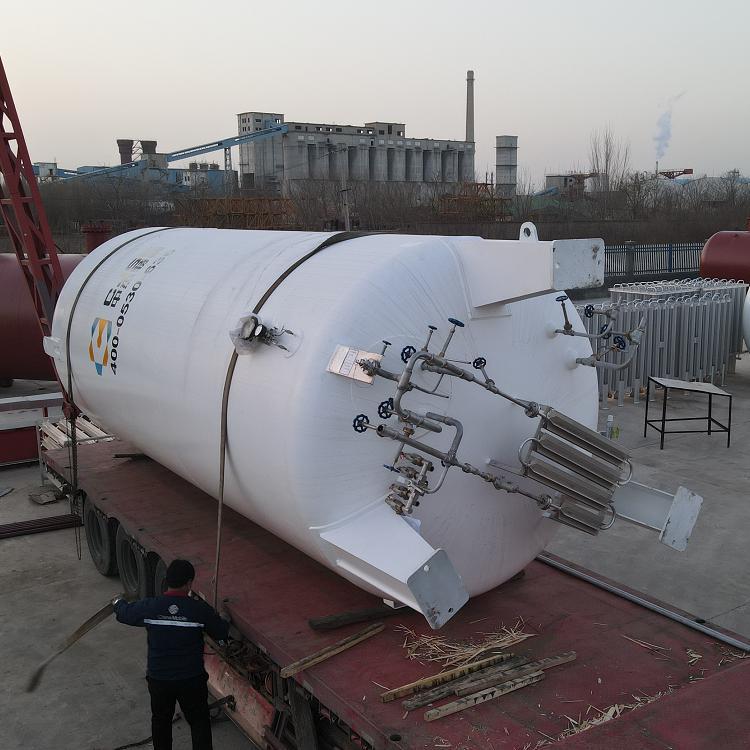
Carbon dioxide storage tanks are devices used for storing and supplying carbon dioxide gas, featuring the following parameters, functions, and characteristics:
Parameters:
- Capacity: The capacity of carbon dioxide storage tanks can be customized to meet demand, typically expressed in volume of liquid CO2, such as kiloliters or cubic meters.
- Pressure: The internal pressure of the tank is usually controlled within a safe range to ensure the safety of storage and supply.
- Temperature: Carbon dioxide storage tanks typically need to be maintained at low temperatures to maintain the liquid state of CO2.
Functions:
- Storage: These tanks can compress CO2 gas into a liquid state, achieving high-density storage, saving space and costs.
- Supply: CO2 within the tank can be supplied to the required fields via pipelines or other methods, such as the food and beverage industry, fire suppression, and more.
Characteristics:
- Environmental and Renewable: Carbon dioxide is an environmentally friendly gas. By storing and utilizing CO2, emissions into the atmosphere can be reduced, promoting environmental protection and sustainable development.
- Safe and Reliable: Carbon dioxide storage tanks are designed and manufactured using high-strength materials with excellent pressure resistance and safety. They are equipped with safety valves, pressure gauges, and other accessories to ensure safe operation.
- Multiple Applications: These tanks are widely used in various fields, including the food and beverage industry, fire suppression, and more. CO2 can be used as a preservative, effervescent agent for beverages, fire extinguishing agent, and has a broad range of applications and market demand.
In summary, carbon dioxide storage tanks offer high-density storage, safety, environmental friendliness, and a variety of applications, making them an essential device for storing and supplying carbon dioxide gas.
ZJ Special Equipment adheres to the grand vision of "realizing employees' dreams, creating customer value, and striving for the prosperity and strength of our motherland," and is dedicated to the development of the green energy equipment industry. We commit to society with high-quality and cost-effective products and services!
Ziyang 60 Cubic CO2 Storage Tank, High Performance and Cost-Effective
