


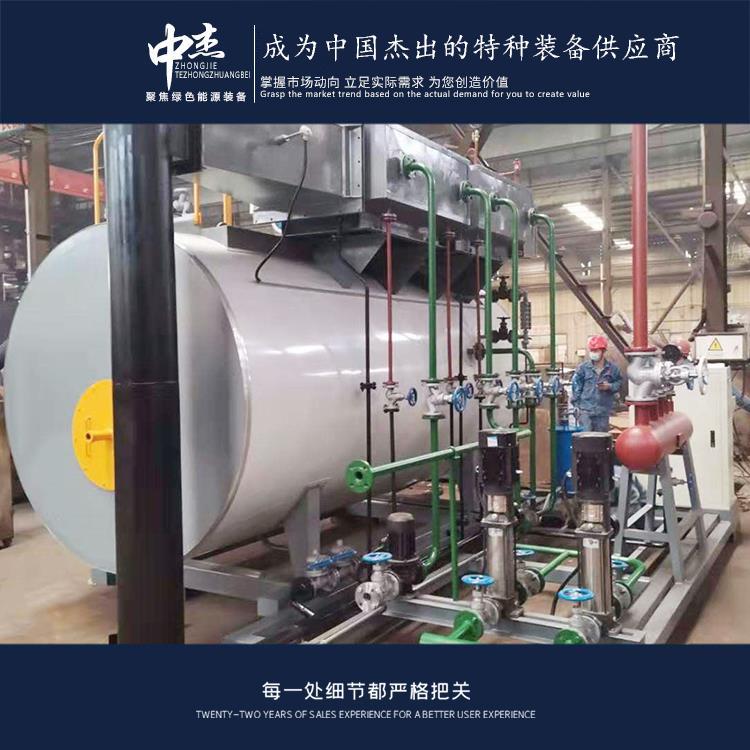

Shandong Zhongjie Special Equipment's main products include: fuel (gas) boilers, organic heat carrier boilers, biomass boilers, waste heat boilers, and other boiler products; vacuum insulation cryogenic pressure vessels such as LNG tanks, oxygen-nitrogen-argon tanks, and CO2 tanks; pressure vessel products such as denitrification engineering equipment, heat storage and energy storage equipment, and complete chemical equipment sets; central air conditioning and HVAC equipment such as ground (water) source heat pumps, air source units, water-cooled screw units, and air-cooled modular units. Planned products include large-scale energy centers, LNG transport vehicles, LNG tank containers, and other green energy equipment.
The primary benefits of installing expansion tanks in a heat transfer oil furnace include:
- Alleviating thermal expansion and contraction: During operation, the heat transfer oil furnace experiences thermal expansion and contraction due to temperature changes. The expansion tank provides space for the heat transfer oil to expand, mitigating the impact of thermal expansion and contraction on equipment and pipelines, and preventing stress concentration and equipment deformation caused by it.
- Protecting equipment and pipelines: The expansion tank absorbs the expansion and contraction of the heat transfer oil, reducing impact and vibration on equipment and pipelines. This aids in extending the lifespan of equipment and pipelines, and reducing the frequency of maintenance and replacements.
- Reducing leakage risks: The expansion tank offers an enclosed space, minimizing the risk of heat transfer oil leakage. When the heat transfer oil expands, excess oil can be accommodated through the expansion tank, preventing leaks and environmental pollution.
- Facilitating maintenance and repairs: The presence of an expansion tank makes it easier to maintain and repair the heat transfer oil furnace system. When equipment or pipelines need to be repaired or replaced, the flow and shutdown of the heat transfer oil can be controlled through the expansion tank, reducing downtime and the difficulty of maintenance.
-In summary, the expansion tank plays a role in alleviating thermal expansion and contraction, protecting equipment and pipelines, reducing leakage risks, and facilitating maintenance and repairs in the heat transfer oil furnace system. It is an important design element that contributes to the safety and reliability of the heat transfer oil furnace system.
Steam boilers produce a certain amount of wastewater during operation, which requires effluent treatment. Here are the general steps for steam boiler effluent discharge:
Preparation: Before discharging, ensure the steam boiler is turned off and the pressure inside has been reduced to a safe level.
Open the Drain Valve: Locate the corresponding drain valve according to the steam boiler's design and open it. The drain valve is typically found on the bottom or near the bottom of the boiler's drain pipe.
Discharge Wastewater: Once the drain valve is open, wastewater will flow out of the drain pipe. Depending on the situation, use a drain pump or gravity to remove the wastewater.
Observe the Wastewater: During the discharge, observe the wastewater's color, turbidity, and odor to determine if there are any abnormalities, such as sediment, impurities, or strange smells.
Close the Drain Valve: Close the drain valve when the wastewater discharge is complete or reaches the predetermined effluent target.
Clean the Drain System: Regularly clean the drain system to prevent blockages or buildup, ensuring the system remains clear.
Note that the specific steps and frequency of steam boiler effluent discharge may vary depending on the boiler model, usage conditions, and operational requirements. Therefore, it is advisable to refer to the boiler's operation manual or consult with experts for proper and safe operation.
The Zhongjie Portable Heat Transfer Oil Furnace is a common industrial thermal energy equipment featuring the following product characteristics: High thermal efficiency: The Zhongjie Portable Heat Transfer Oil Furnace utilizes advanced combustion technology and heat exchanger design to effectively transfer the heat energy generated by fuel combustion to the heat transfer oil, achieving energy utilization and improving thermal efficiency. Stable and reliable: Made with materials and precision manufacturing processes, this furnace boasts excellent high-temperature resistance and a stable operating state, ensuring long-term stable operation with high reliability. Temperature control: Equipped with a temperature control system, the Zhongjie Portable Heat Transfer Oil Furnace can monitor and adjust the temperature of the heat transfer oil in real-time, guaranteeing temperature accuracy and stability during the process. Safety protection: The furnace is equipped with multiple safety protection devices, such as overheat protection, pressure protection, and burner fault protection, to effectively prevent accidents. Additionally, the furnace uses clean combustion technology, resulting in low emissions and environmental friendliness. Easy operation: The Zhongjie Portable Heat Transfer Oil Furnace features an intelligent control system with a user-friendly interface and easy parameter adjustment, making operation simple and reducing the difficulty and labor costs. Overall, the Zhongjie Portable Heat Transfer Oil Furnace is characterized by stability and reliability, suitable for various industrial fields such as chemicals, textiles, and food processing, providing users with reliable thermal energy supply and process temperature control.
Yes, durable thermal oil boilers typically have a longer service life. Here are some reasons:
- Material Quality: Thermal oil boilers are made with high-quality materials, such as heat-resistant and corrosion-resistant steel and alloy materials. These materials can withstand high temperatures and pressures, offering good durability and corrosion resistance, thereby extending the boiler's lifespan.
- Design and Manufacturing Process: Long-lasting thermal oil boilers usually employ advanced design and manufacturing techniques. Rational structural design and precise manufacturing processes reduce stress concentration and thermal stress, enhancing the boiler's stability and durability.
- Regular Maintenance and Care: Regular maintenance and care of thermal oil boilers are crucial for extending their service life. Regularly cleaning and inspecting the internal pipes, flues, and burners, and promptly replacing worn-out parts can minimize malfunctions and damage, thus extending the boiler's life.
- Proper Operation and Management: Correct operation and management are also vital factors in ensuring the lifespan of thermal oil boilers. Operators should follow the operation manual and procedures, avoid overloading and improper operations, and ensure the boiler operates safely and stably.
- It's important to note that even durable thermal oil boilers require regular inspections and maintenance to ensure proper operation and extend their lifespan. Additionally, the boiler's lifespan is also influenced by factors such as the operating environment, load conditions, and operating methods. Therefore, proper use and maintenance are key to ensuring the longevity of thermal oil boilers.
Our company attaches great importance to technological innovation and R&D design, boasting one municipal-level enterprise technology center in Heze City. We have established test facilities for non-destructive testing, physical and chemical testing, welding testing, hydrostatic testing, etc., and are equipped with over 600 instruments and equipment, including CNC machine tools, X-ray flaw detectors, digital ultrasonic flaw detectors, mechanical property test machines, chemical analyzers, spectrometers, tensile testing machines, plasma welding machines, and more. The key products and technologies developed by us, such as temperature and pressure vessel welding, biomass boiler emissions reduction, and waste heat utilization, have successively been included in multiple Shandong Provincial Department of Industry and Information Technology science and technology innovation projects, key provincial projects, and Heze City innovation and excellence projects. We have accumulated a total of 27 authorized utility models, 16 authorized inventions, participated in drafting 2 standards, 2 industry standards, and registered 15 trademarks. The technical team of our company, in collaboration with Professor Yajiang Li of Shandong University, has developed deep cryogenic container processing technology, utilizing the international plasma arc + filler wire tungsten inert gas arc welding (PAW-GTAW) technology. After being appraised by the provincial-level scientific and technological achievement, our technology level has reached the international standard in the field of deep cryogenic container manufacturing.
Choose ZJET Customized Solutions, let's create brilliance together!
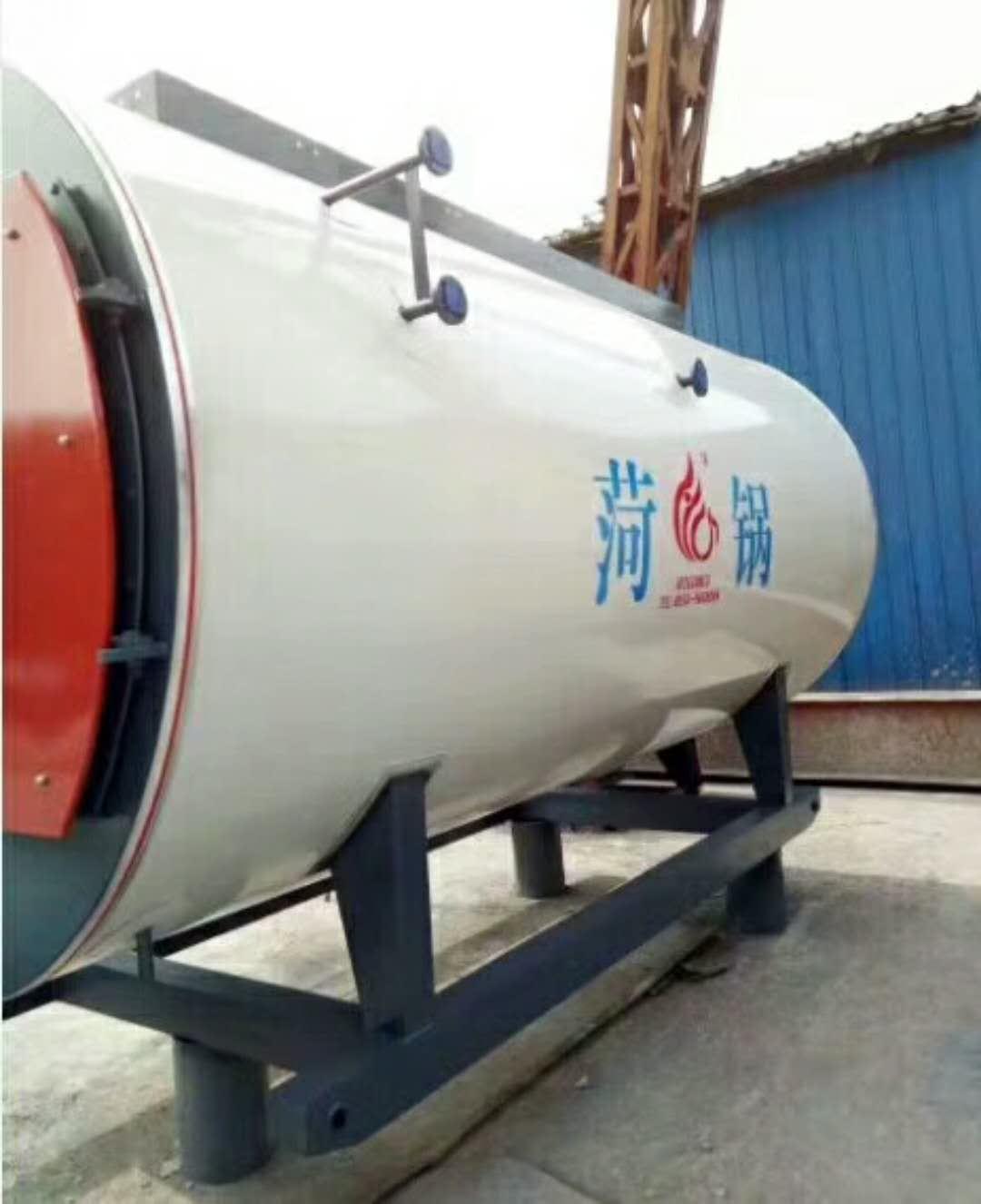
4-ton Lüliang Gas Boiler, Long lifespan
