

Thick-film evaporators are a type of chemical equipment commonly used in chemical production. Processes such as wastewater treatment and food concentration often require evaporative crystallization equipment. Different evaporators are suitable for different materials. Today, let's get to know the thin-film evaporator.
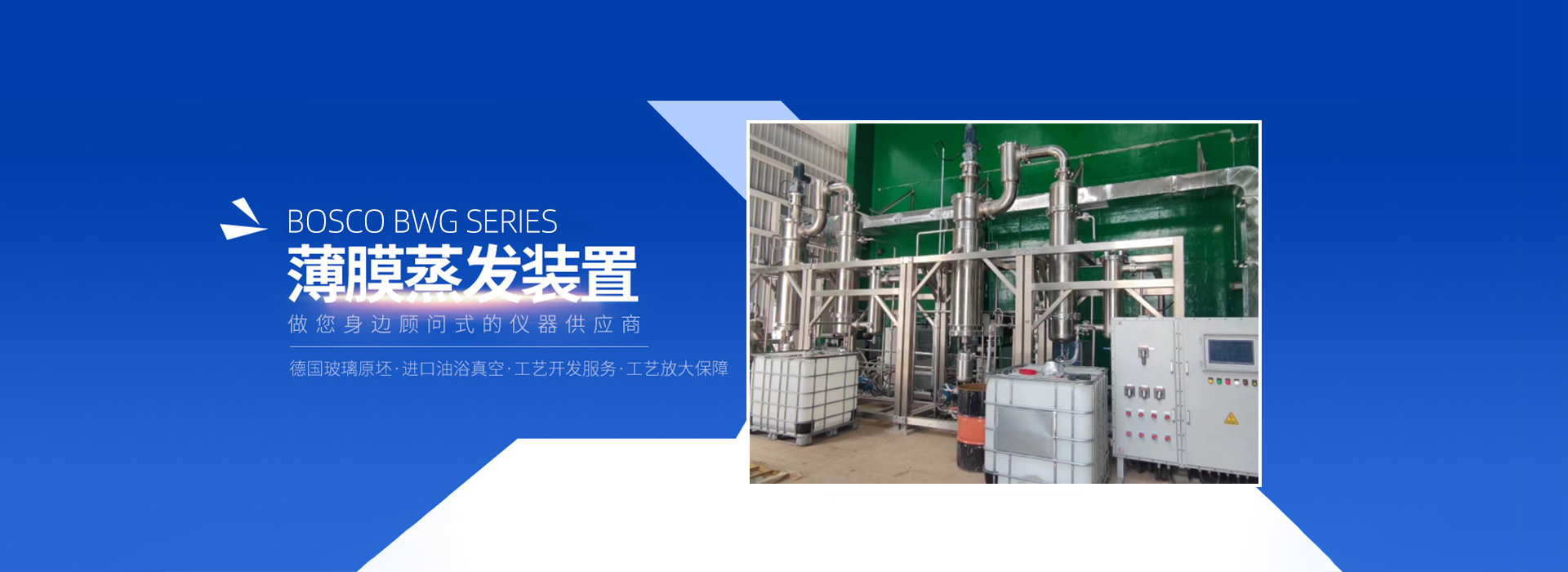
The thin-film evaporator is a new, high-efficiency evaporator that uses a rotating scraper to force the formation of a film, which then flows at high speed, boasting high heat transfer efficiency and short residence time (approximately 10-50 seconds). It is capable of performing film evaporation under vacuum conditions.
It consists of one or more jacketed cylindrical vessels and a rotating scraper inside the cylinder. The scraper continuously刮料 onto the heating surface, forming a uniform, even liquid film, which then moves downward. During this process, the low-boiling-point components evaporate, and the residue is discharged from the bottom of the evaporator.
The working principle of a thin film evaporator:
Material enters the evaporator radially from above the heating zone; it is distributed across the evaporator's heated wall by a distributor. Subsequently, a rotating scraper uniformly heats the material on the surface, forming a uniformly thick liquid film, which is then spirally pushed downwards.
During this process, the rotating scraper ensures the continuous and uniform formation of liquid films, creating high-speed turbulent flow, and prevents the liquid film from coking and scaling on the heating surface, thereby improving the overall heat transfer coefficient.
The light components are evaporated to form a vapor stream that rises and reaches the external condenser directly connected to the evaporator; the heavy components are discharged from the cone at the bottom of the evaporator.
A fabricating device evenly distributes materials to the inner wall of the evaporator, preventing them from splashing into the steam flow within the evaporator. It also prevents flashing of incoming materials at this location, facilitating foam elimination, and allows materials to evaporate only along the heating surface.
An centrifugal separator, designed according to the material characteristics, is fitted above the刮膜蒸发器 evaporation chamber, separating the droplets from the ascending steam flow and returning them to the distributor.
Performance Features of Film Evaporators:
Vacuum pressure drop is minimized.
Material vapor gas is delivered to an external condenser from the heating surface, with a certain pressure difference. In a typical evaporator, this pressure drop (Δp) is usually quite high, sometimes even unacceptably high. However,刮板式薄膜蒸发器features a larger gas cross-sectional area, with the pressure within the evaporator considered almost equal to that in the condenser, thus resulting in a very small pressure drop, with a vacuum level reaching 5 mmHg.
Low Operating Temperature
Due to these characteristics, the evaporation process can be maintained under higher vacuum conditions. The increase in vacuum results in a rapid decrease in the boiling points of the materials, allowing operations to be conducted at lower temperatures, thereby reducing product thermal decomposition.
Short heat time
Due to the scraper film evaporator's structure, the scraper has a pumping effect, which minimizes the material's residence time within the evaporator. Additionally, the high-speed turbulent flow on the heated evaporator surface prevents product from adhering. Hence, it is particularly suitable for evaporating heat-sensitive materials.
High Evaporation Intensity
The reduction in material boiling points has increased the temperature difference with the same heat medium; the刮膜器 (scraping blade) function has decreased the thickness of the liquid film in turbulent state, thereby reducing thermal resistance.
Operational flexibility
The刮板式薄膜蒸发器*'s performance makes it particularly suitable for handling materials that are heat-sensitive, require a smooth evaporation process, and have high viscosity or experience a sharp increase in viscosity with concentration, ensuring a stable evaporation during the process.
It can also be successfully applied to the evaporation and distillation of materials containing solid particles, crystals, aggregates, and scale.