
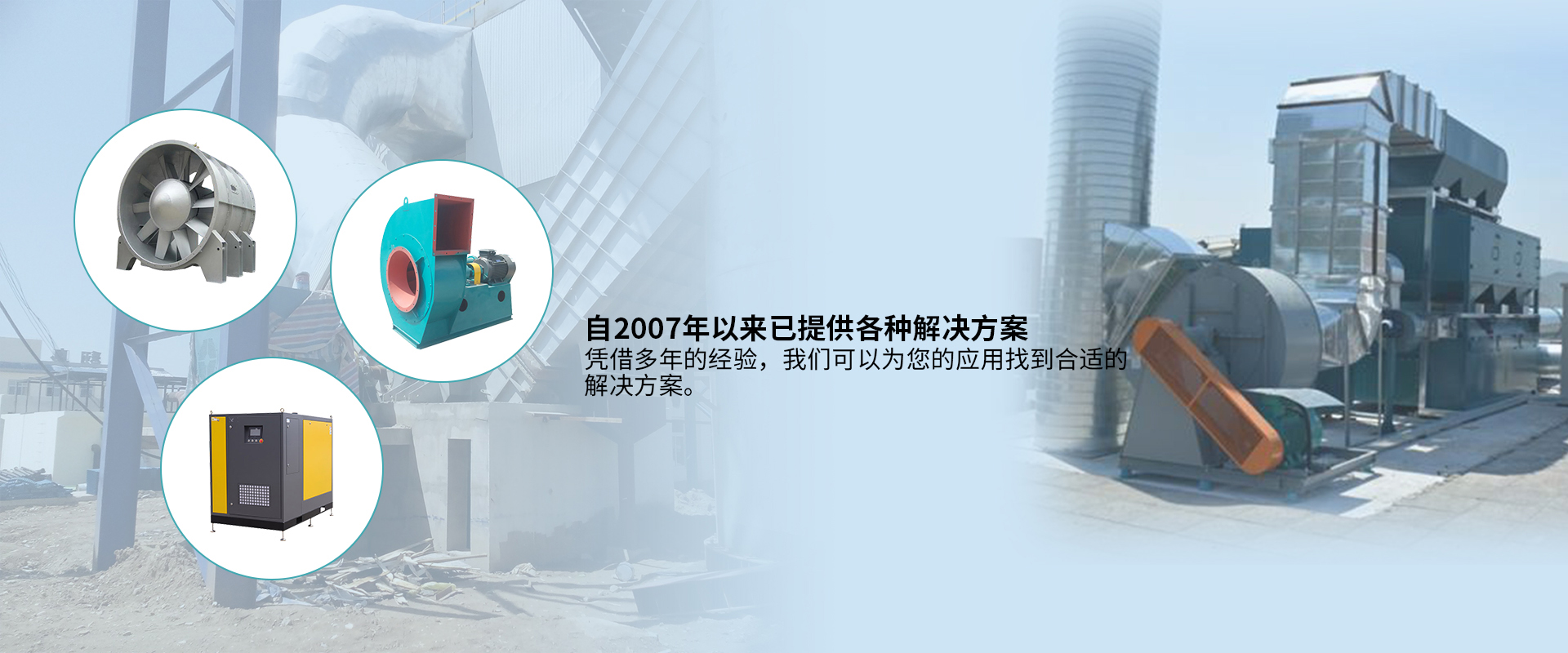


Centrifugal Fans with Different Natures, Principles, Characteristics, and Airflow Volumes: These are mechanical devices that rely on the input of mechanical energy to increase the pressure of gases and parallelly convey them. They are driven fluid machinery.
The Principle: Based on the principle of kinetic energy converting to potential energy, the gas is accelerated through the high-speed rotation of the impeller, then decelerated, and its direction is altered, converting kinetic energy into potential energy (pressure). In a single-stage centrifugal blower, the gas enters the impeller axially. As the gas flows over the impeller, it moves radially before entering the diffuser.
Feature: Centrifugal fans are essentially variable flow constant pressure devices. When the speed is constant, the theoretical pressure-flow curve of a centrifugal fan should be a straight line. Due to internal losses, the actual characteristic curve is curved. The pressure developed by the centrifugal fan is greatly affected by changes in inlet temperature or density. Different air volume applications: Used in locations with low pressure requirements and high air volume requirements.
Roots Blower
Nature: A volumetric fan, including impeller end face and the front and rear end covers of the fan. In the diffuser, the gas changes its flow direction, and the increase or decrease of the pipeline cross-sectional area reduces the airflow, converting kinetic energy into pressure energy. The pressure increase primarily occurs within the impeller, followed by the diffusing process. In multi-stage centrifugal fans, the airflow enters the next impeller stage through recirculation, resulting in higher pressure. Principle: There is a space for two three-blade impellers to rotate relative to each other, sealed by the housing and walls. As each impeller is enveloped by a involute or epicycloid, all three blades of each impeller are identical, and the two impellers are the same, significantly reducing the difficulty of processing. During impeller processing, CNC equipment is used to ensure that the two impellers maintain a certain smaller gap regardless of their rotation position, ensuring gas leakage remains within the permissible range.
Features: With a three-blade rotor design, the shell's inlet and outlet structure is rationalized, resulting in low vibration and noise for the fan. The impeller and shaft are a solid structure, with the impeller being wear-free. The fan maintains consistent performance and can operate continuously for extended periods. It boasts high volume utilization, high volumetric efficiency, compact structure, and flexible installation methods.
Varying Airflow: Suitable for locations with low airflow requirements but high pressure demands.
In summary, the working principles differ: centrifugal fans use curved blades that propel gases to the casing through centrifugal force, whereas Roots blowers employ two 8-shaped blades with minimal gaps between them, squeezing gases out through the outlet via the blades' compression. Due to their distinct working principles, their operating pressures generally vary; Roots blowers tend to have higher discharge pressures compared to centrifugal fans, which have lower pressures. Applications differ too; Roots blowers are typically used in situations where high pressure is required but low airflow is sufficient, while centrifugal fans are employed in areas with lower pressure demands and higher airflow needs. The manufacturing precision varies as well; Roots blowers require high precision and strict assembly standards, whereas centrifugal fans are less stringent. There are also some minor differences that go without mentioning.
If the load requires a constant flow effect, a Roots blower is used. As a constant flow blower, the main operating parameter is air volume, and the output pressure varies with changes in the pipeline and load, with minimal air volume change. The Roots blower is a high-pressure blower, and the Roots blower is a volumetric blower, with the air volume transported being proportional to the speed. It transfers gas from the intake side to the discharge side. If the load requires a constant pressure effect, a centrifugal blower is used. As a constant pressure blower, the main operating parameter is air pressure, and the output air volume varies with changes in the pipeline and load, with minimal pressure change. Centrifugal blowers have moderate air pressure. The air compression process is typically carried out by several operating impellers (or stages) under the effect of centrifugal force. Centrifugal blowers have a square torque characteristic, while Roots blowers are primarily constant torque characteristics.
