


 通过中商114认证
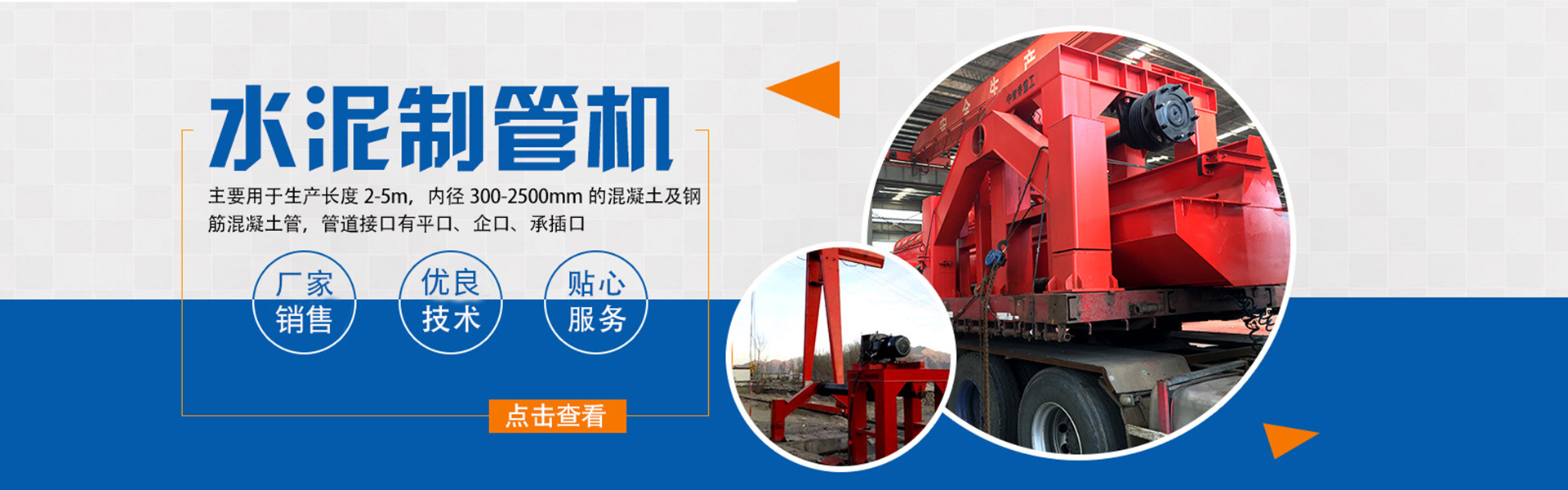
Cement pipe-making machines are widely used in our construction industry, with factories producing precast concrete components in various regions. What are the different production processes for cement pipe-making machines? Today, let's learn together. The cement pipe production process includes extrusion, vibration, centrifugal, and roller-pressing techniques, which, combined with different concrete mix ratios, create cement pipes for various applications. How are these various cement pipe-making machines used?
One: Vibration Method: A manufacturing technique for compacting concrete using various vibration capabilities, commonly known as the vibration molding pipe-making machine. It is suitable for reinforced or non-reinforced concrete pipes, with lengths ranging from 1 to 4 meters. Using semi-wet concrete as the raw material, the vibration compaction allows for immediate demolding after 1 meter, while pipes longer than 1 meter require demolding after the concrete has cured.
Two: Centrifugal Method: A manufacturing technique for concrete pipes, achieved by the action of centrifugal force after the concrete is rotated and molded to fit the mold, commonly known as the centrifugal pipe-making machine. The pipes, with lengths ranging from 1 to 4 meters and reinforced with steel, are made from wet concrete. Their length can be gradually increased through prestressing with the pre-tensioning method and by enhancing the concrete grade. The molds can be removed only after the concrete has cured.
Three: The extrusion method involves using a powered press head and foot to produce pipes through a rotating lifting and extrusion process, commonly known as a vertical extrusion pipe-making machine. It is suitable for the production of non-reinforced concrete pipes with a length of 1 meter or less. It utilizes dry and wet concrete as raw materials and the extruded products can be immediately demolded.
Four: The roller-pressing method involves filling molds on a suspended roller shaft through roller pressing, followed by the rotation and oscillation of the roller shaft for production, commonly known as the suspended roller cement pipe making machine. It produces reinforced and non-reinforced concrete pipes with lengths ranging from 0.8 to 4 meters. The raw material used is dry-wet concrete, and after the reinforcement frame is prepared, it is inserted into the mold for roller-pressing production. The mold can be removed after curing. This is an overview of the production process for cement pipe machines, hoping it is helpful to everyone in choosing the suitable equipment.
