





- AllProduct Category
-
Pipe Fittings & Other Non-Standard Equipment
Chemical Pumps
Storage Devices
Waste Gas Treatment
Vacuum Equipment




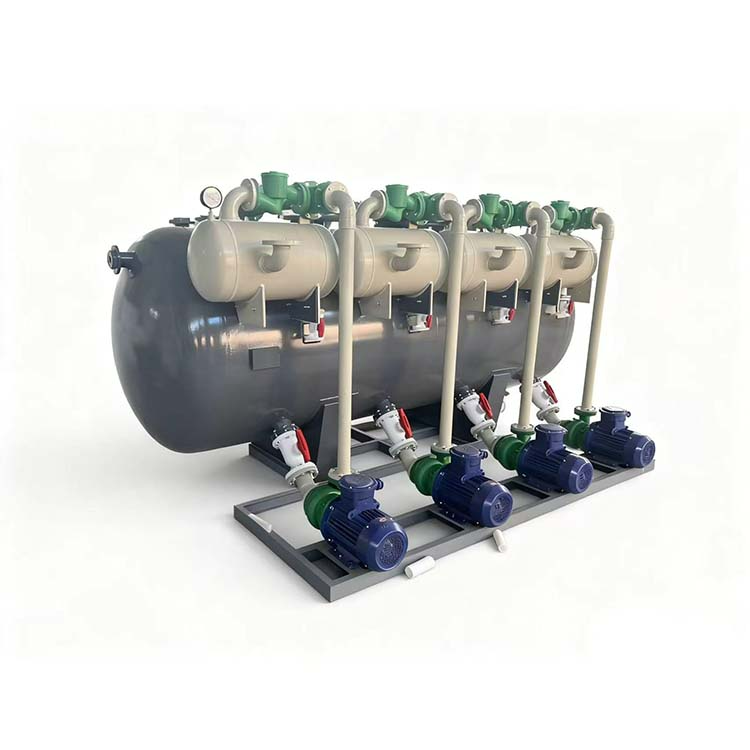
详情描述
Overview:
Ion exchange columns refer to the reaction between ions in water and ions on the resin within the ion exchange columns, which is essentially a traditional water treatment process where various anions and cations in water are exchanged through the use of anion and cation exchange resins.
Composite Bed: Utilizing two exchangers, anion and cation exchange resins are loaded into their respective exchangers according to design specifications. The raw water first passes through the cation exchange agent, where ions such as Ca2+, Mg2+, K+, Na+ are adsorbed, and the exchangeable H+ on the exchanger is displaced into the water, forming corresponding inorganic acids with the anions present. The water then passes through the anion exchange agent, where anions like SO42-, Cl-, HCO3- are adsorbed, and the exchangeable OH- on the exchanger is displaced into the water, combining with H+ to form H2O. The water processed through these anion and cation exchange units has its salt content removed, which is the desalination process for the first-stage composite bed, with the effluent water quality ≤10 μs/cm.
Mixed Bed: In the same exchanger, the anion and cation exchange resins are filled in a certain volume ratio, and the anion and cation exchange is carried out in a uniform mixed state to remove the salt content from the water, resulting in an output water quality resistivity of ≥5MΩ.cm; simultaneously, based on different water quality and usage requirements, the output water resistivity can be controlled between 1~18MΩ.cm.
Product Images:
Product Highlights:
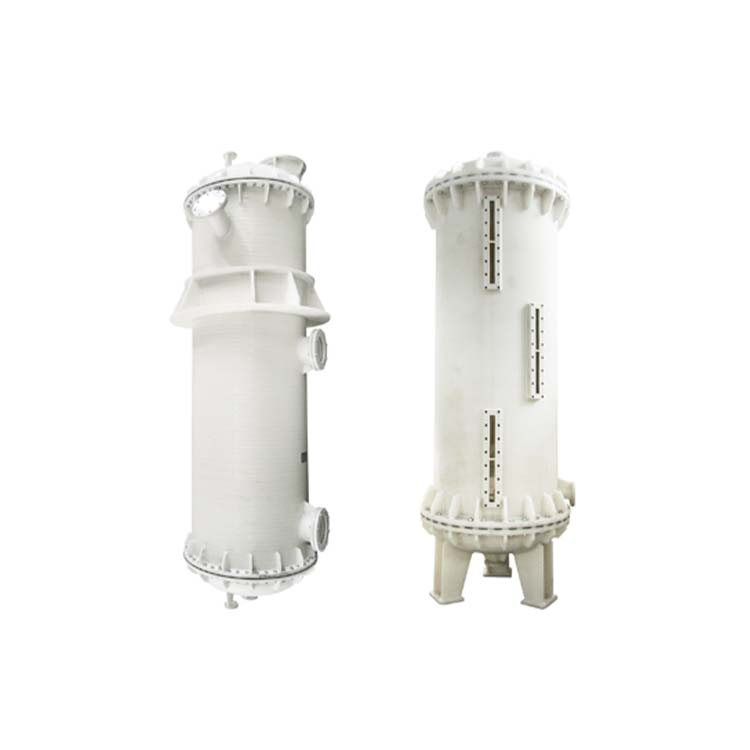
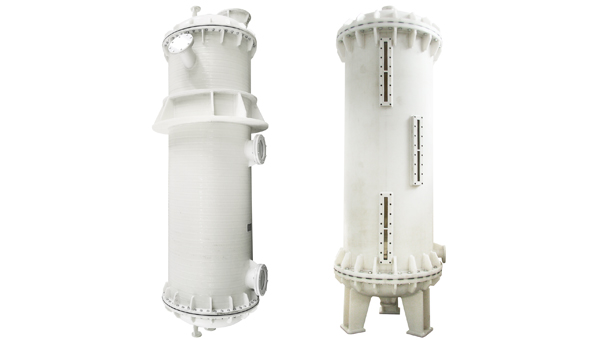
Entirely wrapped drum body, thickness customizable, high safety, no bursting columns
RPP and PPH materials, superior corrosion resistance
Distinctive rectangular view mirror, wide field of vision
Other:
Polypropylene ion exchange columns are safer than glass equipment, as they are less prone to bursting. However, they have a significant drawback: it's difficult to clearly view the interior of the equipment, and the observation holes tend to accumulate material. In response to this, our company has specifically developed a **ion exchange column observation mirror** with a large viewing area and no material accumulation. It also addresses the common issues of leakage and component corrosion.
If you're concerned about the safety of glass ion exchange columns and find traditional polypropylene ion exchange columns inconvenient to use, we recommend our "polypropylene ion exchange columns with sight glasses."


