
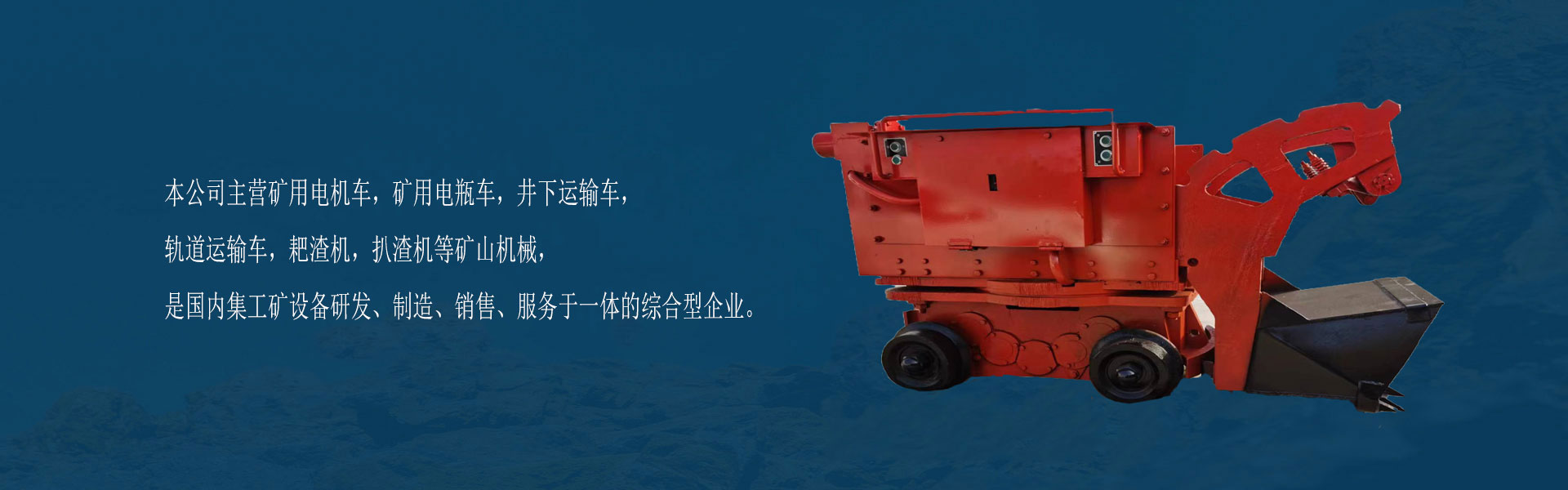



Types and Operating Conditions of Bucket Loaders
Bucket loaders, also known as bucket loaders, use buckets as the working mechanism. They are propelled by a winch to create reciprocating motion for picking up coal or rock and loading it into ore cars, buckets, or transfer conveyors. The bucket loader consists mainly of a fixed wedge, tail wheel, bucket, winch, trolley, guide wheel, feed troughs (input trough, middle trough, discharge trough), and electrical components, as shown in Figure 8-17. Bucket loaders are the primary loading equipment used in China's coal mine excavation, accounting for about 80% of the total number of loaders in use. Bucket loaders have the advantages of simple structure and easy operation, with a wide range of applications. They can be used in horizontal tunnels with a height of about 2 meters and a width of more than 2 meters, as well as inclined tunnels with an inclination angle less than 35°, and can also be used for loading in curved areas. The bucket loaders are efficient at handling large rocks, with high loading efficiency when the rock size is between 300 to 400 mm. However, bucket loaders operate intermittently, which limits the increase in production capacity. Additionally, they are large in size, lack self-propulsion, have poor mobility, and the wire ropes and buckets wear out quickly.
