

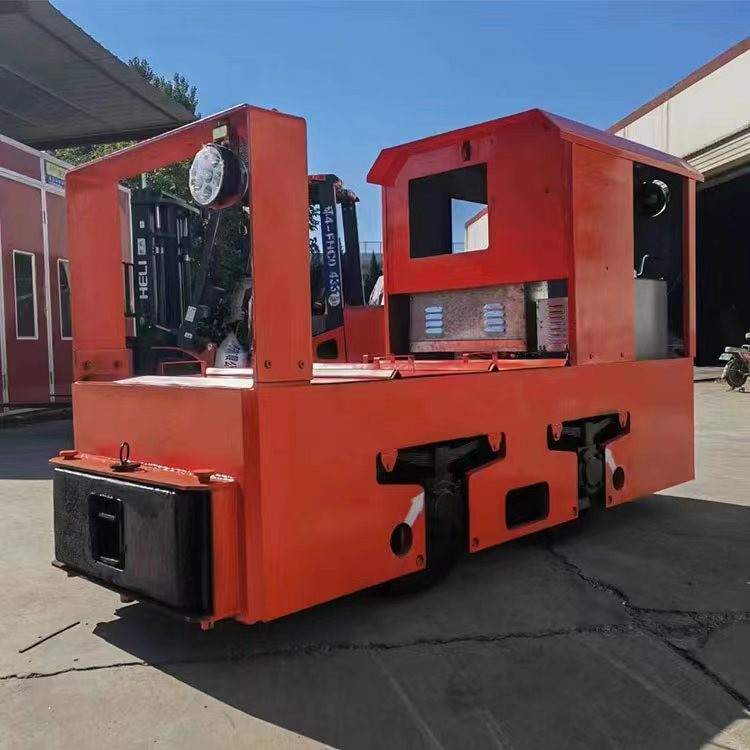


Electric locomotives are traction devices for rail vehicles, powered by drive motors that rotate the wheels. This rotation is achieved through the friction between the wheels and the rail surface, propelling the locomotive along the tracks. The traction force is limited not only by the power of the drive motor (or internal combustion engine) but also by the friction between the wheels and the rail surface. The locomotive's ability to travel up grades is restricted; generally, the gradient of the transport track is 3‰, with local gradients not exceeding 30‰. Structurally, they are categorized into overhead-wire electric locomotives and battery-powered electric locomotives.
Overhead Trolley Motor
The process of the overhead wire trolley: High-voltage AC power is stepped down and rectified at the traction converter, with the positive pole connected to the overhead wire and the negative pole to the rail. The trolley's pantograph contacts the overhead wire, introducing current into the trolley. It then passes through the air automatic switch, controller, and resistor box to the traction motor, driving the motor to operate. The motor drives the wheels through a transmission mechanism, propelling the train forward. The current流出 from the motor returns to the converter via the rail.
Track-mounted electric trolley
Traction trolley cars receive current from the overhead line via receivers and feed it into the circuitry and motor of the trolley car, which then returns through the track to the converter station. In China, the DC voltage for underground overhead power grids is either 250V or 550V, while for outdoor grids, it's either 550V or 750V.
Advantages: The overhead trolley motor has a simple structure, low cost, easy maintenance, high transport capacity, high speed, high electrical efficiency, low transportation costs, and wide application.
Disadvantages: Requires rectifying and overhead wiring equipment, lacks flexibility; overhead wiring may affect tunnel dimensions and pedestrian safety; there is a tendency for arcs between the collector arm and the overhead wire, rendering it unsuitable for mines with severe瓦斯 (gas) conditions; initial construction requires substantial investment. However, in the long run, the total cost of overhead wiring electric locomotives is significantly lower than that of battery-powered locomotives. Therefore, if mine conditions permit, overhead wiring electric locomotives should be primarily used for main transportation in mines.
