


The primary artificial plants are indeed fake, despite modern technology giving them a realistic appearance and texture, and even some special functions. However, they are unable to perform photosynthesis and cannot purify the air. It is recommended to mix and place artificial and real plants together.
The application of plant sculptures features a wide variety, ranging from low, herbaceous plants to towering trees several meters high. For shrubs and trees, only a slight pruning is needed. For slightly chaotic shapes, a light trimming is required during the early stage, which can stimulate plant growth and make the branches and leaves denser.
Green sculpture designs vary from person to person; we simply choose based on practical circumstances. Just what kinds of green sculpture designs are there? This is what many people want to know now, as there are actually quite a few designs available, and many clients are fundamentally unaware of the variety.
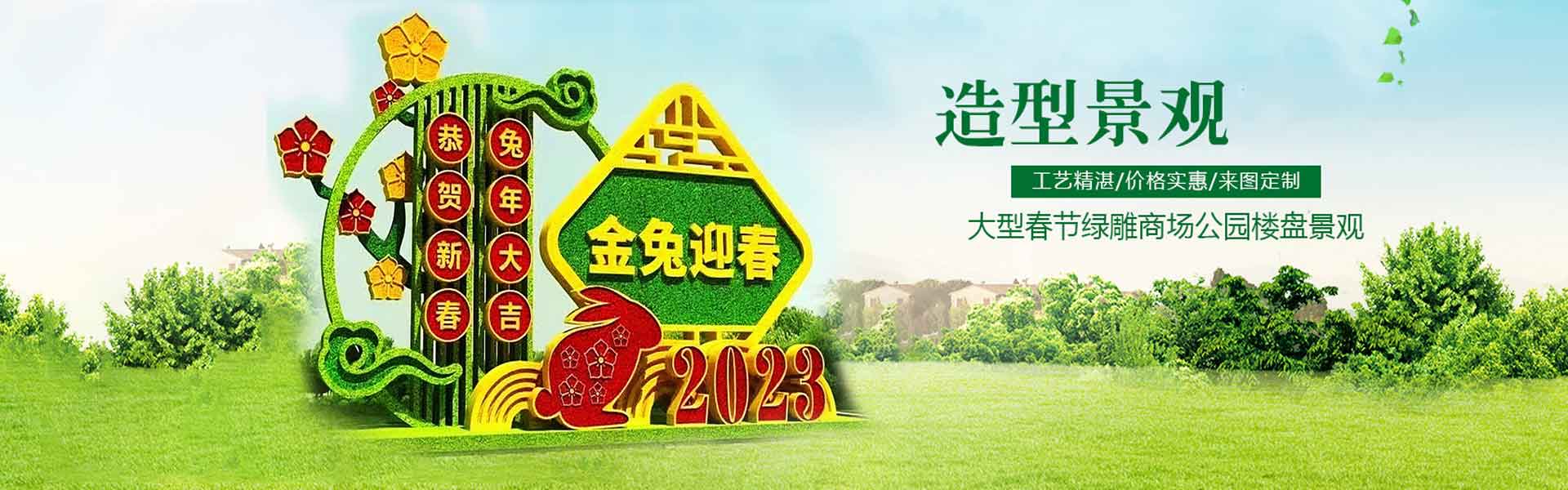
The shapes of artificial green sculptures are incredibly diverse, with different styles emerging in various localities. Common shapes include Chinese characters, animals, and figures, among others. The complexity of these sculptures varies, which in turn affects the production process.
Creating artificial green sculptures is time-consuming and labor-intensive. Therefore, it is crucial to consider this aspect carefully when making green sculptures. Firstly, plan a perfect blueprint before starting the production, and then proceed to make the sculpture according to the blueprint. This ensures that there are no unexpected situations during the entire production process, allowing for a smoother workflow.
1. Variety Selection of Plants
The general procedure for selecting plant varieties is as follows:
1) Based on the layout map of plant phenomena types, the statistics table of plant phenomena types, and the composition analysis table of plant phenomena types, etc., summarize and analyze the structure of each phenomenon type, confirm the types of plants and requirements, and create a worksheet for plant types and requirements.
The module can be obtained through methods such as mimicking nature, querying and analyzing previous designs, or planning and modeling.
Once again, driven by the need for aesthetic planning, such as the overall layout of phenomena lines and points, softening of certain perspectives, or the addition of color or texture changes in certain local areas. Additionally, the same type of plant phenomena can have completely different combinations of plant structures. Structural phenomenon layouts mainly confirm the overall framework of the planning area. Modules are like components or semi-finished products in industrial products that are guaranteed in quality through system inspections.
2. Confirmation of Initial Plant Size
In China, there are no specific standards for the initial planting size specifications of cultivated plants.
Green Sculpture's planning has always been flexible, with each green sculpture varying significantly in different regions and environments. Below, staff from Kaifeng Yijing Landscape Engineering Co., Ltd. will explain the differences in construction under various environments and the unique aspects of the three-dimensional gardens.
I. Diverse Environments
Due to varying environments, the methods for planning green sculptures differ greatly, as do their purposes.
In areas of the city with complex traffic patterns, such as divided roads, safety islands, and turnaround spots, flower beds can be established. The selection of plants and the emphasis on vivid colors are crucial, as the primary focus is on distant appreciation. Not only do these flower beds beautify the cityscape, but they also help organize traffic flow.
The emergence of mobile planters or portable flower piles, assembled from potted flowers, has also been widely adopted. This is due to the rapid expansion of paved areas in city streets, parks, and courtyards, especially during major holidays. To beautify the environment and enhance the festive atmosphere with a colorful array of flowers, potted plants are the only option in some paved areas for creating mobile planters.
In fact, many green sculptures are planned due to the surrounding environment, such as clock flower beds, seasonal flower beds, and holiday flower beds, etc.
Two: Different Construction
Green Sculpture Planning is the process of beautifully integrating floral art with the environment. Whether it's abstract or representational flower beds, the methods and themes to be conveyed should strive for harmony with the surrounding environment and the main content it complements. Different structures require different styles of green sculptures.
Within a formal garden setting, in front of significant structures nearby, thematic sculptures should be sophisticated, elegant, and possess high artistic effect. In bustling urban intersections, public playgrounds, and squares, simple yet dignified and solid sculptures are more suitable. Additionally, the site conditions and topographical features of the flower beds should be fully considered. For example, on rectangular squares, it is advisable to plan rectangular large flower beds, whereas in the center of a circular square, circular or polygonal symmetric flower beds are more appropriate.
When planning, many factors should be considered, such as the fixation methods of green sculptures and the application of plant materials. Adhering to the principle of "Proportion and Standard," the design achieves an appropriate scale with the surrounding space, and multi-angle perspective illustrations are planned based on both flat and three-dimensional structures, providing a more intuitive representation of the green sculpture's spatial structure and volume. Additionally, the color combination of the entire green sculpture and many other elements are timely and consistently distributed, striving for a harmonious blend of diversity within unity, creating a naturally cohesive and highly vibrant design effect.