
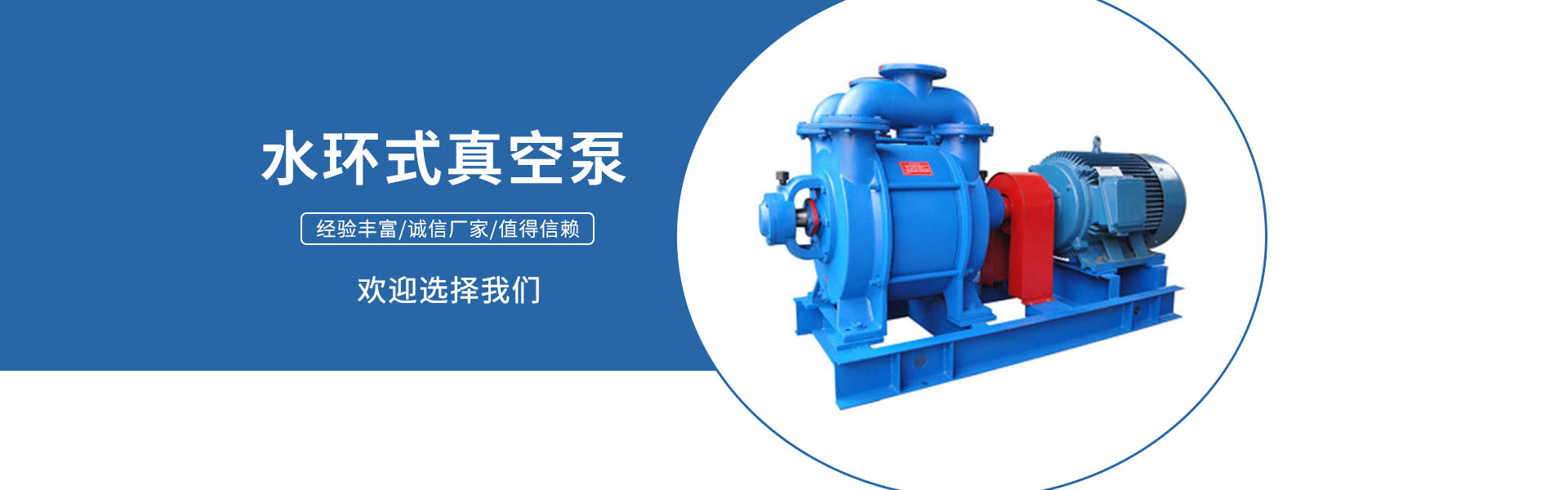


Single-stage, single-action water ring pump: Single-stage means it has only one impeller, and single-action refers to the fact that each revolution of the impeller involves one intake and one exhaust cycle.
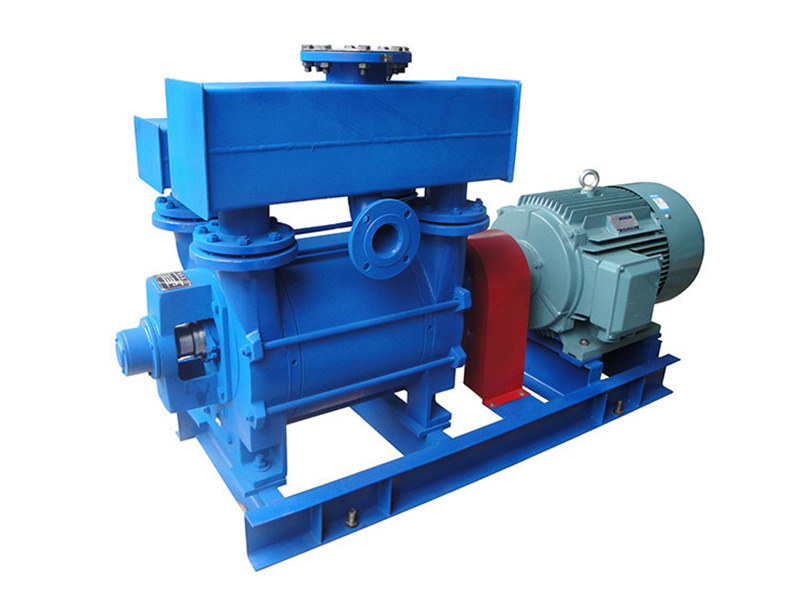
Water ring vacuum pumps can be divided into several types according to their different structures:
(1) Single-stage, single-action water ring pump: Single-stage refers to having only one impeller, while single-action means that the impeller performs one suction and one exhaust per revolution. This type of pump has a high vacuum, but lower flow rate and efficiency.
(2) Single-stage double-acting water ring pump: "Single-stage" refers to a pump with only one impeller, while "double-acting" means the impeller performs two suction and two exhaust cycles per revolution. Under the same discharge conditions, the double-acting water ring pump significantly reduces size and weight compared to the single-acting version. Due to the symmetrical distribution of the working chamber on both sides of the pump hub, it improves the load on the rotor. This type of pump has a higher discharge capacity and efficiency, but a lower vacuum level.
(3) Two-stage Water Ring Pump: The majority of two-stage water ring vacuum pumps are composed of a series of single-acting pumps. Essentially, they are formed by the impellers of two single-stage, single-acting water ring pumps connected by a single shaft. Their main feature is that they maintain a high suction capacity at high vacuum levels while maintaining stable operation.
(4) Atmospheric Water Ring Pump: The atmospheric water ring pump is essentially a unit consisting of an atmospheric jet pump and a water ring pump. The addition of an atmospheric pump in series before the water ring pump is to enhance vacuum and broaden the pump's operational range.
Water ring vacuum pumps have the following advantages compared to other types of mechanical vacuum pumps:
(1) Simple structure, low precision manufacturing requirements, easy to process. Easy operation, convenient maintenance.
(2) Compact in design, pumps are typically directly coupled with electric motors, resulting in higher rotations. Smaller structural dimensions allow for greater exhaust volume.
(3) The water ring vacuum pump features no metallic friction surfaces within the pump cavity, eliminating the need for internal lubrication. The seal between rotating and stationary parts can be directly achieved with a water seal.
(4) The temperature change during the compression process inside the pump cavity is minimal, which can be considered isothermal compression. Therefore, it is possible to remove flammable and explosive gases.
(5) Due to the absence of exhaust valves and friction surfaces, it can remove dusty gases, condensable gases, and gas-water mixtures.
Overall, due to the water ring vacuum pump's features such as isothermal compression and using water as sealing fluid, it can extract flammable, explosive, and corrosive gases, as well as gases containing dust and moisture, thus enjoying widespread applications.
