


H-beams can be produced through either welding or rolling processes. Welded H-beams involve cutting strips of steel to the appropriate width and welding the flanges to the web in a continuous welding line. However,焊接H-beams have drawbacks such as high metal consumption, difficulty in ensuring uniform product performance, and limited size specifications. As a result, rolling is the predominant method for producing H-beams. In modern rolling production, H-beams are rolled using rolling mills. The webs are rolled between the upper and lower horizontal rolls, while the flanges are shaped simultaneously between the horizontal roll sides and the vertical rolls. Since the flange ends cannot be compressed with just the rolling mill, a side-rolling machine, also known as a flange-rolling machine, is set up at the back of the frame to compress the flange ends and control the width. In actual rolling operations, these two frames are used as a set, allowing the workpiece to pass back and forth through several passes, or to pass through a continuous rolling line consisting of several frames and one or two side-rolling machines, applying a certain amount of compression in each pass to roll the billet into the required shape and size. Due to sliding between the horizontal roll sides and the workpiece, the rolling mill rolls experience significant wear. To ensure that the rolls can recover their original shape after heavy loads, the sides of the rough rolling mill's horizontal rolls and the corresponding vertical rolls should have an inclination angle of 3° to 8°. To correct the angle of the finished flanges, a special finishing mill is set up, with the horizontal roll sides perpendicular to or with a small inclination relative to the horizontal roll axis, generally not exceeding 20 minutes, and the vertical rolls are cylindrical.
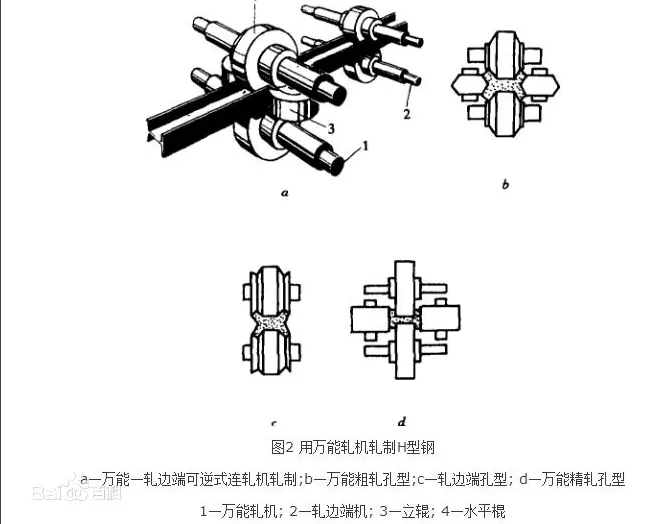
The rolling of H-shaped steel through a rolling mill results in a more uniform extension of the cross-section, with a smaller speed difference between the inner and outer surfaces of the flange rolls. This allows for the rolling mill rolls to have a simple shape, long lifespan, and significantly reduced wear. The advantages of rolling H-shaped steel include: within the same size series, only the thickness of the web and flange varies, while the dimensions of other parts remain constant. Consequently, the same die can produce H-shaped steel in the same series with various web and flange thickness specifications, greatly increasing the number of available sizes and providing users with more convenience in selecting the appropriate dimensions. Occasionally, to meet the urgent needs of production and construction, a vertical roll frame can be added to a standard two-roll rolling mill to form a die for rolling H-shaped steel. Rolling H-shaped steel in this manner results in low product size accuracy, difficulty in achieving a right angle between the flange and web, high costs, limited specifications, and extreme difficulty in rolling column-shaped H-shaped steel, thus making it less popular among users.
