


Plate Heat Exchanger Cleaning Precautions:
In recent years, plate heat exchangers have gradually gained popularity across various industries due to their lightweight design, compact footprint, low investment cost, high heat exchange efficiency, flexible assembly, and ease of scale removal. However, the smaller flow cross-section of plate heat exchangers can lead to clogging after scaling, which reduces their heat exchange efficiency and affects equipment safety and user operation. Consequently, addressing the cleaning of plate heat exchangers and preventing scale formation has become a crucial issue for ensuring safe production and economic operation. During use, improper operation of water treatment equipment and substandard water quality control, such as injecting untreated softened water into the system, cause calcium, magnesium, and carbonates in the water to decompose into calcium carbonate and magnesium hydroxide precipitates, which stick to the heat exchange surface, forming hard scale. Due to the poor thermal conductivity of scale, this results in reduced heat exchange efficiency and significant energy waste, impacting the heat transfer performance.
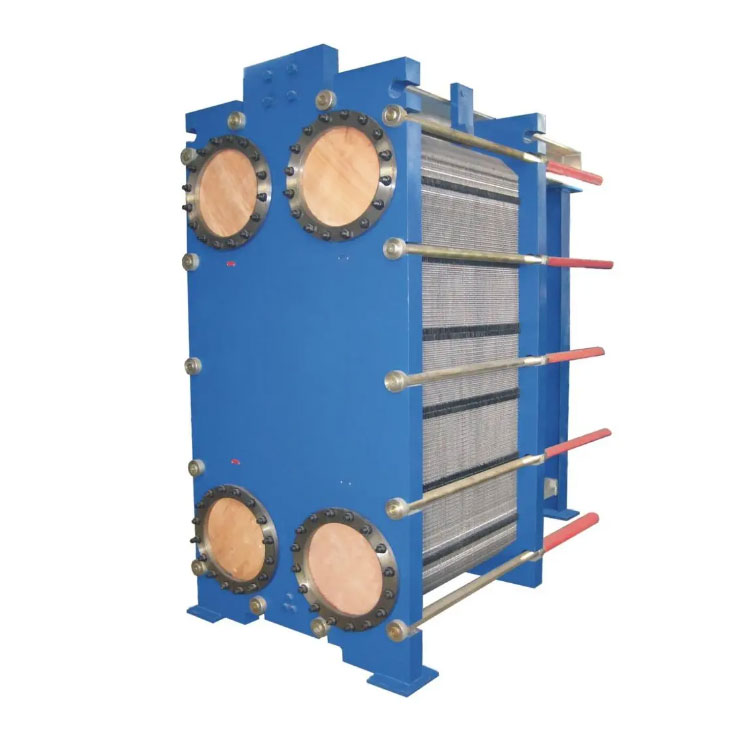
Cleaning Methods for Plate Heat Exchangers Scaling
1. Choice of Cleaning Agents
The choice of cleaning agents currently employs acid washing, which includes both organic acids and inorganic acids. Organic acids primarily include oxalic acid, formic acid, etc. Inorganic acids mainly include hydrochloric acid, nitric acid, etc. Based on the analysis of fouling on heat exchangers, process, material, and scale composition, it is concluded that:
(1) Heat exchangers have a small flow area and complex internal structure, making it difficult to discharge sediment if the cleaning fluid settles.
(2) The heat exchanger is made of nickel-titanium alloy and uses hydrochloric acid as a cleaning solution, which can cause severe corrosion to the plates, shortening the lifespan of the heat exchanger. Repeated tests have found that formic acid is an effective cleaning agent. By adding buffer and surfactant to the formic acid cleaning solution, the cleaning performance is enhanced, and the corrosion to the plates is reduced. Chemical tests on scale samples indicate that formic acid can effectively remove scale. Acid soak tests have shown that formic acid can effectively remove scale adhering to the plates, while exerting minimal corrosion on the heat exchanger plates.
2. Basic Principle of Limescale Removal
(1) Solubility: Acidic solutions readily react with calcium, magnesium, and carbonate scale, forming easily soluble compounds, thereby dissolving the scale.
(2) Detaching Function: Acidic solutions can dissolve oxides on the surface of metals, breaking the bond with limescale. This allows the limescale adhering to the metal oxides to be peeled off and fall away.
(3) The lifting effect: After the acidic solution reacts with calcium, magnesium, and carbonate scale, a large amount of carbon dioxide is produced. During the overflow process, the carbon dioxide gas exerts a certain lifting force on the scale layer that is difficult to dissolve or dissolves slowly, causing the scale to detach from the heated surface of the heat exchanger.
(4) Loosening Action: For mixed silicate and sulfate scale, the calcium, magnesium, carbonate, and iron oxides dissolve in the acidic solution, causing the remaining scale to become loose and easily flushed away by the flowing acidic solution.
Step 3: Requirements for Lime Scale Cleaning Process
(1) Pickling Temperature: Increasing the pickling temperature enhances the descaling effect. However, excessively high temperatures can intensify the corrosion of the heat exchanger plates by the pickling solution. Through repeated testing, it has been found that maintaining the pickling temperature between 60~E is ideal.
(2) Acid washing solution concentration: Based on repeated testing, the optimal concentration for the acid washing solution is 81.0% formic acid, 17.0% water, 1.2% buffer, and 0.8% surfactant, which yields excellent cleaning results.
(3) Pickling Method and Time: The pickling method should be a combination of static immersion and dynamic circulation. The pickling time is to first statically immerse for 2 hours, followed by dynamic circulation for 3 to 4 hours. During the pickling process, the acid pickling concentration should be sampled and tested regularly. When the difference in concentration between two consecutive tests is less than 0.2%, it can be considered that the pickling reaction is complete.
(4) Passivation Treatment: After pickling, most of the scale and metal oxides on the surface of the plate-type heat exchanger have been dissolved and detached, exposing new metal that is prone to corrosion. Therefore, a passivation treatment is conducted on the heat exchanger plates after pickling.
4. Steps for Cleaning Scale
(1) Rinse: Prior to acid washing, an open rinse is performed on the heat exchanger to ensure there are no sediments or scale impurities inside. This not only enhances the effectiveness of the acid wash but also reduces the amount of acid required.
Pour the cleaning solution into the cleaning equipment first, then into the heat exchanger.
(3) Acid Cleaning: Soak the heat exchanger statically in an acid solution for 2 hours. Then, perform a continuous dynamic circulation for 3 to 4 hours. During this time, alternate between forward and reverse cleaning every 0.5 hours. After acid cleaning, if the pH value of the acid solution is greater than 2, the acid solution can be reused. Otherwise, the acid cleaning solution should be diluted and neutralized before disposal.
(4) Alkaline Cleaning: After acid cleaning, prepare a solution with a certain ratio of NaOH, Na, PO, and softened water. Conduct an alkaline cleaning of the heat exchanger using a dynamic recirculation method to achieve acid-base neutralization, preventing further corrosion of the heat exchanger plates.
(5) Wash: After alkali washing, use clean softened water to rinse the heat exchanger repeatedly for 0.5 hours to thoroughly flush out any residue inside.
(6) Record: During the cleaning process, it is essential to strictly record the time for each step to inspect the cleaning effectiveness. In summary, after cleaning, a pressure test should be conducted on the heat exchanger. It can only be used after passing the test.
5. Measures to Prevent Fouling in Plate Heat Exchangers
(1) We strictly monitor water quality during operation, conducting rigorous water tests on the water in the system and the softened water in the softening tanks before it can be injected into the pipeline.
(2) Upon the deployment of the new system, the replacement
Separate the heat exchanger from the system, run a cycle for a period, and then integrate the heat exchanger back into the system to prevent impurities in the pipeline from entering the heat exchanger.
(3) In the entire system, in addition to the periodic cleaning of filters and separators, it is essential to maintain the cleanliness of the pipeline network to prevent heat exchangers from becoming blocked.
In summary, adhering strictly to the cleaning process for plate heat exchangers is crucial for the normal operation of production.
