
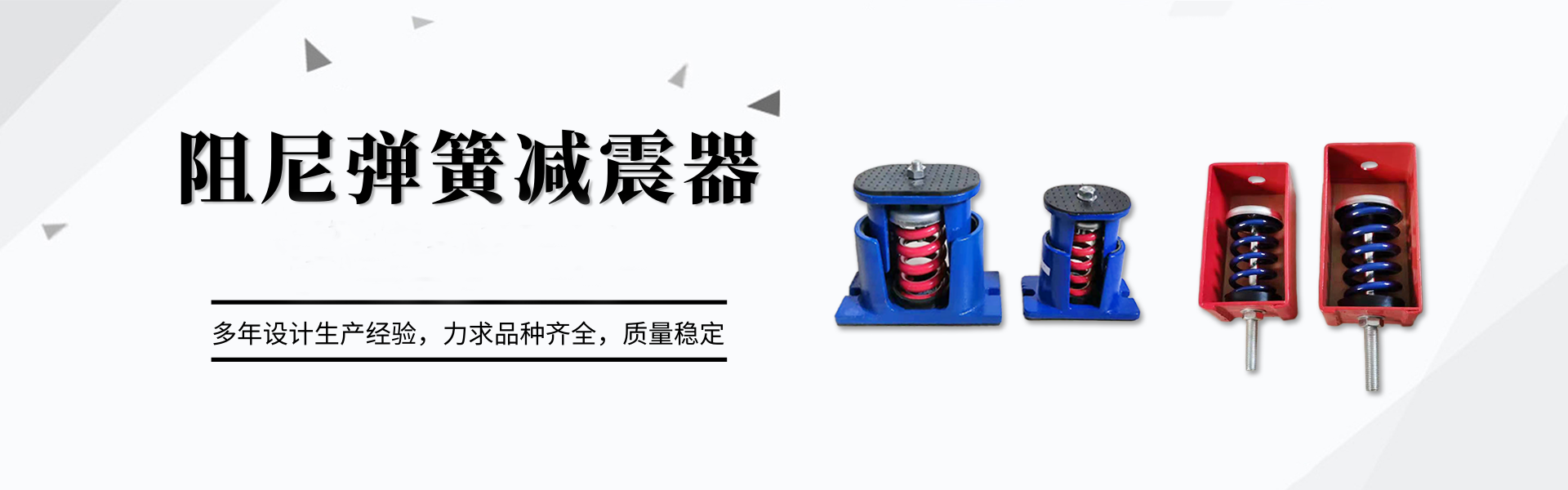



The suspended spring damper is used for equipment installation to reduce vibration. The components of the suspended spring damper assembly are composed of a damping frame and a spring combination. Below, the editor will introduce the vibration damping principle and installation precautions of the suspended spring damper.
The shock absorption principle of the suspended spring damper:
The anti-vibration principle of the hoisting spring damper absorbs the elasticity of the spring with different deflection values. It is improved according to the required number of deflection value indices. The spring's deflection elasticity can achieve excellent rebound and extension effects during equipment operation, providing excellent cushioning and shock absorption for the hoisting equipment. It stabilizes and strengthens the balance of the hoisting equipment, offering a strong protective effect.
Installation Precautions for Suspended Spring Damper:
Selecting the appropriate hoisting shock absorber, including the correct model of suspended spring shock absorber and the proper installation load, securing the indicator plate of the hoist with two positioning blocks at the corresponding position of the installation load, ensures that the spring hoist remains in a rigid state for stability.
2. Ceiling and hoisting equipment require a thorough confirmation of shock absorbers to ensure there are no uncertain risk factors present, guaranteeing the safety of the hoisting operation.
3. After the overall installation is complete, the equipment begins operation. First, check for the presence of the positioning blocks, then inspect for any jamming during the displacement process from the installation load to the working load on the indicator panel, and whether there is excessive displacement.
4. Once in normal operation, verify if the displacement of the spring bracket under working load matches the design specifications. After the equipment has stopped running, check if the indicator panel has returned to the installed load position. Testing these precautions will yield accurate installation data, ensuring stable shock absorption and safety.
Selecting a good spring damper is crucial for a procurement professional, as only the best can deliver results, and results are what meet the expected standards. In fact, to assess the quality of a spring damper, appearance-wise, one should inspect the paint, the weld joints, and the housing, with the primary focus being on the spring. The spring is the core damping component of a spring damper, and while material is important, it's often not easy for customers to discern the quality of the material. This can be understood by observing the external damping pads of the spring:
1. Whether the spring ends are tightly clamped and flattened; those that are not can affect the damper's stability; 2. If the spring is evenly wrapped and the surface is smooth; 3. Many small manufacturers' springs do not meet the load requirements, and some large manufacturers occasionally have this issue as well, so please note when purchasing, and customers with the means should conduct pressure tests on the springs; 4. The national standard requires a damper compression of 25mm, as this compression ensures the damper's natural frequency is sufficiently low, guaranteeing effective damping; 5. Some manufacturers, to save costs while meeting load requirements, may make the spring very stiff, resulting in minimal compression at the rated load.
Most shock absorbers on the market fail to meet the above standards. Customers must pay close attention to the compression amount of the springs during procurement. In fact, as the core component of the spring shock absorber, the quality of the spring significantly affects the shock absorption performance. Moreover, strict standards must be adhered to when selecting the type. Asymmetrical shock absorbers, even if considered合格, cannot meet the expected standards.

