

According to statistics, most customers pay close attention to the battery lifespan when purchasing industrial cleaning equipment, as the battery is one of the higher-value accessories in cleaning equipment. Taking a Yangzi floor cleaner as an example, it uses two 12V 100AH batteries in total, with replacement costs roughly ranging from $1,800 to $2,000. Therefore, the battery is indeed a point that deserves the focus of the users, and it's something we emphasize to customers during our daily deliveries. Good usage habits can significantly extend the battery's lifespan, whereas neglecting the battery's safe voltage and over-discharging it随意 can lead to the battery being damaged within less than a year.
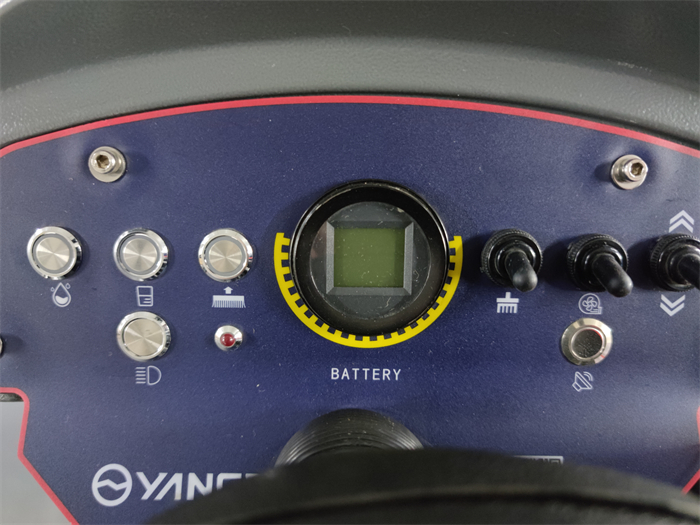
Battery-powered industrial cleaning equipment like floor washers and sweepers involves a term called "safe voltage." It is the voltage at which the equipment can be safely used. When the voltage is above the safe level, the equipment is operational. However, when the voltage is about to fall below the safe threshold, it is crucial to stop using the equipment and charge it promptly. How do you determine the safe voltage? Here's a formula for you: Rated Voltage x 0.845 = Safe Voltage. Let's take the Yangzi YZ-S5 ride-on sweeper as an example; its rated voltage is 48V. Using the formula, the calculated safe voltage is 42V. All Yangzi cleaning equipment panels feature a voltage display. If the voltage shows above 42V, the equipment can be used normally; if it's approaching 42V, it's time to recharge.
If safety voltage is ignored at this point, the battery is likely to be discharged prematurely. Frequent under-discharging of lead-acid batteries can result in a sharp decrease in capacity, even rendering the battery unusable for charging. Therefore, our users should develop the habit of checking safety voltage when using any brand of industrial cleaning equipment. With good usage habits, the normal lifespan of a floor cleaner's battery can reach 2-3 years.