


 通过中商114认证

Operation Instructions for Sterilizing Kettles: The sterilization process uses reverse-pressure sterilization, which involves introducing compressed air into the kettle to increase pressure, preventing can bulging and lid popping. The operation details are as follows: Since compressed air is a conductor of heat, and steam itself has a certain pressure. Therefore, during the heating process for sterilization, compressed air is not introduced; instead, it is only introduced into the kettle after reaching the sterilization temperature, when the kettle is being kept warm, increasing the pressure inside the kettle by 0.5 to 0.8 atmospheres. After sterilization, during the cooling process, steam supply is stopped, and water is forced into the spray pipes. As the kettle temperature drops, steam condenses, reducing the internal pressure. Compressed air pressure is then used to compensate for this.
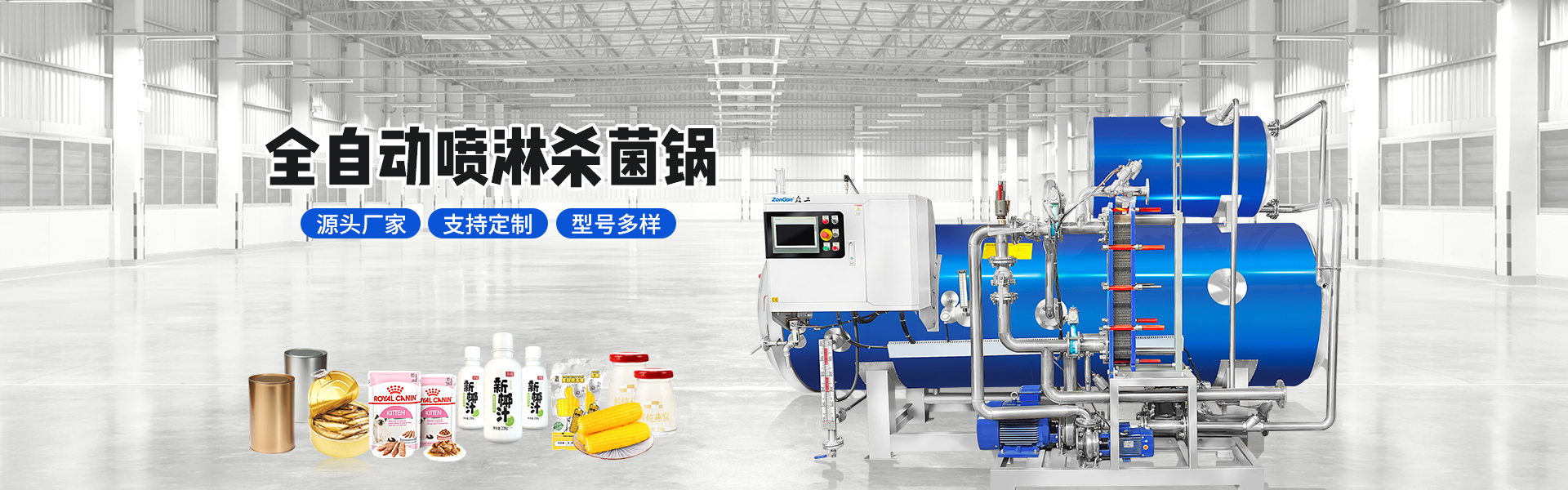
Automatic Sterilization Pot
How to Prevent Corrosion in Sterilizing Kettles:
The automatic sterilization pot is a high-pressure vessel, but due to the characteristics of actual operation and processing technology, it falls under high-pressure vessels that endure alternating loads and are often in intermittent actual operation. Therefore, it is necessary to improve safety management, establish scientific and standardized operation standards, and formulate safety work countermeasures. This is a prerequisite to prevent corrosion.
During installation, the pot body can have a slight inclination (front low to back high) to ensure proper waste water treatment.
3. Enhance management to immediately eliminate wastewater or waste from the pot, especially when discontinuing use of the pot, it's crucial to keep the pot dry.
4. To reduce oxygen levels within the pot, it is necessary to supplement the heating furnace with water and drainage equipment, and the time for feeding and discharging materials should be as short as possible.
During normal operations, to ensure the iron cones and hard particles enter the pot regularly, it is recommended to minimize collisions and friction with the furnace wall.
6. The slide track outside the pot should be properly positioned to avoid collision with the pot body. Additionally, the aspect ratio of the slide track on the external surface of the pot should match that of the internal slide track. The gap should be as small as possible to ensure the feed mechanism moves stably in and out of the pot body.
7. The exhaust pipe should be positioned properly to prevent steam from entering the insulation layer of the pot body during the exhaust process, and it should be inspected. If the insulation material is damaged, damp, or cold, it should be appropriately handled.
Automatic Sterilization Pot
