



The Evolution of Holographic Technology
Holographic projection technology has been applied in electron microscopy, serving as a research tool. In 1947, British physicist Dennis Gabor accidentally invented holographic projection while studying ways to enhance the performance of electron microscopes. The technology was swiftly patented and earned Gabor the Nobel Prize in Physics in 1971.
Since the discovery of lasers in 1960, projection technology itself has rapidly advanced. More accurate and interference-resistant projections have emerged, and holographic projection has been brought back to the agenda. However, despite this, the medium issue for holographic projection still remains unresolved. Because lasers need to reflect off a medium to present information, holographic projection requires the medium to coordinate with the three-dimensional space. As a result, either the medium is too expensive or the viewing experience is not satisfactory.
In 2001, with the advent of holographic film, humanity finally discovered a medium for holographic projection that offered relatively clear results at a low cost. This marked the beginning of a surge in the application of holographic projection. Interestingly, a technology that emerged as a scientific auxiliary tool has since drifted further away from science. It is now more commonly found in exhibitions, museums, stage performances, and fashion shows, serving as a means to deliver visual震撼 to audiences.
In 2010, the Japanese virtual idol Hatsune Miku made her debut at the "Great Thanking Festival" using holographic projection technology. Although the technology was still in its infancy at the time, Miku's image was merely a screen presence yet was brought to life in three dimensions. Nonetheless, the impact of her jumping from the second dimension to the third, dancing and singing, was a powerful hit to the neurons of anime fans. To this day, we can see the application of holographic projection in various tourist attractions, museums, ceremony openings, concerts, even airport and hotel navigation services.
Classification of Holographic Technology
Currently, holographic technology is categorized into three types: air projection and interactive technology, laser beam projection of 3D images, and 360-degree holographic display screens.
Air Projection and Interactive Technology
A 29-year-old engineering graduate named Chad Dyne in Massachusetts has invented an air projection and interactive technology, marking a milestone in display technology. It can project interactive images on walls formed by air currents. This technology is inspired by the principle of mirages, projecting images onto water vapor, which, due to uneven molecular vibrations, can create images with strong depth and stereoscopic effects.
Projecting 3D Images onto Solid Objects with Laser Beams
Japanese company Science and Technology has invented a technology that uses a laser beam to project 3D images of physical objects. This technique involves mixing nitrogen and oxygen in the air, which then becomes a fiery slurry, creating a brief 3D image in the atmosphere. The method primarily achieves this by continuously conducting small explosions in the air.
360-degree holographic display
Researchers at the University of Southern California's Institute for Innovation in Science and Technology have announced the successful development of a 360-degree holographic display. This technology projects images onto a high-speed rotating mirror to create three-dimensional visuals.
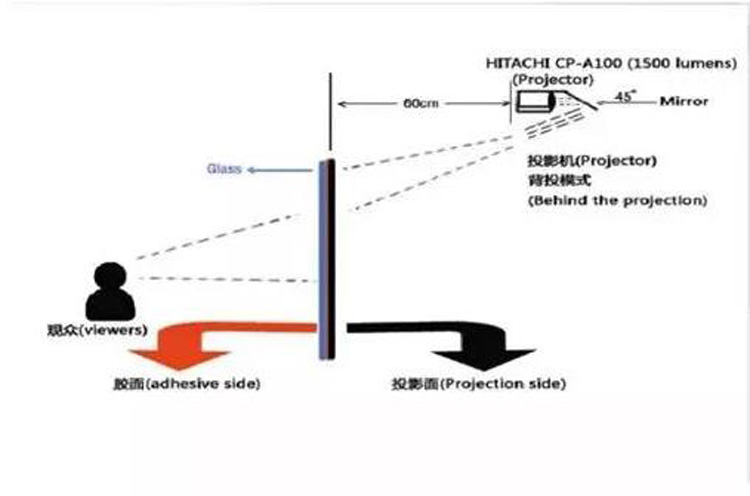
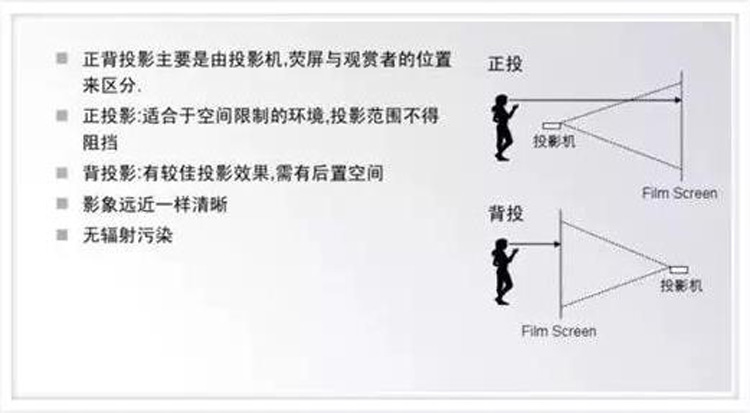
Holoscreen projection method
The Future Development Trend of Holographic Film
Holographic film, capable of providing dynamic aerial displays, offers clear imagery while allowing viewers to see the scene behind the projection. It can be integrated with interactive software to create three-dimensional interactive images, immersing the audience in an immersive experience and enabling them to manipulate space. It boasts numerous unparalleled advantages such as high definition, resistance to strong light, ultra-thinness, and anti-aging, making it one of the materials with promising future development prospects.
Certainly, here is the translation: Certainly, in the future, there will undoubtedly be more research conducted on holographic films. Considering the current trends in materials, the predicted future developments of holographic films primarily include the following two aspects:
1. Nanophotonic components at the molecular level will be the trend, with holographic color filter crystals (HCFC) as the core material, integrating nanotechnology and the achievements of multiple disciplines such as materials science, optics, and polymer science.
2. Thin and lightweight, the internal design incorporates advanced optical structures for high-definition and high-brightness imaging. The imaging effect boasts crystal-clear visuals with a minimalist and slender material that embodies deep design concepts. Suitable for electronic devices and optical films.
Holographic film technology is being researched by many countries, and it's no exaggeration to say it encompasses the future. Whichever country masters and utilizes this technology first will be among the vanguard of advanced technologies.
