


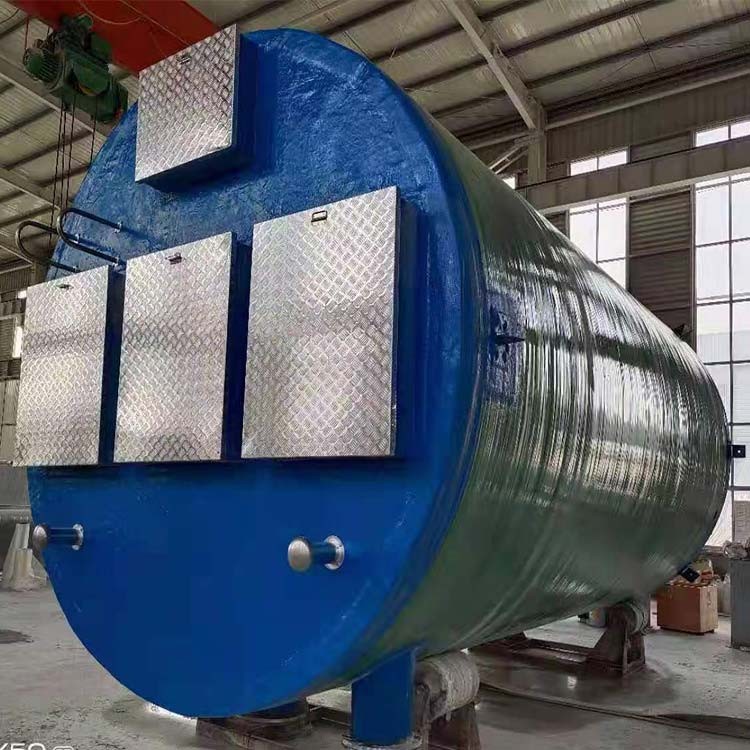















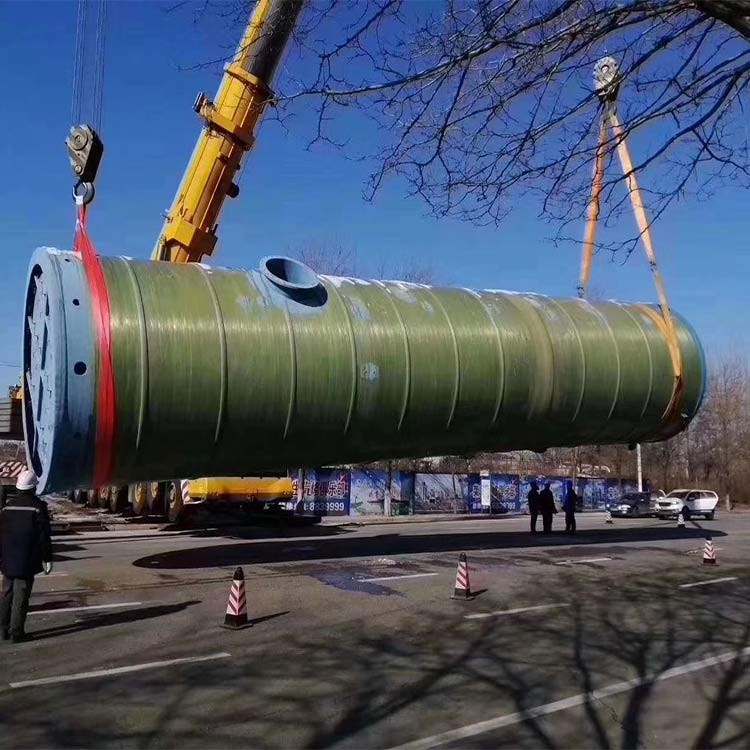

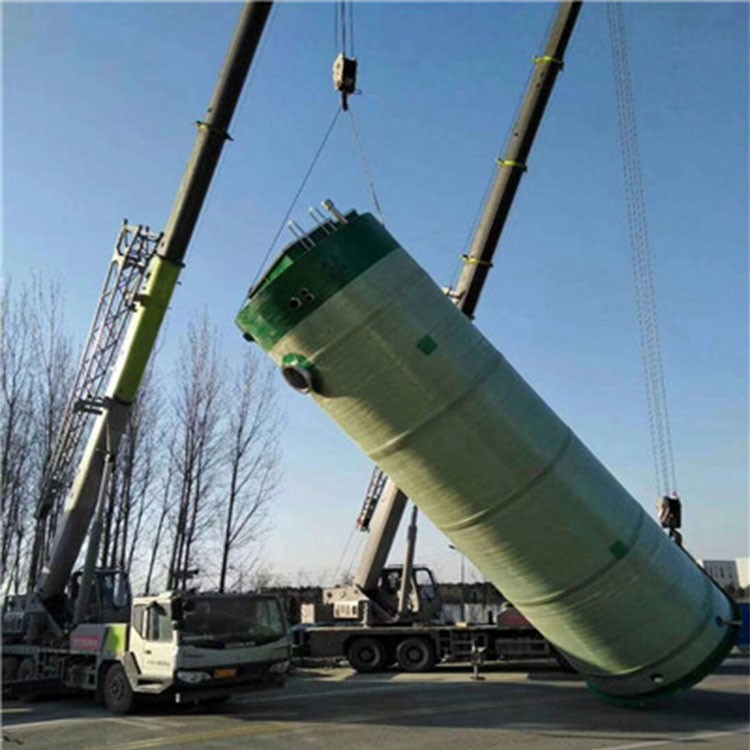
Integrated precast pumping stations are equipment for lifting sewage, rainwater, drinking water, and wastewater. They are factory-produced and assembled, then transported to the site for installation as pressure boosting stations. The top cover should consist of a glass fiber edge cover and an openable pumping station lid. The lid material can be made from glass fiber, aluminum alloy, or other lightweight materials.
2.1.2 The inner and outer surfaces of the lid should be smooth, without cracks deeper than 2mm, and there should be no delamination, exposed fibers, resin nodules, foreign matter mixed in, or uneven coloration.
2.1.3 The GRP (Glass Reinforced Plastic) cylinder material should consist of a corrosion-resistant layer, a waterproofing layer, a structural layer, and an outer protective layer (as shown in Figure 2.1.3), with the thickness of each layer as indicated. The outer protective layer is added with UV-resistant material to prevent aging when exposed to sunlight.
Figure 2.1.3 Fiberglass Cylinder
Figure 2.1.3 GRP (Glass Reinforced Plastic) Cylinder (Unit: mm)
2.1.4 The overall roof cover should have anti-slip measures. Anti-slip roof covers can be made of glass fiber.
2.1.5 The aluminum alloy material for the lid should be anti-slip patterned plate, with a tensile strength of 120MPa or more, and the plate thickness should be 5mm or more (excluding the pattern). The lid's edge should be at least 20mm.
2.1.6 Glass steel pipes made by computer-winding process with unreinforced coarse glass fiber yarn and its products as reinforcement materials and thermosetting resins as matrix, with uniform thickness. The Vickers hardness should reach 40HBa or higher, the compressive strength should reach 120MPa or higher, the circumferential tensile strength should be 150MPa, and the longitudinal tensile strength should be 60MPa.
2.1.7 The lining layer includes the sub-lining and inner surface layer, with a total thickness of not less than 2mm, where the thickness of the inner surface layer is not less than 0.3mm. The wall thickness of the pipe should not be less than the nominal thickness specified in the approved drawings and technical documents through the prescribed procedures.
2.1.8 The cylinder exterior should be equipped with at least two external lifting lugs.
2.2 Base
2.2.1 The base should be a concave, arched structure. The inner side of the base can be pre-drilled or fitted with a mixer or crushing grid as needed by the design.
2.2.2 The base should have a tensile strength of 120MPa or higher, and the Brinell hardness should be 40HBa or higher.
2.2.3 The skirt periphery of the base should have at least two grouting holes, with the diameter of the grouting holes reaching DN100 or more.
2.2.4 The base should have a concrete slab to resist buoyancy at the bottom, with the design dimensions of the concrete slab determined based on buoyancy calculations. It is advisable for multi-well pump stations and structures at the front and rear ends of the pump station to use the same base. The concrete slab should have a cement strength grade of not less than C40, the diameter of the reinforcement should be not less than 10mm, and the thickness should be not less than 250mm. The concrete slab should have anchor bolts pre-buried for the purpose of securing the prefabricated pump station after it is hoisted into the pit. The concrete slab can be prefabricated or cast directly in the foundation pit.
2.2.5 The weight of the pump station base should be ≥ 1.5 times the total weight of the pump to prevent vibration and resonance at the fixed connection points of the pump. For dry pump stations, select vibration-proof components based on the pump type.
2.3 Service Platform and Automatic Coupling System
2.3.1 It is advisable to set up a service platform within the integrated prefabricated pump station.
2.3.2 The service platform should be made of aluminum alloy or glass fiber reinforced plastic, with a load-bearing capacity of not less than 450kg.
2.3.3 The automatic coupling system must not leak during normal operation and should facilitate the hoisting of the pump.
2.4 Control Cabinet
2.4.1 The control cabinet dimensions should comply with the provisions of GB/T3047.1, "Basic Dimensions of Panels, Racks, and Cabinets with a Height Increment of 20mm."
2.4.2 The control cabinet surface should be flat and even, welds should be uniform and strong, and there should be no obvious warping, bowing, deformation, or burn-through defects.
2.4.3 Electrical and electronic components inside the control cabinet shall comply with the requirements of relevant product standards.
2.4.4 Terminal connections within the control cabinet should be secure, and wiring should comply with the design drawings and relevant standards.
2.4.5 The color of the wires and busbars used in the control cabinet should comply with the relevant standards.
2.4.6 The color of indicator lights and buttons should comply with the specifications of relevant standards.
2.4.7 The control cabinet's bottom should have mounting holes for securing to the foundation.
2.4.8 The control cabinet should have lifting rings or similar for easy hoisting.
2.4.9 The protection grade of the control cabinet should comply with the provisions of the current national standard "Shell Protection Grades" GB4208.
2.4.10 The control cabinet should be equipped with various intelligent sensors, enabling unattended operation, programmable control, and remote control.
2.4.11 The display function of the control cabinet panel shall comply with the following specifications:
1 The control cabinet panel should have a display interface.
2 The control cabinet panel should have displays for power, current, voltage, etc.
3 The control cabinet panel features a display indicating the pump's start and stop status.
4 The control cabinet should be capable of setting pressure, displaying actual pressure, and frequency.
5 The control cabinet panel has fault sound and light alarm display.
2.4.12 The electrical performance of the control cabinet shall comply with the following specifications:
The temperature rise of each component in the control cabinet should comply with the provisions of the current national standard "Electrical Control Equipment" GB/T 3797.
2 The electrical clearance and creepage distance between the live circuits of the control cabinet, between live components or grounded components, shall comply with the provisions of the current national standard "Electrical Control Equipment" GB/T3797.
3 The insulation resistance measured between live loops within the equipment and between live loops and conductive components, based on the rated voltage, shall be at least 1000Ω/V.
Dielectric strength should comply with the provisions of the current national standard for "Electrical Control Equipment," GB/T3797.
The metal cabinet of the control cabinet should have a reliable grounding protection.
2.5 Submersible Pump
2.5.1 Submersible pumps should be equipped with relevant production licenses and product certification. The average failure-free operation time of submersible pumps should not be less than 2500 hours.
2.5.2 Pumps should be securely connected to pipes.
2.6 Pipe System
2.6.1 Pipe materials shall be made of stainless steel. The material shall comply with the provisions of the current national standard "Welded Steel Tubes for Fluid Transportation" GB/T12771.
2.6.2 Pipe fittings used with pipelines are made of stainless steel.
2.6.3 Selection of pipes, pipe fittings, and valves, as well as connection methods, should comply with the Outdoor Drainage Design Code GB50014 and the Construction Quality Inspection Code for Building Water Supply, Drainage, and Heating Systems.


















