










Villas, split-level homes, and self-built houses, among large floor plans, are often chosen as retirement homes by owners. Many HVAC or renovation professionals argue that electric underfloor heating has a high power load, which is naturally very energy-consuming. Is electric underfloor heating only suitable for small homes for heating, and even less suitable for large floor plans?
Large户型residences are more suitable for electric underfloor heating than small户型residences.
Actually, this can only be attributed to a lack of understanding or misunderstanding of the electric underfloor heating system, or even... it's merely a subjective judgment based on one's own assumptions! Truly, it's like the saying goes, "It takes one mouth to spread rumors and many legs to refute them!"
For villa, duplex, mezzanine, and self-built houses with large floor areas, the heating system is actually more suitable for electric radiant heating than for small residential units.
Let's summarize and analyze, focusing on the 9 common fields of floor heating selection issues for cognitive exploration.
2. Not enough power load?
Villas, split-level, and large-area户型 feature expansive floor space, necessitating a larger electrical load and corresponding infrastructure. Most villas or large-area户型 are equipped with 380V power supply for air conditioning and household appliance electrical loads. HOCHTIEF's electric underfloor heating, however, utilizes 220V, the standard for household appliances. 380V, which is a three-phase four-wire system with three live wires and one neutral wire, means each live wire is 220V apart from the neutral wire. This means 380V is not just about higher voltage; it's effectively three 220V lines, approximately equivalent to a higher electrical load capacity for functionality.
2. The size of the house and the area heated by the underfloor heating are two different matters.
Even for villas or luxury homes over 1000㎡, at night, it's just one bed being used. With three generations of the family plus a nanny, about five rooms are sufficient. Even during the height of summer with extreme heat, it's rare to see many families running air conditioning in all rooms. This isn't just about costs; it's more about whether such extravagance is necessary.
Why run the radiant heating system at full capacity during the winter, especially in rooms that are rarely used or unused, such as when the family is not present or in the evenings after rest, when it's unnecessary and actually very seldom done?
Traditional Chinese medicine practitioner Deng Tietao emphasizes the importance of nurturing the heart and virtue in health preservation. He advocates for alternating hot and cold temperatures to promote blood circulation, enhance vitality, and alleviate fatigue. Even in the extremely cold Hulunbeier Genhe City in Inner Mongolia, China, due to the good thermal insulation properties of the building structure, the house does not need to operate at full capacity when unoccupied.
3. Often Overlooked Calibration and Post-Maintenance Issues
Water floor heating is not the same as electric floor heating. Each room in the HOCHTIEF Hochtief electric floor heating comfort heating system is independent, with no邻里 relationships or interferences. In contrast, water floor heating is interconnected, which leads to different resistance in the water system across different floors, areas, and distances, resulting in varying flow rates and heating times to reach the desired temperature, with significant discrepancies. This can only be achieved through installation and adjustment. While radiators are relatively easier, to get each room of water floor heating to be perfectly identical requires real skill. It's often left to the hope of encountering a dedicated, diligent, responsible, and crafty water floor heating installer, which is a common issue for many water floor heating users and HVAC merchants. The adjustment process usually takes a long time, with the need to adjust the next day to check the heating effect, come back the day after to adjust, and review the effect the day after that, requiring multiple adjustments. Often, it's not a one-time fix, with some even needing annual adjustments.
HVAC suppliers often add boosters, mixing centers, and coupling tanks to increase pressure and balance water pressure to lighten the workload during the warranty period and boost profits. However, this does not solve the problem and makes the radiant heating system more complex. It not only increases the installation cost of the radiant heating system but also raises the system's failure rate and maintenance costs. More importantly, these post-warranty costs are not covered by the warranty...
From the above hints, it is important to recognize that the simple is reliable, stable, and cost-effective. In life, many times, convenience is more important than saving money.
Villas, townhouses, and self-built homes may have large floor areas, but when it comes to winter heating, just like using air conditioning for summer cooling, it's generally unnecessary to turn on underfloor heating in all rooms simultaneously. This leads to unnecessary麻烦, wasted effort, and a meaningless expenditure of funds, which is truly not needed.
4. Rapidly heating radiant floor heating is equivalent to using energy-saving
In the southern regions of our country, which are not traditional heating areas, we do not require a continuous operation of the underfloor heating system during winter, nor do we need to activate it in all rooms. With electric underfloor heating, which heats up quickly, its flexibility in use translates to energy savings. For instance, if we use it for 12 hours a day, we only need to run the electric underfloor heating for 12 hours. This is not possible with a hydronic heating system, which heats up slowly and cannot be easily turned off once it's on; it's almost always running.
So, while natural gas water ground heating saves energy per unit price, it all ends up being wasted in speed due to its capabilities. Upon careful calculation, not only is there no savings, it might even be more costly. According to a report from Guiyang City, the average annual gas cost for households using gas heating in Guiyang is over 9,500 yuan. Using HOCHTIEF Hochtief electric ground heating is significantly more energy-efficient and cost-effective than natural gas water ground heating.
6. Simple and flexible installation equals safety.
Villas, duplexes, mezzanines, and self-built houses, although large in area, typically have a high number of permanent residents. Therefore, when it comes to the demand for radiant heating systems, not all rooms necessarily need to be equipped with underfloor heating. However, with dual fuel options like natural gas or air-source heat pumps, the initial cost is usually the main unit. Since the main unit has been purchased, it seems wasteful not to install full-house radiant heating, especially when considering the costs already incurred. For instance, a wall-hung boiler costing over 10,000 yuan can cover areas of 100㎡ or 200㎡. With the larger expenses already paid, it's natural to proceed with full-house heating.
Over the past century, HOCHTIEF has established the gold standard for residential and commercial space heating systems with its application and development of far-infrared heating technology for incubator warming platforms for newborns, adapting temperature to you, not the other way around.
Hoch蒂夫,let the temperature adapt to you
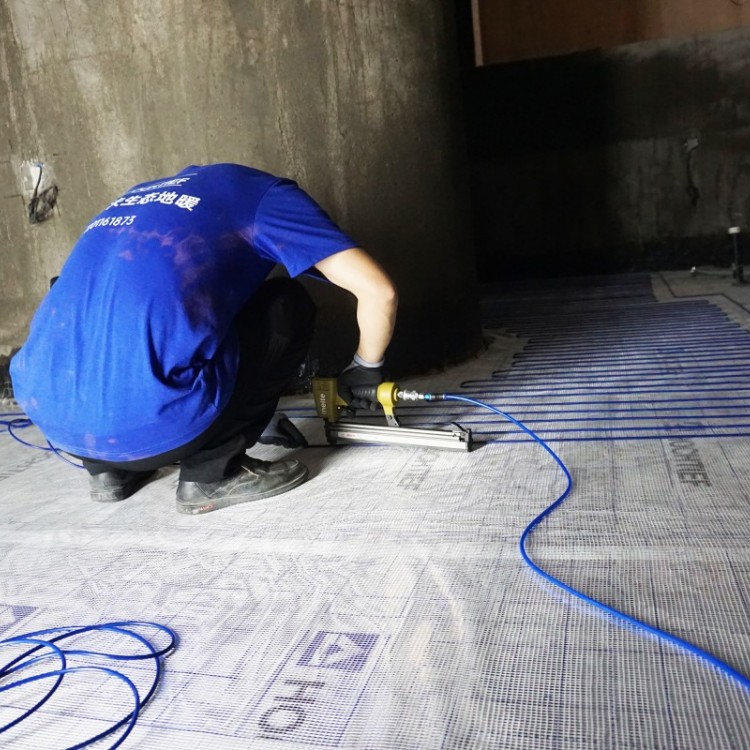
Carbon fiber electric floor heating installation details are crucial:
Before installing carbon fiber electric floor heating, the construction crew should first conduct a site inspection. Check the installation area to confirm it meets construction requirements, design the plans, and then lay according to the plans. Prior to installation, clean the installation area, lay the cement mortar heat storage layer as per design requirements, create a moisture-proof isolation layer, lay the ground decorative materials, and complete the ground construction.
Important Points for Electric Floor Heating Use:
1. After the installation of the ground heating is complete, gradually increase the temperature 24 hours later. Ensure the floor is clean and dry before heating to prevent cracking or warping due to rapid temperature rise.
2. When using the underfloor heating for the first time or after a long period of non-use, set the temperature low initially and then gradually increase it, ideally raising by about 1℃ per hour, allowing the wooden floor to acclimate to the temperature change. Rapid heating may cause the wooden floor to expand and warp, leading to cracking and reducing its lifespan.
3. Avoid fixed decorations or placing furniture without legs on geothermal heated wooden floors to prevent poor heat dissipation in localized areas, trapping heat within the wood, which can easily lead to uneven heating and warping of the floorboards.
Installation Standards for Electric Underfloor Heating
The electric underfloor heating installation process is similar to that of low-temperature water underfloor heating. After the electric underfloor heating is installed, just install a thermostat on the indoor wall. For low-temperature water underfloor heating, a boiler and a manifold are also required after the ground installation is completed.
Electric underfloor heating is also safe to use. It has been tested with 4,000-volt high-voltage, while domestic voltage is only around 220V. The heating element is double-insulated and equipped with electromagnetic wave shielding and grounding protection. In case of a potential leak, your home's main power supply will immediately shut off. The product's lifespan exceeds 50 years, and there are large-scale engineering cases of electric underfloor heating in China and around the world.
The decorative layer above the electric underfloor heating can be chosen from: tiles, marble, engineered hardwood flooring, and solid hardwood flooring (self-regulating heating cables can be used for solid hardwood flooring).
Installation of electric underfloor heating:
a. Inspect the laying area to confirm it meets construction requirements.
b. Clear the laying area.
c. Apply insulation layer (only on the bottom layer)
d. Install reflective layer
e. Laying steel mesh.
f. Lay heating cables according to design drawings.
g. Test the standard resistance and insulation resistance of the heating cable.
h. Lay the cement mortar thermal storage layer according to design requirements, act as a moisture-proof isolation layer, install floor decorative materials, and complete the ground construction.
i. Install the temperature controller.
Less is More
Comfort to life
Underfloor heating, never so simple
Haughton, let the temperature adapt to you
As a pioneering manufacturer and supplier of single electric floor heating systems, Haughtif emphasizes health and environmental protection, master craftsmanship, user-friendly design, and a simple, comfortable lifestyle.
Haugheitiv adheres to the company's values of technology, safety, responsibility, and sustainability, thereby seeking to provide innovative electric heating system solutions and services that purely enhance life, creating a simple, beautiful, worry-free, and comfortable living space for consumers.
In the past century, HOCHTIEF has set the gold standard for comfortable heating systems in residential and commercial spaces, adapting temperature to you—instead of you adapting to the temperature.
WeChat Official Account

Scan to follow Official Account