













Building sponge cities, coordinating the natural ecological functions and artificial intervention functions, effectively controlling rainwater runoff, achieving a natural accumulation, natural infiltration, and natural purification urban development mode, is conducive to restoring urban water ecology, conserving water resources, enhancing urban flood prevention capabilities, expanding effective investment in public goods, improving the quality of new urbanization, and promoting harmonious development between humans and nature.
Garage roof siphon drainage system
Adopting the principle of siphon, the original passive drainage has been changed to active drainage, effectively solving the existing problem of poor drainage, reducing costs and construction period, effectively extending building life, and the collected water can be reused.
.Roof Garden Greening Storage and Drainage System
The roof greening storage and drainage system itself has two comprehensive functions of water storage and drainage. The board has the characteristic of high spatial stiffness, and its compressive strength is significantly better than similar products (which can be tested on site). It can withstand high compressive loads of more than 400KPA, and can also withstand extreme loads caused by mechanical compaction during the process of planting roof backfill soil.
Rainwater Collection and Utilization System Characteristics of cost.
Moisture proof drainage system for basement floor
The gap interlayer formed by the concrete support point poured in the groove of the drainage plate effectively protects the waterproof quality, ensures the seepage and discharge of groundwater, and can achieve the functions of anti-seepage and moisture-proof, reducing long-term maintenance costs.
.Introduction to siphon drainage system construction:
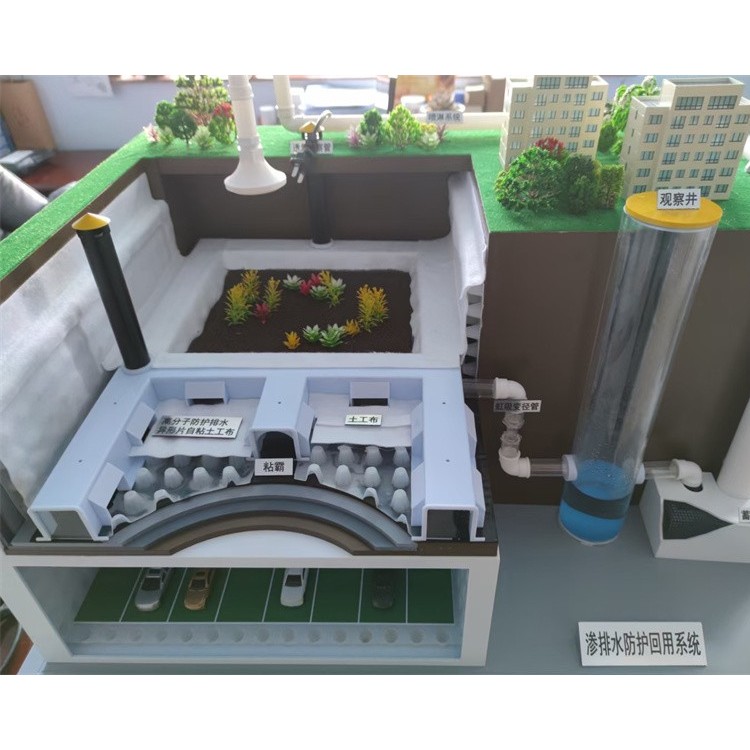
The collection method is to continuously collect soil infiltration water through a long-term composite drainage plate and flow it to the siphon drainage tank. The water in the siphon drainage tank quickly collects at the outlet, and the outlet forms a siphon by changing the diameter of the pipeline, so that the siphon straight pipe forms a full flow, and then enters the observation well and the collection well in sequence for reuse.
. The construction process involves sequentially laying adhesive tapes, siphon drainage channels, long-term composite drainage boards, variable diameter pipes, observation wells, and collection wells. The siphon drainage collection method and construction technology do not require slope finding or waterproofing treatment. The principle of siphon is used to change from passive drainage to active drainage, effectively solving the problems of incomplete drainage, leakage, and damage to vegetation in existing drainage structures. It can reduce costs and construction periods, effectively extend the life of buildings, and the collected water can be reused.Characteristics of long-lasting composite drainage board:
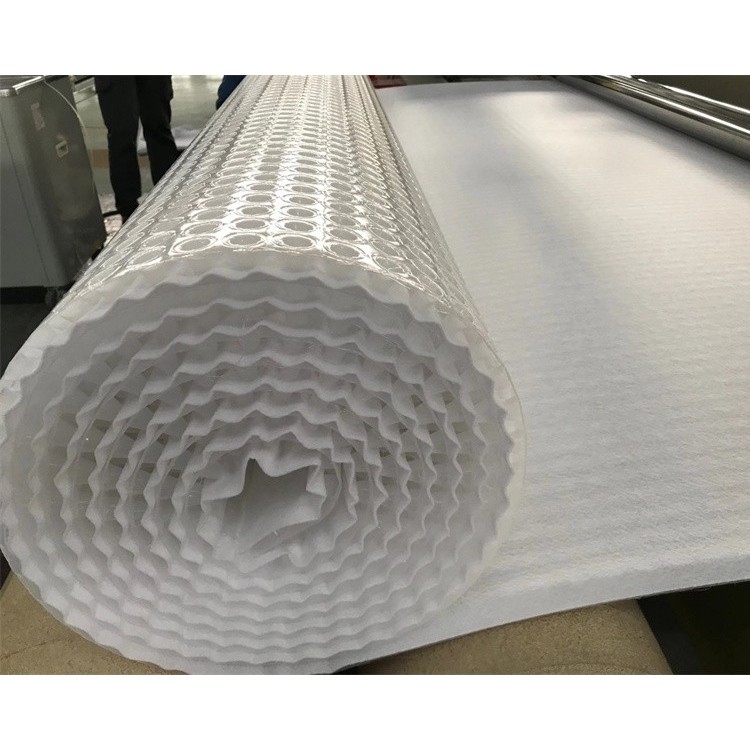
(1) It has functions such as drainage, water storage, thermal insulation, moisture resistance, and flexible protection of waterproof layer.
. (2) High compressive strength, stable chemical properties, acid and alkali resistance, and impact resistance.(3) The size of the gap between the protrusions determines different drainage capacities and air layer thicknesses, which can meet the needs of different projects.
(4) Construction safety and convenience: The production process of long-term composite drainage boards is advanced, and the spacing between plastic protrusions is accurate and uniform. The sheets can be connected by flat seam bonding, fulcrum overlap, and hot welding, ensuring the connection quality of long-term composite drainage boards.
.(5) Long service life.
The function of long-term composite drainage board
(1) In roof waterproofing, long-term composite drainage board is mainly used for drainage;
; In the integrated structure of planting roof waterproofing and drainage, the long-term composite drainage board can both drain and store water.(2) Underground engineering drainage: Use long-term composite drainage boards to drain the leakage water around the foundation, so as to prevent erosion of the bottom plate; The use of long-term composite drainage on the upstream surface of the basement exterior wall can discharge groundwater and prevent erosion of the basement exterior wall by groundwater.
(3) Municipal road drainage: timely discharge of infiltrated water, blocking the capillary phenomenon in the road base; In the construction of new roads, a layer of long-term composite drainage board is installed on the subgrade base, which can reduce subgrade materials, simplify construction, shorten the construction period, and avoid the occurrence of slurry and cracking on black road surfaces.
Basement Bottom Moisture proof Drainage System: Product Introduction
Based on the different water sources of the underground engineering top plate, wall plate, and bottom plate, the Luban drainage board adopts a combination of structural waterproofing measures to discharge leakage water, effectively improving the waterproof quality of the underground engineering. This plan adopts a stable structure to block water, and then uses the Luban drainage board to discharge trace leakage water, which can achieve the quality goals of seepage prevention and moisture prevention and reduce long-term maintenance costs.
. The gap interlayer formed by the concrete support point poured by Luban drainage has the same surface durability as the structure.Construction of garage floor drainage board
a. The construction base surface should be solid, flat, smooth, and free from looseness, sanding, warping, pointed protrusions, potholes, hollowing, and other phenomena.
.b、 Plastic drainage boards are overlapped and fully laid on a flat structural bottom plate, and there is no need to slope the surface of the structural bottom plate.
c、 The Luban drainage board is laid using the overlapping method, with the edges and supporting points overlapping 1-2 nodes with each other.
d、 Fill the support gap of the Luban drainage board with C20 fine aggregate concrete, with a height of 2-3cm. After the concrete strength reaches 70% or more, tie the steel bars, pour concrete with a thickness of 20 and 100, set up compartment joints, and set up drainage ditches and collection wells in the bottom plate.