
















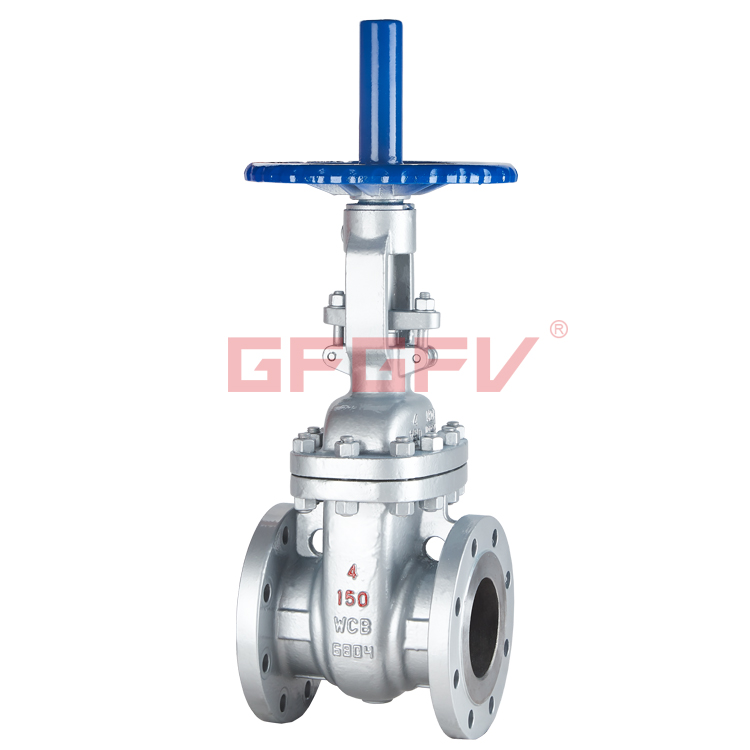
American Standard Gate Valve is a basic component used for controlling fluid flow, classified as an actuator, and is not limited to hydraulic and pneumatic systems. Its main feature is that the gate movement direction is perpendicular to the fluid flow direction, allowing only full open or full close operations, and is not suitable for regulating or throttling.
Working Principle and Structural Features
The American standard sluice valve controls the opening and closing of the gate plate through the up and down movement of the valve stem. When the valve stem moves upwards, the gate plate rises, allowing fluid to pass through; when it moves downwards, the gate plate closes, blocking fluid flow. During the closing process, by rotating the handwheel, the valve stem descends and rotates the gate plate and valve seat by 90 degrees, tightly pressing the gate plate against the valve seat for a complete seal.
Application Scenarios and Advantages/Disadvantages
The American standard gate valve is suitable for conditions that do not require frequent opening and closing, especially when the medium needs to be fully open to reduce pressure loss. It is not suitable for use with high-velocity flowing media, as partial opening may cause vibration or erosion. Its advantages include low fluid resistance, simple structure, compact size, light weight, easy operation, and convenient maintenance. Additionally, the American standard gate valve does not cause erosion of the valve sealing surface when the medium passes through in full open or full closed positions, making it widely applicable, from high vacuum to high pressure.