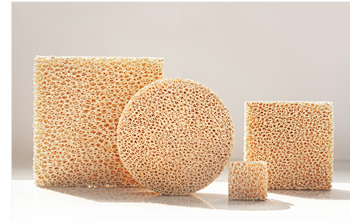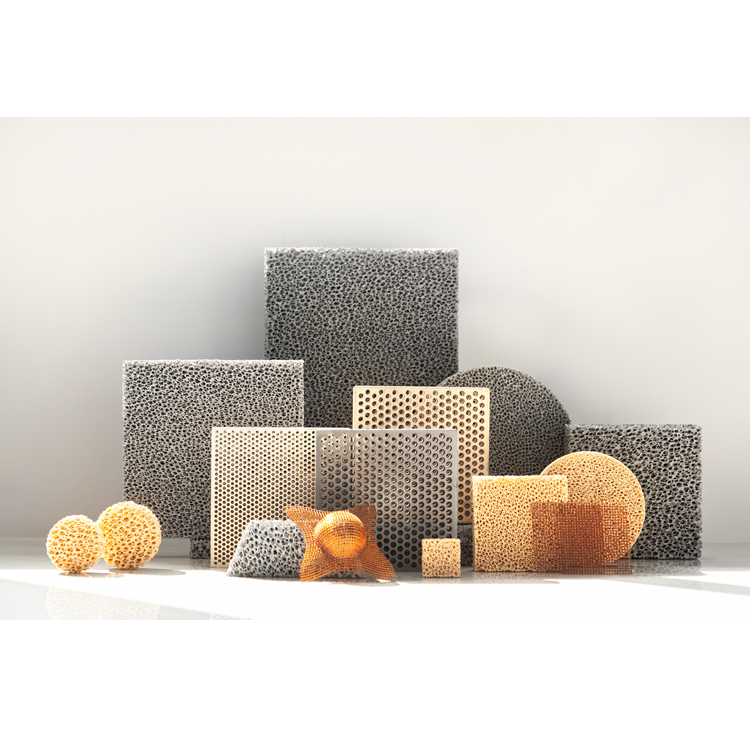













The main working principle of the foamed ceramic filter sheet is to allow turbulent and churning metal liquids to become smooth, uniform, and clean after passing through the foamed ceramic honeycomb pores. The unique honeycomb structure can adsorb some small particle impurities in the steel (iron) melt, such as non-metallic particles, slag, refractory material fragments, etc., onto the filter sheet. Furthermore, the smooth metal layer flow improves the model filling, on one hand expelling excess gas, and on the other hand reducing erosion on the model, thereby lowering the product scrap rate. Consequently, it enhances the microstructure and mechanical properties of castings, produces high-quality precision castings to meet strict standards, reduces the rate of defective castings, and minimizes tool wear during machining, significantly increasing economic and social benefits.
Specific functions and characteristics are as follows::
1The honeycomb structure can absorb particles and filter out inclusions in castings, release bubbles contained in the metal liquid, effectively reduce internal and external gas pores in castings, minimize surface defects, and lower the turbulence during casting, significantly improving the yield of finished castings. This is clearly superior to high-silicon oxygen yarn mesh filters and straight-hole filters. The former is for sieving and adsorbing fine inclusions, while the latter two only offer sieving.
2Stabilize the molten metal from turbulent flow to a stable, balanced flow, achieving a stable and purified metal liquid. Not only does it ensure uniformity in the molten metal, but it also enhances the compressive and sealing properties of castings, as well as improves their elongation.(Enhance25%Left and right)The tensile strength and surface smoothness have also been relatively improved.
3Streamline casting system design requirements, reduce the length of the runner, and enhance the yield of castings.
4The castings are internally clean, which reduces the time for mechanical processing and tool wear, significantly improving production efficiency.
Usage Recommendations:
1Maintain control over the alloy melting point to use filter sheets. Avoid excessive temperature to prevent damage to the filter sheet's function.
2Select the appropriate aperture, ensuring the purification effect matches the casting requirements.
3Casting temperatures should be as close to the process limit as possible to enhance metal fluidity.
4When the filter sheet is horizontally placed under the junction cup or on the mold surface, the casting height should not exceed20Centimeters, the metal liquid is poured against the cup wall, not directly onto the filter plate, to prevent damage to the filter.
5Handle the filter sheet with care, avoiding any rough handling. When not in use, store it in a dry and well-ventilated area. Before use, blow it with air to ensure no fragments are present in the filter sheet.
Here are silicon carbide foam ceramic filter sheets, mainly used for cast iron and non-ferrous metals.
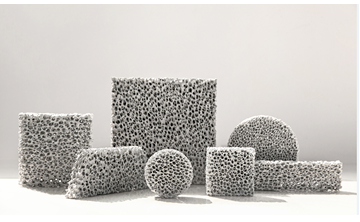
Here are zirconia foam ceramic filter sheets, mainly used for casting steel.