























Cautionary Notes
1. Cylinders must be stored in well-ventilated areas and kept at least 1.5 meters away from any sources of fire or heat. Cylinders are strictly prohibited from being heated with fire, boiled in water, or left in direct sunlight. Regular checks should be conducted on the gas tightness of cylinder valves and pipe joints to ensure no leakage. Leaks can be detected using soap and water, but absolutely not with an open flame.
2. When lighting, ignite the igniter first, followed by opening the gas, never reverse the sequence. Always have someone supervising during use, do not leave unattended to prevent boiling water from overflowing and extinguishing the flame, which could cause a surge of liquefied gas and lead to an explosion. After using the gas cylinder, make sure to close the valve tightly to prevent any gas leaks.
3. The liquefied gas in the cylinder should not be completely exhausted; a certain residual pressure must be maintained. The residual pressure should generally be greater than 49.03 kPa (i.e., 0.5 kg/cm², gauge pressure) to prevent air from entering the cylinder. After the liquefied petroleum gas is used up, the remaining residue in the cylinder is also a flammable material and should not be poured out arbitrarily to prevent fires caused by the flow and evaporation of the residue.
4. LPG cylinders are pressurized containers that require proper maintenance and regular inspections. Prevent the cylinders from falling or being struck during handling and use. Do not use metal tools to敲击 open the valve, and protect them from direct sunlight and prolonged exposure to rain. Cylinders should be inspected every 2 years.
5. Although the explosion range of liquefied petroleum gas (LPG) is not very wide, its lower limit is small, making it easy to ignite and explode upon leakage. Additionally, since LPG is heavier than air, it tends to flow downward in the air, accumulating in low-lying areas and posing a hidden danger of gas explosions. Therefore, areas where gas is prone to leak cannot rely solely on window ventilation; attention must also be given to proper ventilation at the lower levels.
6. When液化 gas leaks are detected indoors, windows and doors should be opened immediately for ventilation, allowing the gas to disperse away from any open flame. Fire is strictly prohibited in the vicinity. Use can resume only after the fault is rectified and the distinctive odor has dissipated. Dispose of any liquid泄漏 on the ground by covering it with sand and soil before removing it to a safe location. In the event of a gas cylinder fire, shut off the valve immediately, move it to an open area outside, and extinguish the fire using dry powder extinguisher, CO2 extinguisher, or by covering with a wet sack.
7. Educate children not to tamper with gas cylinders carelessly, and users must be aware of the safety knowledge regarding the use of gas cylinders.

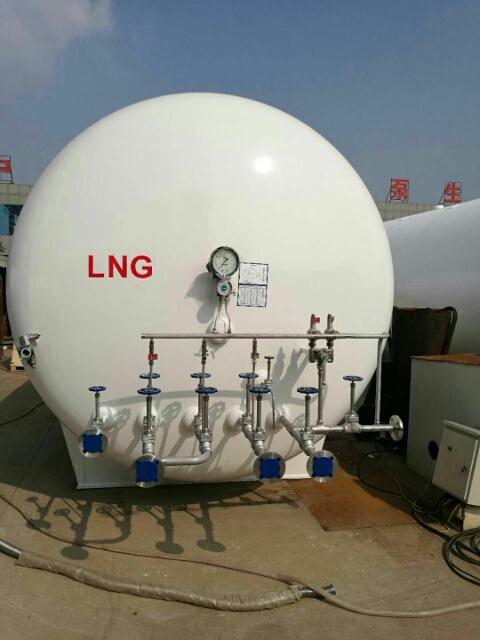
1、Natural Gas Storage TankLNG Storage System: The LNG storage system consists of low-temperature storage tanks, auxiliary pipelines, and control instruments. 2. Categorized by capacity: Small-sizedNatural Gas Storage Tank5-50 cubic meters, commonly used in civil gas liquefaction stations, LNG vehicle refueling stations, etc.; medium-sizedNatural Gas Storage Tank50-100 cubic meters, commonly used in satellite liquefaction units, industrial gas vaporization stations, etc. 3Natural Gas Storage TankLNG pipelines typically employ austenitic stainless steel tubes, which boast excellent low-temperature properties. 4. VerticalNatural Gas Storage TankLNG Storage Tanks, insulated with vacuum powder insulation technology. Inner cylinder and pipeline materials are made of OCr18Ni Austenitic stainless steel, while the outer cylinder is made of high-quality carbon steel Q345R pressure vessel steel plate. We offer various sizes from 50 to 100 cubic meters.Natural Gas Storage Tank。5、Natural Gas Storage TankApplications: Chemical fuel, residential fuel, automotive fuel, cogeneration, heat pumps, fuel cells, etc. 6,Natural Gas Storage TankLiquefaction Process: Cascade liquefaction process, mixed refrigerant liquefaction process, liquefaction process with an expander. 7,Natural Gas Storage TankThe liquefaction unit consists of a natural gas pretreatment process, liquefaction process, storage system, control system, and fire protection system.






















