


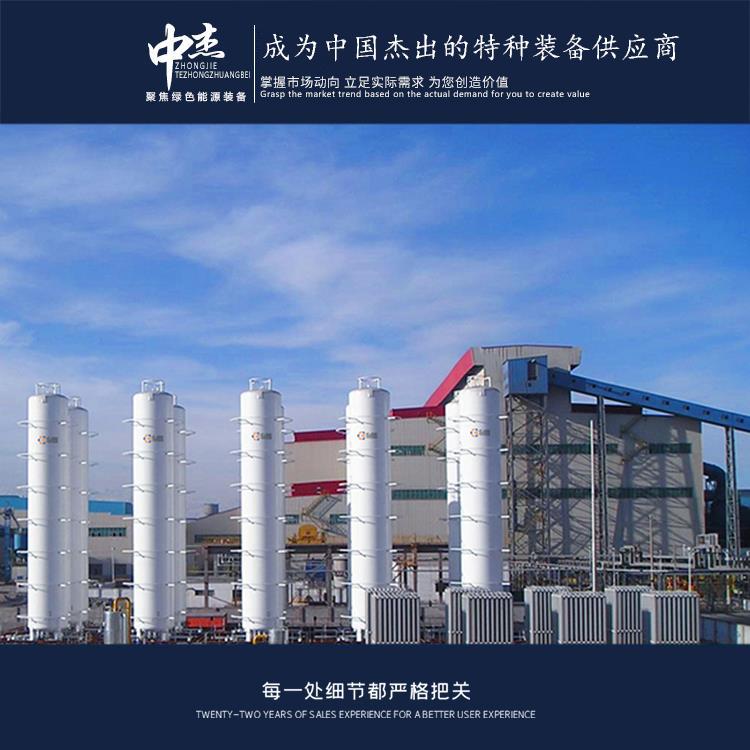

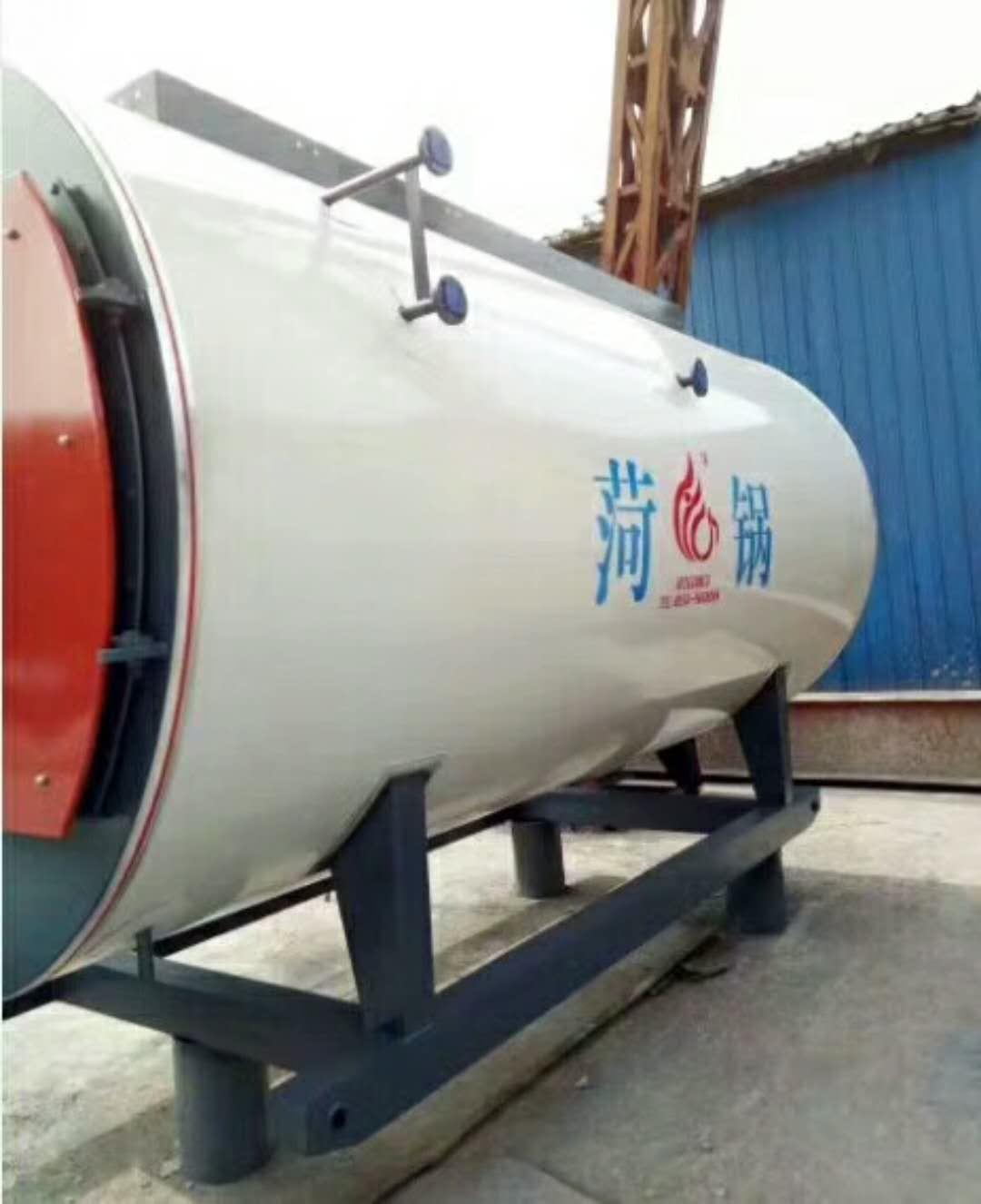



















Shandong Zhongjie Special Equipment's main products include: fuel (gas) boilers, organic heat carrier boilers, biomass boilers, waste heat boilers, and other boiler products; vacuum insulation deep-freeze pressure vessels such as LNG storage tanks, oxygen/nitrogen/argon storage tanks, and CO2 storage tanks; pressure vessel products such as denitrification engineering equipment, heat storage and energy storage equipment, and complete chemical equipment; central air conditioning and HVAC equipment such as ground (water) source heat pumps, air source units, water-cooled screw units, and air-cooled modular units. Planned products include large-scale energy centers, LNG transport vehicles, LNG tank containers, and other green energy equipment.
To prevent hazards caused by static electricity in liquid oxygen storage tanks, the following measures can be taken:
Ensure proper grounding of the liquid oxygen storage tank and associated equipment. Grounding helps dissipate static electricity to the ground, reducing the likelihood of static buildup. Metal components such as tanks and pipelines should be connected to a reliable grounding system.
Static dissipative materials: Utilize static dissipative materials to reduce the accumulation of static electricity. For instance, apply conductive coatings or conductive materials to the insulation layer of liquid oxygen tanks and pipelines to discharge static electricity to the ground.
Static Dissipative Equipment: Utilize static dissipative equipment, such as static conductive pipes and hoses, to minimize the accumulation and release of static electricity. These devices aid in grounding static electricity, reducing the occurrence of static sparks.
Static grounding wire: Install static grounding wires on liquid oxygen storage tanks and related equipment to discharge static electricity to the ground. These grounding wires should be connected to a reliable grounding system and be inspected and maintained regularly.
Electrostatic Discharger: Utilize an electrostatic discharger to neutralize static electricity. These devices release opposite charges to balance static, thereby reducing static buildup and sparking.
Electrostatic Safety Training: Provide electrostatic safety training for personnel using liquid oxygen tanks to enhance their understanding and awareness of electrostatic hazards. Training content can include the principles of electrostatic formation, preventive measures, and emergency response procedures.
It is important to note that the static control measures for liquid oxygen tanks should be designed and implemented by personnel, following relevant safety operation procedures and standards. During operation, strict adherence to the prescribed operational procedures is required to avoid the generation of static sparks, ensuring the safety of the tank.
Carbon dioxide tanks and liquid oxygen tanks are containers used for storing different gases; they have some distinct physical properties:
Physical State: Carbon dioxide is a gas at room temperature and pressure, and it must be cooled and compressed to become a liquid. Liquid oxygen is a liquid at room temperature, and it must be cooled further to solidify.
Boiling and freezing points: The boiling point of carbon dioxide is -78.5 degrees Celsius, with a freezing point of -56.6 degrees Celsius. The boiling point of liquid oxygen is -183 degrees Celsius, and its freezing point is -218.8 degrees Celsius. Both the boiling and freezing points of liquid oxygen are significantly lower than those of carbon dioxide.
Density: Liquid oxygen has a higher density, approximately 1.14 grams per cubic centimeter. Carbon dioxide has a lower density, around 0.00198 grams per cubic centimeter. The density of liquid oxygen is about 570 times that of carbon dioxide.
Pressure: Liquid oxygen has a high pressure, typically ranging from tens to hundreds of MPa (megapascals). Carbon dioxide has a lower pressure, usually within a few MPa (megapascals).
Safety: Liquid oxygen has a high oxygen content and is prone to cause fires and explosions. Carbon dioxide also poses asphyxiation and suffocation risks at certain concentrations.
Note that carbon dioxide and liquid oxygen are highly flammable and explosive substances. Strict adherence to relevant safety operation procedures and standards, as well as necessary safety measures, is required during storage and use to ensure the tank's safety and stability.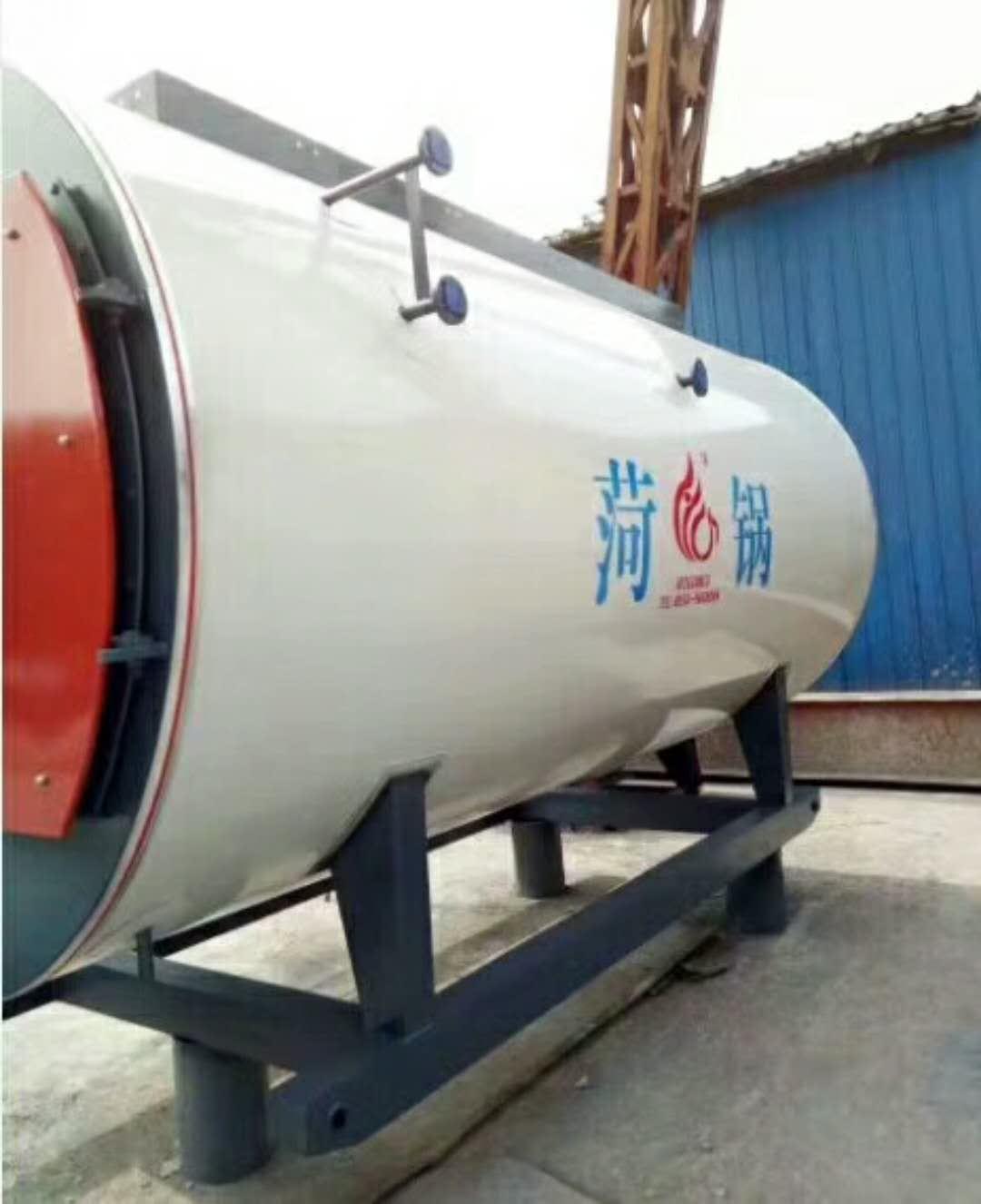
Liquid nitrogen storage tanks are widely used in meat freezing. Here are several main applications of liquid nitrogen storage tanks in meat freezing:
Quick Freezing: Liquid nitrogen tanks can provide low temperatures to rapidly freeze meat to the desired temperature. Due to the low-temperature properties of liquid nitrogen, meat temperatures can be quickly reduced in a short period, effectively preserving the quality and texture of the meat.
Cryogenic Storage: Liquid nitrogen tanks are suitable for long-term freezing storage of meat products. Placing meat in a liquid nitrogen tank can maintain it at low temperatures, preventing the growth of bacteria and microorganisms, thereby extending the shelf life of the meat.
Chilled Transportation: Liquid nitrogen tanks are suitable for the frozen transportation of meat products. Placing meat in the liquid nitrogen tank maintains its低温 condition, ensuring the quality and freshness of the meat throughout transportation.
Chilled Processing: Liquid nitrogen tanks can be used for meat chilling. By exposing meat to liquid nitrogen, the surface can be quickly frozen, forming a frozen layer, thereby preserving the meat's moisture and nutritional content.
Chilled Processing: Liquid nitrogen tanks are used for the freezing of meat products. Placing meat in liquid nitrogen makes it harder and more brittle, which is ideal for cutting, slicing, and processing.
Be mindful that when using liquid nitrogen tanks for meat freezing, it is essential to adhere to the relevant safety operating procedures and guidelines. Ensure that operators are equipped with the necessary safety awareness and operational skills to prevent accidental incidents. Additionally, consult with food safety experts.
The low-temperature storage tank boasts several advantages:
Storage: Low-temperature storage tanks can store liquid cryogenic substances (such as liquid nitrogen, liquid oxygen, etc.) at low temperatures, maintaining their liquid state. Compared to gas storage, liquid storage significantly increases storage density and saves space.
Long-Term Storage: Low-temperature storage tanks are designed for long-term storage of low-temperature materials, extending their service life. By controlling the temperature inside the tank and the performance of the insulation layer, the evaporation and oxidation of the liquid material can be slowed down, maintaining its stability and purity.
Safety: The low-temperature storage tank boasts excellent safety features. Constructed with special materials and structural design, it can withstand low temperatures and high-pressure environments. Additionally, the tank is equipped with safety devices such as pressure relief valves and liquid level alarms to ensure safe operation and usage.
Broad Applications: Low-temperature storage tanks are widely used in various fields. They can be used for storing liquid oxygen and providing oxygen supply; in industrial applications, they are suitable for storing liquefied natural gas (LNG) and other process gases like liquid nitrogen; in scientific research, they are ideal for storing low-temperature experimental samples.
Environmental Protection and Energy Saving: Low-temperature storage tanks enable effective storage and utilization of low-temperature materials, reducing energy waste and environmental pollution. During the storage and transportation of liquid substances, energy loss is minimized, enhancing energy utilization efficiency.
In summary, low-temperature storage tanks offer advantages such as storage, long-term storage, safety, multi-field applications, and environmental protection and energy conservation. This makes them crucial equipment for storing and supplying low-temperature materials, playing a significant role in various industries.
Zhongjie Special Equipment upholds the grand vision of "realizing employees' dreams, creating customer value, and striving for the prosperity and strength of our motherland," wholeheartedly committed to the development of green energy equipment. We dedicate high-value products and services to society!
WeChat Official Account

Scan to follow Official Account




















