


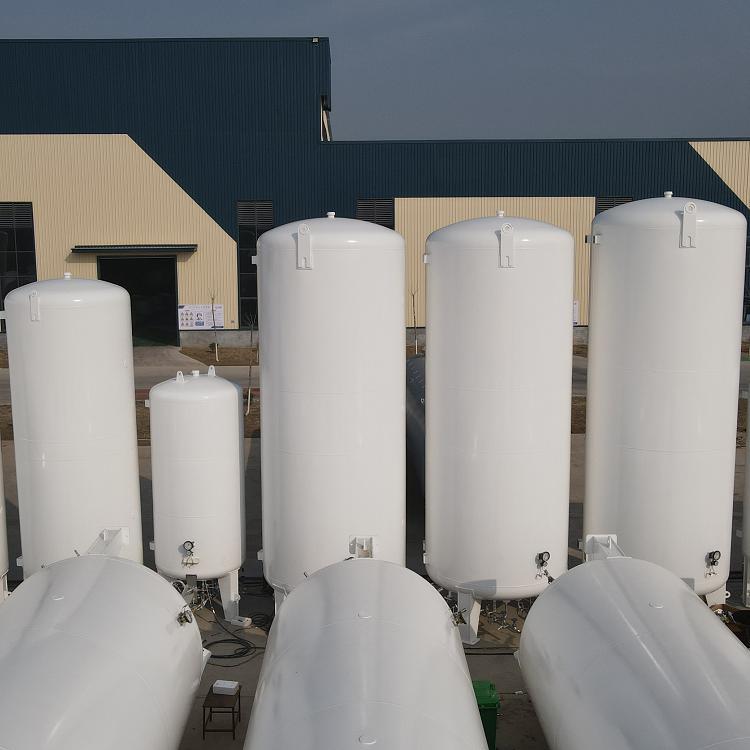



















Shandong Zhongjie Special Equipment (formerly Heze Boiler Factory Co., Ltd.) holds an A-grade boiler manufacturing license, A2-grade pressure vessel manufacturing license, A2-grade pressure vessel design license, B-grade boiler installation, and GB2/Class, GC2/Class pressure pipeline installation licenses, as well as an equipment and machinery installation contracting qualification. It is a member of the China Boiler and Water Treatment Association, the China Chemical Equipment Association, and a council member of the Shandong Equipment Manufacturing Association. The company has also passed the ISO9001 Quality Management System, ISO14001 Environmental Management System, OHSAS18001 Occupational Health and Safety Management System certifications, and the American ASME/U2 certification.
Liquid Argon Storage Tank is a specialized equipment designed for storing liquid argon, featuring the following parameters, functions, and characteristics:
Parameters:
Tank Capacity: The capacity of liquid argon tanks can be customized to meet requirements, typically available in various sizes such as 500L, 1000L, 2000L, and so on.
Operating Pressure: The operating pressure of liquid argon tanks is typically atmospheric or slightly above atmospheric pressure.
Storage Temperature: The storage temperature for liquid argon tanks is typically -196 degrees Celsius, which is the boiling point of argon, maintaining its liquid state.
Feature:
Liquid Argon Storage: Liquid argon tanks are primarily used for storing liquid argon, maintaining its liquid state at low temperatures for supply and usage.
Insulation: The liquid argon storage tank utilizes high-efficiency insulation materials and structural design to minimize heat conduction and retention, maintaining the low-temperature state of liquid argon.
Safety Control: The liquid argon storage tank is equipped with safety devices such as pressure relief valves and level alarms to ensure safe operation and use.
Features:
High Purity Supply: Liquid argon tanks offer high purity liquid argon supply to meet the requirements of applications such as cryogenic storage, gas shielded welding, and semiconductor manufacturing.
Long-term Storage: Liquid argon cylinders are designed for long-term storage of liquid argon, extending their service life. By controlling the temperature inside the cylinder and the performance of the insulation layer, the evaporation and oxidation of the liquid argon are slowed down.
Multi-Domain Applications: Liquid Argon Storage Tanks are widely used in various fields such as industry and scientific research, including cryogenics and semiconductor manufacturing.
Eco-friendly Energy Conservation: Liquid argon storage tanks enable efficient storage and utilization of liquid argon, reducing energy waste and environmental pollution.
In summary, liquid argon storage tanks are designed for storing liquid argon, thermal insulation, and safety.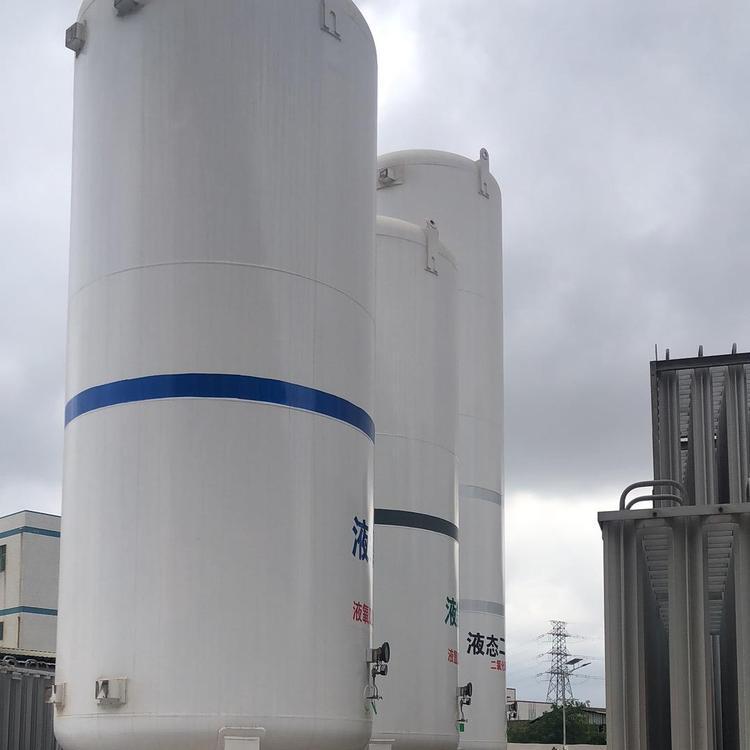
The cooling process and precautions for liquid argon cylinders are as follows:
Cooling Process Analysis:
Clean the tank: Prior to cooling the liquid argon tank, ensure the interior is clean and free of impurities and contaminants. Use an appropriate cleaning agent for washing and rinse thoroughly.
Drainage and Exhaust: To empty the gas inside the tank and expel it through the exhaust system to reduce the gas content within the tank.
Add Liquid Nitrogen: Inject liquid nitrogen into the tank, which will rapidly cool the air and walls inside the tank due to its low temperature, thereby reducing the tank's temperature.
Wait for cooling: Liquid nitrogen will gradually lower the temperature inside the tank through the heat conduction until it reaches the required low temperature.
Cautionary Notes:
Safety Protection: During the cooling process of liquid argon cylinders, necessary safety precautions must be taken. Liquid argon has low temperatures and high flammability, so operators should wear protective suits, gloves, and other personal protective equipment to ensure safe operation.
Fire Prevention Measures: Liquid argon is highly flammable; therefore, during the cooling process of the liquid argon tank, it is essential to ensure there are no ignition sources in the surrounding environment and to have appropriate fire extinguishing equipment on hand.
Temperature Control: During the cooling process of the liquid argon cylinder, it is necessary to control the temperature of the cylinder to prevent overcooling or insufficient cooling. Temperature sensors and temperature control systems can be used to monitor and control the cylinder's temperature.
Insulation and Heat Retention: Liquid argon tanks are typically designed with double or multi-layer structures, filled with insulating material in the middle to minimize heat transfer and evaporation of liquid argon. Ensure the integrity and good insulation of the insulating layer.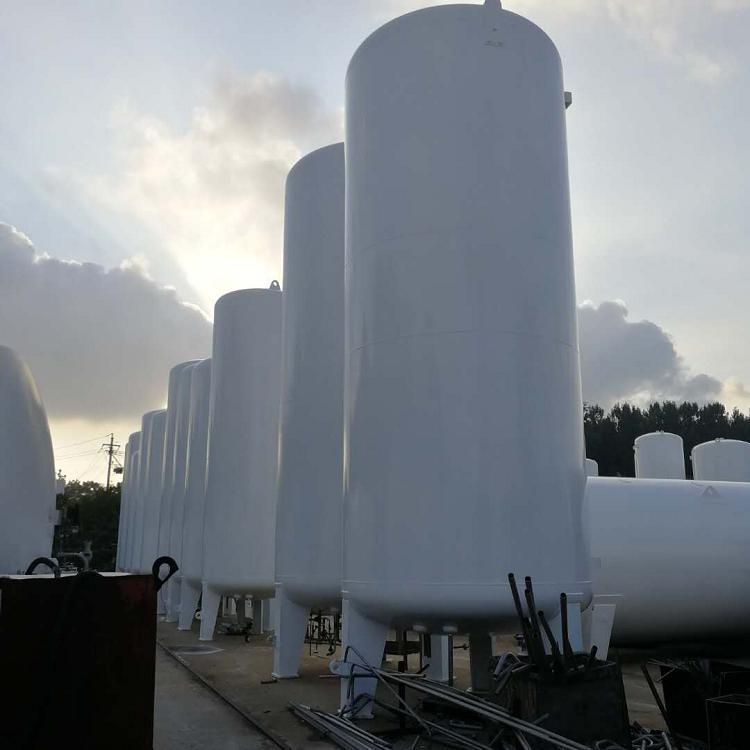
The manufacturing process for the heads and cylinders of low-temperature storage tanks typically includes the following steps:
Material Preparation: Select suitable materials, such as low-temperature alloy steel or stainless steel, based on design requirements and specifications. Inspect and verify the materials to ensure their quality meets the standards.
Sheet Cutting: Cut sheets according to design dimensions and shapes. Common cutting methods include flame cutting, plasma cutting, or laser cutting, etc.
Bending and Shaping: Cut sheets are bent and shaped to form heads and cylinders. Common shaping methods include cold bending, hot bending, or hydraulic forming, etc.
Welding: The formed sheets are welded together to form the structure of the head and cylinder. Common welding methods include manual arc welding, gas shielded welding, or laser welding, etc.
Weld Seam Treatment: Post-weld treatment of the seams, including processes such as sanding, polishing, or applying anti-corrosion coatings, to enhance the quality and appearance of the weld seams.
Inspection and Acceptance: Conduct inspections and acceptances on the finished caps and cylinders to ensure their quality and compliance with design requirements. Common inspection methods include ultrasonic testing, radiographic testing, or liquid penetrant testing, etc.
Strengthening and Support: As required, processing and installation of reinforcing and supporting structures on the heads and cylinders to enhance the structural strength and stability.
Surface Treatment: The heads and cylinders undergo surface treatment, such as applying corrosion-resistant coatings, hot-dipped galvanizing, or polishing, to enhance their corrosion resistance and appearance quality.
It's important to note that the manufacturing process for low-temperature storage tanks must comply with relevant standards and regulations to ensure the quality and safety of production. During the manufacturing process, strict adherence to safety operating procedures and the implementation of necessary protective measures are required to ensure the safety of the operators.
Several factors must be considered when determining the design pressure and calculated pressure of a liquid oxygen storage tank:
Design Pressure: Design pressure refers to the maximum pressure a tank can withstand under normal operating conditions. When determining the design pressure, factors such as the working pressure range of liquid oxygen, the material strength of the tank, and the safety factor need to be considered. Generally, the design pressure should be slightly higher than the high working pressure of liquid oxygen to ensure the tank is safe and reliable within the normal operating range.
Calculation Pressure: The calculation pressure refers to the actual working pressure of the tank under the design pressure. The calculation pressure is derived based on factors such as the properties of liquid oxygen, the geometric shape of the tank, and the material strength. The calculation pressure should consider factors like the expansion coefficient of liquid oxygen, temperature changes, and pressure fluctuations to ensure the safety and stability of the tank under actual operating conditions.
Determining the design pressure and calculated pressure of liquid oxygen storage tanks typically requires referencing relevant standards and specifications, such as Standard GB150 for Steel Pressure Vessels and GB18442 for Technical Conditions of Liquid Oxygen, Liquid Nitrogen, and Liquid Argon Storage Tanks. These standards and specifications provide detailed design and calculation methods to ensure the safety and reliability of the tanks.
In practical applications, the design pressure and calculated pressure of liquid oxygen tanks should be calculated and determined by pressure vessel designers. They will take into account specific engineering requirements, tank dimensions, materials, and other factors to ensure that the tank's design and use comply with relevant safety standards and regulations.
ZJ Special Equipment adheres to the great vision of "Realizing employee dreams, creating customer value, and striving for the prosperity and strength of our motherland," and is dedicated to the development of green energy equipment. We commit to society with high-quality, cost-effective products and services!
WeChat Official Account

Scan to follow Official Account




















