


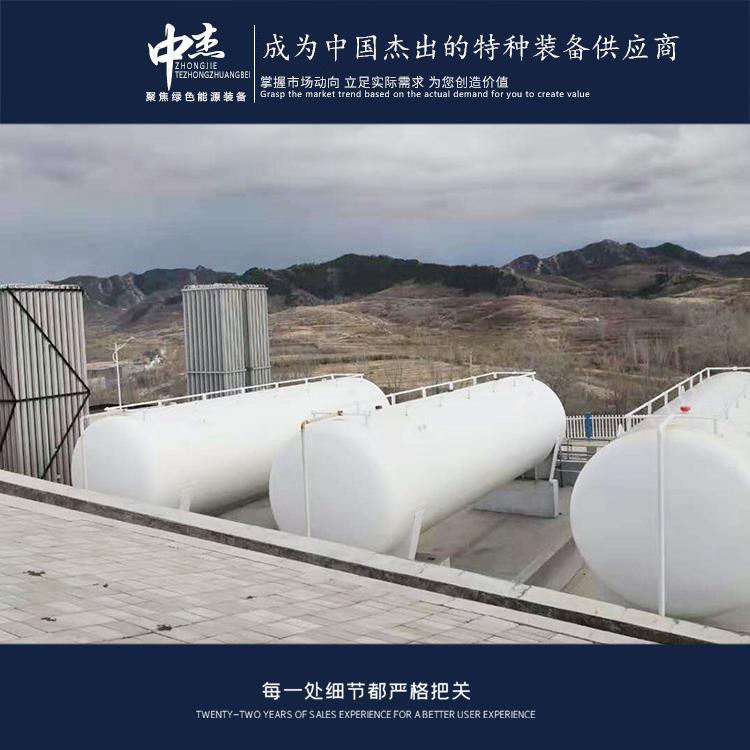



















Shandong Zhongjie Special Equipment's main products include: fuel (gas) boilers, organic heat carrier boilers, biomass boilers, waste heat boilers, and other boiler products; vacuum insulation cryogenic pressure vessels such as LNG tanks, oxygen/nitrogen/argon tanks, and CO2 tanks; pressure vessel products like denitrification engineering equipment, heat storage and energy storage equipment, and complete chemical equipment sets; central air conditioning and HVAC equipment such as ground (water) source heat pumps, air source units, water-cooled screw units, and air-cooled modular units. Planned products include large-scale energy centers, LNG transport vehicles, LNG tank containers, and other green energy equipment.
Carbon dioxide storage tanks possess the following characteristics:
- High-pressure Vessel: Carbon dioxide storage tanks are typically designed as high-pressure vessels, capable of withstanding high pressure. This is because carbon dioxide requires high pressure at room temperature to maintain a liquid state.
- High Oxidizing: Carbon dioxide has a high oxidizing nature, which supports combustion. Therefore, when using and storing carbon dioxide, precautions must be taken to prevent contact to avoid the risk of fire and explosion.
- Low-temperature Storage: Carbon dioxide is in a gaseous state at room temperature but can be compressed into a liquid at lower temperatures. Consequently, carbon dioxide storage tanks usually need to have excellent insulation properties to maintain the low-temperature liquid state of the stored carbon dioxide.
- High Density: Liquid carbon dioxide has a high density, allowing for the storage of large amounts of carbon dioxide in a relatively small volume. This makes carbon dioxide storage tanks useful in scenarios requiring substantial carbon dioxide supply.
- Safety Valve and Pressure Control: To ensure the internal pressure of the tank remains within a safe range, carbon dioxide storage tanks are commonly equipped with safety valves and pressure control devices. These devices monitor and control the tank's internal pressure to prevent excessive pressure from causing the tank to burst.
- Corrosiveness: Carbon dioxide has some degree of corrosiveness, particularly in high humidity environments. Therefore, the materials and corrosion prevention measures of the tank need to consider the corrosiveness of carbon dioxide to ensure the tank's durability and safety.
These characteristics make carbon dioxide storage tanks widely applicable in many industries, such as the food and beverage industry, fire extinguishing, and the gas industry. When using carbon dioxide storage tanks, it is necessary to follow relevant safety operation procedures and standards to ensure the safety of operations.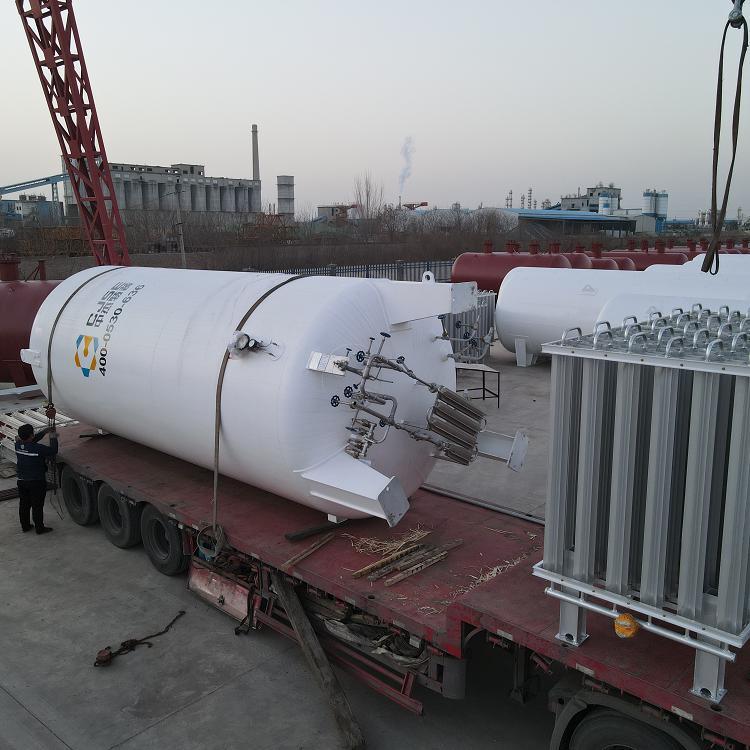
Low-temperature carbon dioxide storage tanks offer several advantages:
- Low-temperature storage capacity: These tanks can store carbon dioxide at low temperatures, typically between -40°C and -70°C. This low-temperature storage allows carbon dioxide to be stored in a liquid state, significantly reducing the storage space required.
- High storage density: Due to the liquid state of carbon dioxide at low temperatures, its storage density is relatively high. Compared to gaseous storage, liquid storage can hold more carbon dioxide in a smaller tank, enhancing storage efficiency.
- Environmental and renewable: Carbon dioxide is an environmentally friendly gas, with minimal harmful emissions during storage and use. Additionally, carbon dioxide can be reused through capture and recovery technologies, reducing environmental impact.
- High safety: Low-temperature carbon dioxide storage tanks are made from high-strength materials with good sealing and corrosion resistance. They are equipped with safety valves and pressure relief devices to effectively control internal pressure and temperature, ensuring safe storage.
- Wide application: These tanks are widely used in various industries, including food and beverage, pharmaceutical, and chemical industries. They can be used for frozen food, refrigeration equipment, gas supply, and more, meeting diverse industry needs.
In summary, low-temperature carbon dioxide storage tanks offer advantages such as low-temperature storage capacity, high storage density, environmental friendliness, renewability, high safety, and wide application. These benefits make them essential equipment for storing and using carbon dioxide in many industries.
Leakage defects in carbon dioxide storage tanks may be caused by the following reasons: Material Corrosion: Carbon dioxide has some corrosive properties, and prolonged contact can lead to corrosion of the tank materials. Corrosion can damage the surface protective layer of the tank, causing it to lose its sealability and resulting in leaks. Welding Defects: Welding joints on the tank may have defects, such as cracks in the weld seam or voids. These defects can weaken the strength of the welding area, leading to leaks. Design Defects: Inadequate design or defects in the tank may also cause leakage. For example, improperly designed interface connections or unreasonable structural designs can all lead to leakage issues in the tank. Excessive Pressure: If the internal pressure of the tank exceeds its capacity, it may cause deformation or cracking of the tank, leading to leaks. Temperature Fluctuations: During temperature changes, the carbon dioxide tank may deform or experience stress concentration due to thermal expansion and contraction, resulting in leaks. Operation Errors: Incorrect operation and maintenance can also cause tank leaks. For example, over-tightening valves or improper maintenance measures can all lead to a decrease in the tank's sealing performance. External Damage: If the tank is impacted, scraped, or corroded by external forces, it may lead to surface damage or corrosion, causing leaks. To avoid leakage issues in carbon dioxide storage tanks, choose appropriate materials, reasonable design, and manufacturing processes, and conduct regular inspections and maintenance. At the same time, operators should receive training and adhere to operating procedures to ensure the safe operation of the tank.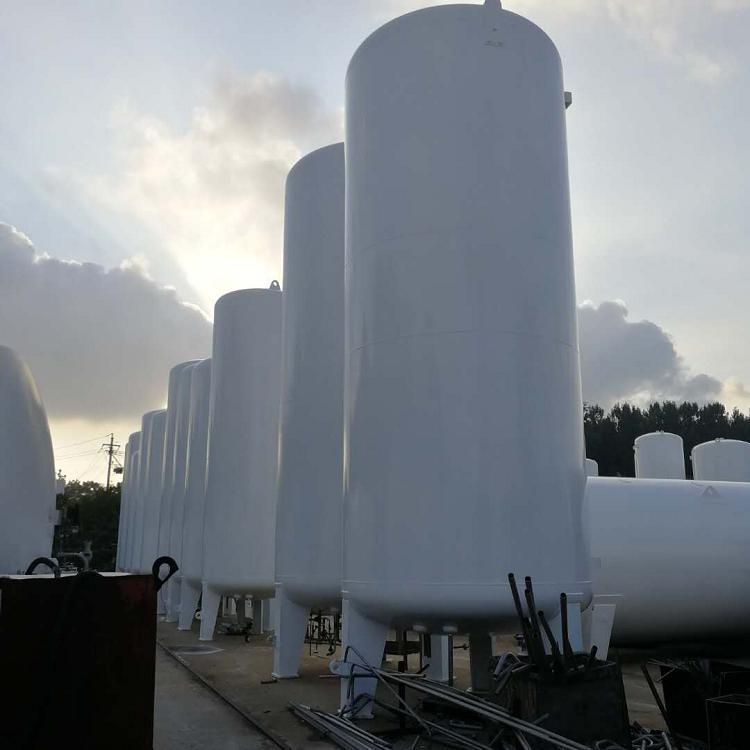
When handling CO2 storage tanks, static electricity is a safety issue that requires attention. Here are some ways to avoid static electricity:
Grounding: Ensure the tank and related equipment are properly grounded. Grounding releases static electricity to the ground, reducing the likelihood of static buildup. Use specialized grounding devices and wires to ensure reliable grounding.
Antistatic Equipment: Use antistatic equipment such as antistatic clothing, shoes, gloves, etc. These devices help eliminate or reduce static buildup and protect the safety of the operators.
Avoid Friction: Prevent friction during operations, especially when in contact with substances or flammable gases. Friction can generate static electricity, increasing the risk of fire or explosion.
Control Humidity: Maintain a suitable humidity level in the operating environment. Higher humidity can reduce the generation and buildup of static electricity. Use humidifiers or other humidity control devices to adjust the environmental humidity.
Avoid Plastic or Rubber Materials: Plastic and rubber materials are prone to generate static electricity. Try to avoid using these materials during operations. Choose materials with good antistatic properties for operation.
Static Eliminators: Use static eliminators to eliminate or reduce static buildup. Static eliminators neutralize static by releasing charges, reducing the dangers of static electricity.
Tank Cleaning: Regularly clean the interior of the tank to remove accumulated impurities and dirt. Be cautious to prevent the generation and buildup of static electricity during the cleaning process.
It is important to note that the methods for avoiding static electricity should be determined based on the specific operating environment and characteristics of the tank. During operations, follow relevant safety regulations and standards, and consult with experts if necessary.
Our company attaches great importance to technological innovation and R&D design. We have one municipal-level enterprise technology center in Heze City, equipped with testing facilities for non-destructive testing, physical and chemical testing, welding testing, hydrostatic testing, etc. We have over 600 various instruments and equipment, including CNC machine tools, X-ray flaw detectors, digital ultrasonic flaw detectors, mechanical property testing machines, chemical analyzers, spectrometers, tensile testing machines, plasma welding machines, and more. The key products and technologies we have developed, such as temperature and pressure vessel welding, biomass boiler emission reduction, and waste heat recovery, have successively been selected for multiple Shandong Provincial Department of Industry and Information Technology science and technology innovation projects, Shandong Provincial key projects, and Heze City innovation and excellence projects. We have accumulated 27 authorized utility models, 16 authorized inventions, participated in drafting 2 standards, 2 industry standards, and registered 15 trademarks. Our technical team, in collaboration with Professor Yajiang Li from Shandong University, has developed deep cryogenic container processing technology using the international plasma arc + filler wire tungsten inert gas arc welding (PAW-GTAW) technology. The provincial-level scientific and technological achievement identification has confirmed that our technology level in deep cryogenic container manufacturing has reached an international standard. Choose Zhongjie Special Equipment, and let's create brilliance together!
WeChat Official Account

Scan to follow Official Account




















