


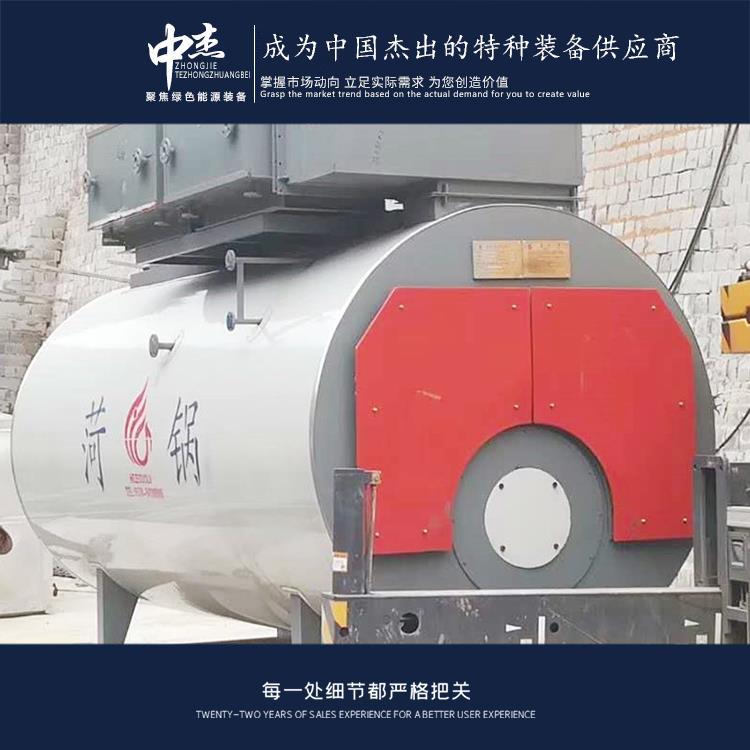



















Shandong Zhongjie Special Equipment (formerly Heze Boiler Factory Co., Ltd.) holds an A-grade boiler manufacturing license, an A2-grade pressure vessel manufacturing license, an A2-grade pressure vessel design license, a B-grade boiler installation license, as well as GB2 and GC2 grade pressure pipeline installation licenses, and a mechanical and electrical equipment installation contracting qualification. It is a member of the China Boiler and Water Treatment Association, the China Chemical Equipment Association, and the Standing Committee of the Shandong Equipment Manufacturing Association. The company has also passed the ISO9001 Quality Management System, ISO14001 Environmental Management System, OHSAS18001 Occupational Health and Safety Management System certifications, and the American ASME/U2 certification.
The main benefits of installing expansion tanks in a thermal oil furnace are as follows:
- Alleviate thermal expansion and contraction: During operation, the thermal oil furnace experiences thermal expansion and contraction due to temperature changes. The expansion tank provides space for the thermal oil to expand, mitigating the impact of thermal expansion and contraction on equipment and pipelines, and preventing stress concentration and equipment deformation caused by it.
- Protect equipment and pipelines: The expansion tank absorbs the expansion and contraction of the thermal oil, reducing impact and vibration on equipment and pipelines. This helps extend the service life of equipment and pipelines, reducing the frequency of maintenance and replacement.
- Reduce leakage risk: The expansion tank provides a sealed space, minimizing the risk of thermal oil leakage. When the thermal oil expands, excess oil can be accommodated through the expansion tank, preventing leakage and environmental pollution.
- Facilitate maintenance and repair: The presence of an expansion tank makes it easier to maintain and repair the thermal oil furnace system. When equipment or pipelines need to be repaired or replaced, the flow and shutdown of the thermal oil can be controlled through the expansion tank, reducing downtime and the difficulty of maintenance.
In summary, the expansion tank plays a role in alleviating thermal expansion and contraction, protecting equipment and pipelines, reducing leakage risk, and facilitating maintenance and repair in the thermal oil furnace system. It is an important design element that contributes to the safety and reliability of the thermal oil furnace system.
Steam boilers produce a certain amount of wastewater during operation, which requires drainage treatment. Here are the general steps for steam boiler drainage:
Preparation: Before drainage, ensure the steam boiler is shut down and the pressure inside has been reduced to a safe level.
Open the Drain Valve: Locate the appropriate drain valve according to the steam boiler's design and open it. The drain valve is typically found on the bottom or near the bottom of the boiler's drainage pipe.
Discharge Wastewater: After opening the drain valve, wastewater will flow out of the drainage pipe. Depending on the situation, you can use a drain pump or gravity to discharge the wastewater.
Observe the Wastewater: During the discharge, monitor the wastewater's color, turbidity, and odor to determine if there are any abnormalities, such as sediments, impurities, or unpleasant smells.
Close the Drain Valve: Once the wastewater has been discharged or the predetermined drainage target is reached, close the drain valve.
Clean the Drainage System: Regularly clean the drainage system to prevent blockages or buildup, ensuring the system remains clear.
Note that the specific steps and frequency of steam boiler drainage may vary depending on the model, usage conditions, and operational requirements. Therefore, it is advisable to refer to the boiler's operation manual or consult with experts for proper and safe operation.
The Zhongjie Portable Heat Transfer Oil Furnace is a common industrial thermal energy equipment with the following product features: High thermal efficiency: The burning technology and heat exchanger design of the Zhongjie Portable Heat Transfer Oil Furnace effectively transfer the heat energy generated by fuel combustion to the heat transfer oil, achieving energy utilization and improving thermal efficiency. Stable and reliable: The materials and precise manufacturing processes used in this furnace ensure good high-temperature resistance and stable operating conditions, allowing for long-term stable operation with high reliability. Temperature control: The temperature control system of the Zhongjie Portable Heat Transfer Oil Furnace can monitor and adjust the temperature of the heat transfer oil in real time, ensuring temperature accuracy and stability during the process. Safety protection: The furnace is equipped with multiple safety protection devices such as overheat protection, pressure protection, and burner failure protection, effectively preventing accidents. Additionally, the furnace uses clean combustion technology, with minimal emissions, making it environmentally friendly. Easy operation: The Zhongjie Portable Heat Transfer Oil Furnace features an intelligent control system with a user-friendly interface, easy parameter adjustment, and simple operation, reducing the difficulty of operation and labor costs. Overall, the Zhongjie Portable Heat Transfer Oil Furnace is characterized by stability and reliability, suitable for many industrial fields such as chemicals, textiles, and food processing, providing users with reliable thermal energy supply and process temperature control.
Clean and environmentally friendly gas boilers offer several advantages:
- Low emissions: The exhaust from gas combustion has relatively low emissions, with fewer pollutants like nitrogen oxides and particulates. Compared to coal or oil-fired boilers, gas boilers have lower emissions and cause less environmental pollution.
- High thermal efficiency: Gas combustion has a higher thermal efficiency, allowing for the full utilization of fuel energy and reducing energy waste. Compared to other traditional fuels like coal and oil, gas combustion is more efficient, providing more heat energy.
- Clean combustion: Gas combustion does not produce ash or dust, reducing the accumulation of carbon and dirt inside the boiler and in the flue. This reduces the cleaning and maintenance work of the boiler, extending its lifespan.
- Combustion stability: The combustion performance of gas is stable, with minimal flame fluctuations and explosion risks during combustion. This makes gas boilers safer and more reliable in operation.
- Quick start and stop: Compared to other fuels, gas boilers have faster and more flexible start-up and shutdown processes. This makes them suitable for scenarios requiring frequent start and stop, such as seasonal heating and hot water needs.
- Renewable energy integration: As a clean fuel, gas can be combined with renewable energy sources, such as solar hot water systems and biomass fuel. This combination can further enhance energy efficiency and environmental friendliness.
Our company highly values technological innovation and R&D, boasting one municipal-level enterprise technology center in Heze City. We have established testing facilities for non-destructive testing, physical and chemical testing, welding testing, hydrostatic testing, and more. Equipped with over 600 instruments and equipment, including CNC machine tools, X-ray flaw detectors, digital ultrasonic flaw detectors, mechanical property testing machines, chemical analyzers, spectrometers, tensile testing machines, plasma welding machines, and others, we have developed key products and technologies such as welding for temperature and pressure vessels, emissions reduction in biomass boilers, and waste heat utilization. These have successively been included in multiple Shandong Provincial Department of Industry and Information Technology science and technology innovation projects, Shandong Provincial key projects, and Heze City innovative and excellent projects. We have accumulated 27 authorized utility model patents, 16 authorized invention patents, participated in drafting 2 standards, 2 industry standards, and registered 15 trademarks. Our technical team, in collaboration with Professor Yajiang Li of Shandong University, has developed deep cryogenic vessel processing technology using the international plasma arc + wire filling argon arc welding (PAW-GTAW) technique, which has been appraised as internationally competitive at the provincial level.
Choose ZJET customized solutions, let's create brilliance together!
WeChat Official Account

Scan to follow Official Account




















