



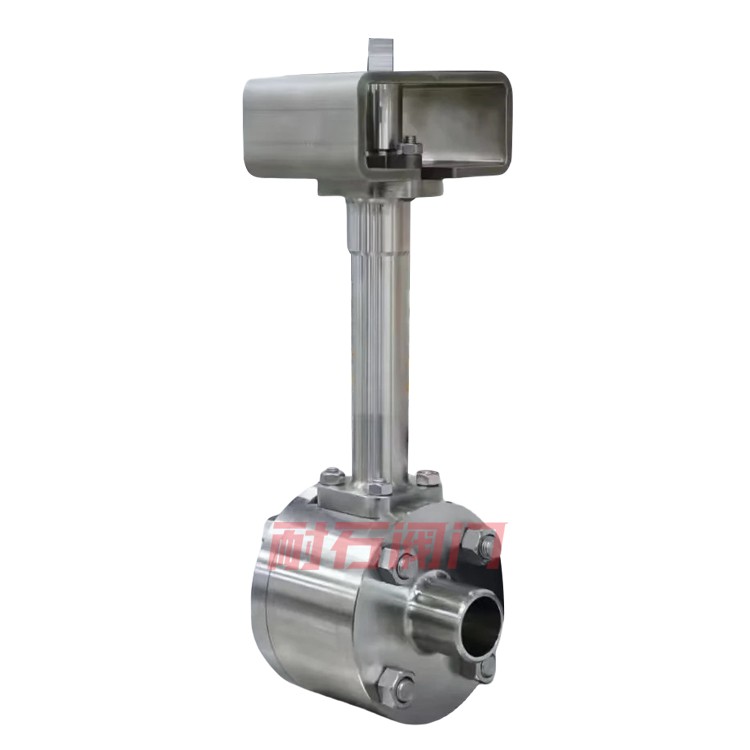















Welded low-temperature ball valves are valves that achieve sealing performance in low-temperature environments through a welded structure, primarily used in control scenarios for low-temperature fluids ranging from -40℃ to -196℃.
Structural characteristics
The design employs a welding configuration (such as flange connection or direct welding onto the pipeline), connecting the valve body and ball via welding, ensuring a compact structure and reliable sealing. The valve seat is made of PTFE composite material or glass-fiber-reinforced Teflon, paired with a double-piston effect design and Lipseal sealing ring, achieving zero leakage in both directions.
Material Selection
The valve bodies are typically made of low-temperature-resistant alloys such as LCB, LC3, or stainless steel, with some models using improved LF2 alloy steel. They achieve an impact energy of 42J at -196℃ (a 28% increase over traditional materials). The sealing rings are made of PTFE composite materials with 20-25% carbon content, with a temperature resistance range from -29℃ to 200℃.
Application Scenarios
Suitable for transportation systems of cryogenic mediums such as liquefied natural gas, liquid oxygen, and liquid hydrogen, as well as for storage and transportation of aerospace propellants and polar engineering in extreme low-temperature environments. The domestic model for 2024 has achieved a 37% market share in domestic LNG receiving stations.
Technical Standards
Compliant with API 6D, BS6364, and National Standard GJB 4040-2000, critical components must pass impact tests at -196℃.


















