






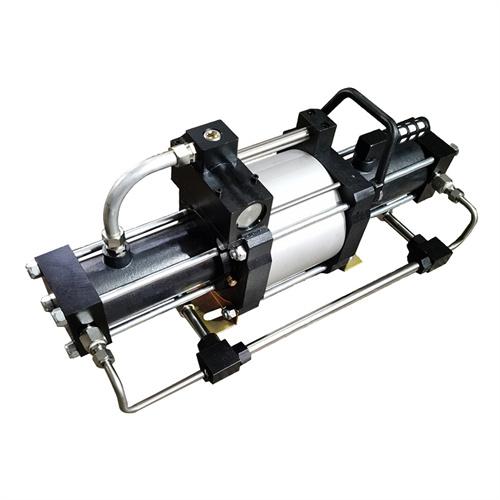
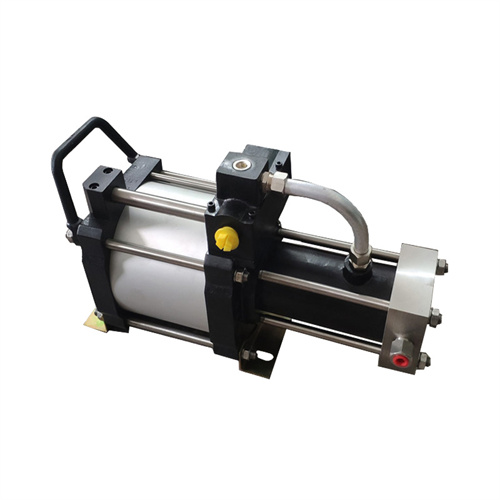

Equipment Introduction
Nitrogen pressure boosting equipment is driven by compressed air and used for boosting gases with certain pressures. It is categorized into single-stage and two-stage boosters based on the pressure before boosting. Single-stage boosters are designed for nitrogen with original pressure above 2 MPa, while two-stage boosters are for nitrogen with original pressure between 0.3-0.8 MPa. The high-pressure pipeline system uses non-welded connections and metal rigid pipes. Various models of boost pumps, either individually or in combination, can achieve different pressure and flow ratios, meeting the requirements of high-pressure gas applications in various fields. The control method can be customized according to customer needs.
Application Scope
Gas high-pressure boosting, gas high-pressure filling, high-pressure airtightness testing, nitrogen spring nitrogen filling, accumulator air filling, etc.
Equipment Composition
Composed of gas booster pumps, pneumatic two-in-one units, high-pressure stop valves, pipelines, pressure gauges, cabinets, etc.
Technical Specifications
1. Boost Pressure: 1.6 MPa, 4 MPa, 8 MPa, 20 MPa, 32 MPa, 48 MPa, 100 MPa, 120 MPa
2. Pressure Media: Nitrogen
3. Drive Pressure: 5-8 bar
4. Output Station: 1 Station
5. Pressure Accuracy: 0.5% F.S.
6. Operating Environment Temperature: Room Temperature -50℃
7. Control Method: Manual/PLC/Computer Control
Typical Applications
1. Airtightness Testing: Including aviation castings, component inspections, and engine cylinder sealing tests; air conditioning pipelines, heating cores, cylinder seals, automotive braking systems, and other equipment; pump bodies and valves: gas sealing pressure resistance tests and water-bubble tests; safety valve inspections; capillary tube testing.
2. Inflation: Accumulator filled with nitrogen; High-pressure gas source: such as high-pressure gas sources for calibration instruments; Air inflation for aircraft tires; High-pressure oxygen, helium, nitrogen, air, and standard gas filling as well as inflation for the recovery of expensive gases; gas spring inflation;
3. High-pressure gas source: for production power and assembly line testing; isostatic press; can provide simulated test high-pressure gas source; high-pressure dew point meter for high-pressure gas source detection; permeation test