FV-Ⅰ-3000 Integrated Water Purification Module

Integrated Modular Water Purification Equipment Structure Description
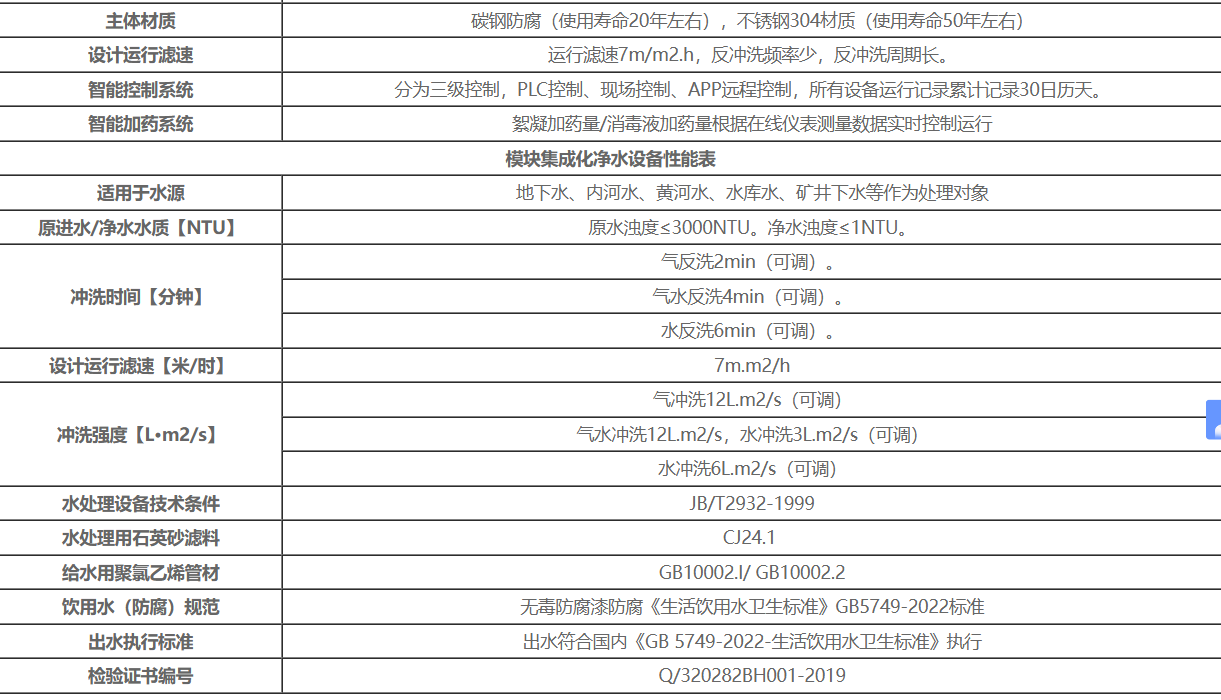
This modular water purification system consists of five sections (pail-shaped grid flocculation reaction zone, balanced overflow distribution area, inclined tube sedimentation zone, sludge collection and drainage area, V-shaped filtration zone), with an inlet electric valve, an inlet flow meter, a liquid level gauge, turbidity/residual chlorine, modular water purification equipment, dosing equipment actuator, disinfection equipment actuator, water backwashing module, steam backwashing module, and waste valve operation modes manual/automatic/remote.
This modular water purification unit features automatic water intake, automatic timed sludge discharge, automatic backwashing, and can control the automation of its own equipment and the automatic interlock of other related equipment based on the liquid level of the clear water tank.
Utilizing grid coagulation pond reaction coagulation, with a box-like structure, it represents a key process at the beginning of the three conventional physical treatment methods in waterworks. Prior to the raw water entering the grid coagulation and sedimentation, it must pass through the tube-type mixer's dosing port, where coagulants (solution) are added. After the initial mixing, the water undergoes multi-layer grid coagulation, further slowing the flow rate. As the water flows through the grid holes, it contracts, expands after passing through the grid, and the flow rate decreases. This sustained segmented turbulence causes the floc particles to collide repeatedly, effectively squeezing out the water within the flocs. Under the action of the coagulant, a dense, easily separable floc is formed, which then settles.
The sedimentation area is equipped with honeycomb inclined tube packing (with a pore size of 35mm and a thickness of ≥δ0.6mm). To withstand the shock load caused by sudden water flow changes, the inclined tube packing is made of ethylene propylene copolymer (modified), which boasts long service life underwater, high strength, and excellent shock resistance. This raw material allows for a thorough reaction between raw water, suspended particles, and chemicals, enabling the flocculent in the water to come into full contact with impurities in the circulation state of the water distribution area, forming large flocculents. These formed large flocculents become denser and larger, with a flocculent density greater than water's density, sinking by gravity to the bottom sedimentation area. Smaller flocculents, with a density close to water, enter the inclined tube sedimentation area together. Due to the adsorption and adhesion of the flocculents on the inclined tube wall, the system equipment operates continuously, causing the flocculents on the inner wall of the inclined tube to accumulate over time. When the action of the water flow loosens the large flocculents formed on the inclined tube wall, they slide down under gravity into the sedimentation area. The sludge in the sedimentation area is automatically discharged into the external drainage channel by the排污阀 through the force of water gravity (static pressure).
The Rotary Lobe Blowers, pipelines, cables, control cables, as well as the power distribution cabinet and control cabinet for the filter bed backwashing are all automatically controlled by an integrated unit's PLC control box with an automatic program.
Integrated Water Purification System Operation Logic Table

Key Technical Advantages of Modular Integrated Water Purification Equipment
◆ Designed for the source water quality, employing rational design parameters and purification technology, aiming for simplicity and reliability.
Intelligent Water Inflow System; intelligently controls and adjusts valve opening based on the feedback signal from the inflow flow meter, stabilizing the water inflow without human intervention, achieving intelligent and stable water production.
◆ Utilizes a grid-type static mixer; achieves instant mixing by the internal cross-mixing, which results in分流, cross-mixing, and reverse vortex effects, ensuring the added chemicals are quickly and evenly distributed throughout the water body, achieving instant mixing with excellent results and reducing user investment.
◆ Drum-shaped mesh flocculation device; enhances flocculation efficiency, shortens flocculation time, and reduces the amount of flocculant required. The flocculated mass formed by raw water and chemical solution undergoes multiple collisions in the reaction zone, resulting in larger floccule particle sizes and denser flocs.
Net water treatment sedimentation zone; utilizes a balanced overflow water distribution area, ensuring stable water flow speed, maintaining uniform distribution, and no cross-flow phenomena.
◆ Integrated water purifiers utilize slanted tube media; made from stainless steel 304 with automatic welding, the internal slanted holes are smooth with consistent sizes and no deformation, ensuring even water surface load increase in the sedimentation zone, reducing water turbulence, and eliminating dead-end crossflow, enhancing sedimentation efficiency. It boasts long service life, high strength, and excellent resistance to impact forces.
◆ Sludge collection and drainage area; utilizing U-shaped sludge collection channels, each water purification unit is equipped with multiple collection channels. Combined with our company's siphon expansion drainage device, it features increased sludge concentration, thorough and clean drainage, uniformity in drainage, no dead corners, and short drainage time without wasting water resources.
◆ The filter pond utilizes a traditional gravity-based filter pond; the filter media layer is designed as a two-layer structure, with a filtration rate designed to be within 5-7 m/h. It boasts advantages such as a large amount of suspended solids removal, a deep collection and infiltration layer, a long filtration cycle, and stable effluent water quality.
◆ Smart Control Water Module; the intelligent water regulating valve adjusts the valve opening based on the water level signals from the clear water pool and filter tank, maintaining the water level of the filter zone at the preset constant level.
Intelligent anti-money laundering module; filters based on the clogging status of the filter bed. When the surface of the filter layer is clogged with pollutants, the filter layer can no longer hold water, and the water level rises to the preset backwashing water level, at which point the water level pressure controller is activated to automatically start the backwashing unit.
Modular integrated water purification equipment advantages
(1) Modular arrangement for easy operation and management, suitable for both indoor and outdoor settings.
(2) This integrated unit not only achieves a high removal rate of turbidity, but also offers effective removal of COD, color, colloids, and organic matter.
(3) Under conditions of windy and rainy weather or unstable siltation source water, capable of withstanding source water turbidity ≤ 3000 NTU and effluent turbidity ≤ 1 NTU.
(4) Suitable for single-unit small processing capacity of Q=500 m3/d, suitable for large processing capacity of Q=15,000 m3/d. For processing capacities between 5,000 m3/d, multiple units can be combined for use. During maintenance, the units can be operated separately to produce water, facilitating maintenance without affecting water production requirements.
(5) Wide application range; such as industrial and mining enterprises' water supply, emergency fire-fighting water, medium to large-scale waterworks, rural domestic water supply, etc.
Control System Description
1. PLC Control System
The design concept of this engineering automation system employs a PLC system that is commonly used in the market today, a high-performance and highly reliable central control system based on standard, open fieldbus technology and the concept of full-factory integrated automation. It has been implemented and proven effective through practical application, demonstrating its reliability, maturity, professionalism, practicality, and ease of expansion. This system can effectively meet the control needs of various industrial production facilities and lays a solid foundation for achieving full-factory control and management integration as well as process control. High-performance and highly reliable automation instruments are also provided.
2. Industrial Control Operating System
Based on the process flow and layout of the water purification plant, a control room is set up for the entire water purification station. The system control station is located next to the low-voltage distribution room. The management computer of the full water purification station can use Ethernet to connect with other computers in the later-stage operation control rooms, forming an integrated factory computer management system.
This operation control room is equipped with 1 operator station. Operators in the water treatment operation room complete the program start-up, normal operation monitoring and adjustment, as well as the handling of abnormal and accident conditions of the water treatment system. In addition to central control, PAC/PAM/nextSodium ChlorateDisinfection equipment, integrated water purifiers, backwash blowers, backwash pumps, flow meters, and level gauges for control.
(1) The integrated water purification system's on-site control cabinet is controlled by the on-site PLC cabinet one-to-one. It has reserved Ethernet interfaces for equipment startup/faults. The on-site control system is installed in Phase II, while the control system is in Phase I. After the on-site installation of all equipment suppliers is completed, the later installation of the network cable to transmit the operating status of the on-site control cabinets in Phase II to the Phase I industrial control system will be handled by Party A. The manufacturer provides an on-site PLC control cabinet that must be capable of local/remote switching via a switch.
(2) The on-site control cabinet for the PAC dosing equipment is controlled by a local PLC cabinet, which uses variable frequency one-to-one control for the dosing pump. It has pre-set Ethernet interfaces for equipment startup/failure, with data collection of each device's operational status to be handled by Party A later on. The manufacturer provides the on-site PLC control cabinet, which must be capable of local/remote switching through a conversion switch.
(3) SubsequentSodium ChlorateThe dosing equipment's on-site control cabinet is controlled by the on-site PLC cabinet, using variable frequency one-to-one control for the dosing pump. The equipment features pre-installed Ethernet interfaces for start-up/faults, with the later data collection of each device's operating status handled by the client. The manufacturer provides the on-site PLC control cabinet, which must be capable of local/remote switching via a transfer switch.
3. Self-Control System Design Principles
(1) High Reliability Principle
Features include self-diagnosis and fault tolerance, with continuous 24/7 operation; equipped with computer system-assisted diagnosis and repair functions; equipped with anti-interference and lightning protection measures; the monitoring system can be downgraded for use, meaning that in the event of a failure or communication interruption at the higher-level machine, the on-site control station can independently perform basic local control.
(2) Practicality Principle
For ease of use and operation by users, convenience, simplicity, clear interface, and practical functionality are another design principle we adhere to. Within the premise of practicality, elegance, and beauty, we avoid pursuing excessive ostentation without substance, ensuring users feel the true situation.
Full graphical human-machine interface, allowing users to clearly understand the operation status of various sections in the water plant and the branch details of fault alarm points, enabling operations to be conducted quickly and accurately; dynamic graphic control technology, enabling operators to issue various commands or switch screens through hotkeys or the mouse; capable of centrally managing data as required, including recording, archiving, statistics, inquiries, and printing.
(3) Professionalism Principle
Products that are not likely to be phased out in the short term. Preferably use international standards and current technology. Of course, as practical industrial control systems, the maturity of technology is also fully considered.
4. Automation System Requirements
The control system adheres to the principle of "centralized management, decentralized control, and data sharing." It is designed with advanced and reliable selection, ensuring that the instruments, central control controllers, computers, communication equipment, and other selected items can operate long-term, stably, and efficiently. The control of the entire water purification plant can be achieved through the following three-tiered control layers:
(1) On-Site Manual Operation: High priority; when the on-site transfer switch is set to "Manual Operation," the control of the industrial control system is disabled. All major field equipment can be manually/automatically switched and operated manually for start/stop functions at the on-site control box.
(2) Remote Industrial Control Automation: Utilizing the logical control functions of industrial control, we offer automatic control of equipment, as well as interlock and连锁 control for associated equipment, and closed-loop control. The equipment under the jurisdiction of each sub-station primarily operates through this control method.
(3) Control Room Industrial Control: Operate the entire plant's equipment remotely through a human-machine interface, achieving macro-control, handling local shutdown accidents and emergencies, and maintaining overall system coordination. The control system features undisturbed switching capabilities during manual/automatic/centralized control transitions.
The control system provided in this project is a complete system that meets the buyer's technical specifications. Upon the user correctly connecting the signal cables from the site and the substation, as well as the main power lines to our supplied system, the system will operate stably, reliably, and safely, performing the pre-set functions of monitoring, operation, management, automatic control, and interlock protection.
5. Industrial Control Room
An operator management industrial control system is set up in the control room, which analyzes, processes, and stores information on various process parameters, electrical parameters, and the operating status of major equipment at the water treatment plant. It generates trend curves for different process parameters, allowing simple keyboard operations to configure system functions, modify and set control parameters online, issue commands to lower-level machines. The CRT visually displays the dynamic process flow of the entire plant and enlarges the process flow diagrams of individual sections, featuring dynamic parameter and trend curve displays, and automatically generates various reports that can be viewed and printed. The alarm system sounds and lights up at the central control room to alert of various equipment failures on-site and can categorize and print the faults.
(1) Real-time Dynamic Graphical Data Display
Real-time dynamic display of the water treatment process, operation status of key process equipment, and level control and power distribution equipment for high and low liquid levels on computer monitors, providing managers with current water treatment operation details. Allows for multi-level monitoring from an overall layout to detailed diagrams.
(2) The overall structural form of the dynamic graphics is a layered unfolding style, the image includes
Overall Monitoring System Diagram
Dynamic Process Flow General Diagram
Power Distribution System Diagram
★ Status Diagram of Main Equipment Parameters
(3) Control
Operators issue start/stop/stop commands via the keyboard or mouse on the computer. The screen should display an operation sequence diagram, indicating the current step with different colors. Upon receiving instructions, the control system executes them correctly based on the on-site conditions and sends a response signal to the operator station. All operation events are automatically logged into the "Event Log."
(4) The supplied Uninterruptible Power Supply (UPS) features an automatic transfer function, with the backup power capacity designed for 30 minutes.
(5) Control System: Operators issue start/stop/shutdown commands via the keyboard or mouse on the main control computer. The screen should display an operation sequence diagram, indicating the current executing steps in different colors. After receiving instructions, the PLC control system executes them correctly based on the on-site conditions and provides feedback signals to the operator station. All operational events are automatically logged into the "Event Log."
6. Intelligent System Composition

7. Features of the Smart System

8. Intelligent System Framework

V. Overall Processing Technology System
1. Processing Technology

2. Process Overview

3. Process Advantages

Six: Performance Advantages of FV Series Integrated Water Purification Equipment