






- AllProduct Category
-
Water Level Sensing
Traffic Sensing
Weighing Instrument
Analytical Instruments
Flow Meters
Pressure Gauges
Material Level Instrument





详情描述
I. Overview
During the combustion process in furnace kilns, if the air excess coefficient is too low, indicating insufficient oxygen content, it leads to reduced thermal efficiency and the emission of black smoke due to increased unburned losses. Conversely, if the oxygen content is too high, the large smoke exhaust losses, increased SO2 and NOX levels, will also result in low thermal efficiency and environmental pollution. Therefore, only by utilizing the continuous monitoring capability of our series oxygen content analyzers to automatically control the air/fuel ratio in various furnace kiln flue gases can we achieve economic combustion, enhance thermal efficiency, and reduce environmental pollution. The AO-100P oxygen content analyzer not only provides operators with useful parameters to adjust the air/fuel ratio but also enables the automation of thermal control, aiming for energy conservation and increased production.
The core component of the oxygen analyzer, the oxygen sensor, is made from a stable zirconia material with a melting point above 2200°C, exhibiting excellent high-temperature resistance and corrosion resistance. The zirconia flue gas oxygen analyzer can adapt to high-temperature, high-dust, and corrosive environments, which is unparalleled by other methods. It has been the preferred instrument widely adopted by countries around the world in the past few decades.
1. Detector
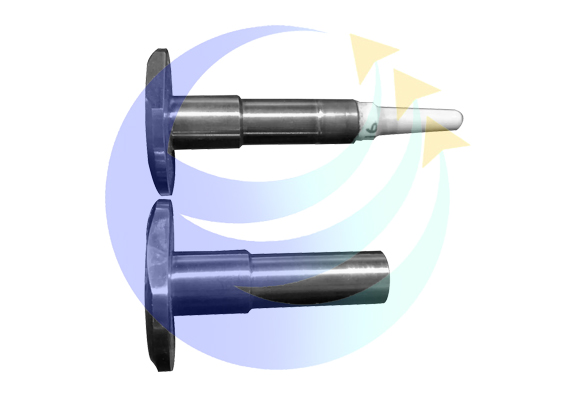
In this system, the detector is a critical working component, directly affecting the performance and lifespan of the entire system. Among them, the zirconium tube assembly is the main working device, which is crucial for converting changes in oxygen concentration into changes in electrical signals. The principle of its oxygen measurement is as follows: the zirconium tube is made by sintering a stable zirconium oxide, which contains yttria or calcium oxide in pure zirconium oxide, under high temperatures. It is a solid electrolyte, usually made into a tubular shape. At temperatures above 600°C, it is an excellent conductor of oxygen ions. If platinum electrodes are coated on both sides of the zirconium oxide, and the zirconium tube is heated using an electric furnace, making its inner and outer walls contact with gases of different oxygen concentrations, the zirconium oxide tube becomes an oxygen concentration difference battery, where the following reaction will occur at the two platinum electrodes:
At the reference electrode: O2 + 4e → 2O2-
On the low-oxygen side (the side being measured) of the electrode: 2O2- → O2 + 4e

An oxygen molecule in the air夺取 four electrons from the electrode, becoming two oxygen ions. Driven by the oxygen concentration gradient potential, the oxygen ions migrate to the low-oxygen side electrode through zirconia, leaving four electrons for the electrode to recombine into oxygen molecules. When the battery is in a balanced state, the voltage value E between the two electrodes remains constant. The voltage value E conforms to the Nernst equation:
In the formula:
R – Gas Constant T – Temperature
F—Faraday's constant Px—Percent oxygen concentration of the gas being measured
Pa – Oxygen concentration percentage of the reference gas, usually 20.60%
Thus, if the oxygen battery is heated to a specified temperature and gases to be measured and a reference gas are flowed through opposite sides of the zirconium tube, the generated potential is related to their concentrations. If the concentration of the reference gas is known, it is easy to determine the oxygen concentration of the gas to be measured. The detector utilizes this principle to provide the zirconium tube with normal operating conditions for practical purposes.
2. Transmitter
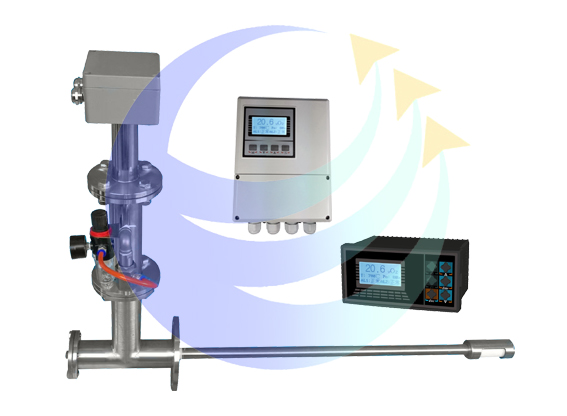
The oxygen transmitter's function is to convert the oxygen electromotive force signal from the sensor and the temperature signal into oxygen content according to the Nernst equation, and to control the working temperature of the zirconium tube. It encompasses functions such as temperature measurement, temperature control, oxygen conversion, and output. To accommodate various application scenarios, its appearance is available in three forms: disk horizontal gauge, disk vertical gauge, and wall-mounted gauge for selection. Different types of transmitters are functionally identical.
II. Comprehensive Technical Parameters
1. Measurement Range: 0~5% O2 Vol; 0~10% O2 Vol; 0~20.60% O2 Vol; 0~25% O2 Vol.
2. Output Signal: 4-20mA (Load Resistance ≤ 400Ω, Isolated).
3. Probe Length: 180mm, 400mm, 600mm, 800mm, 1000mm, 1200mm; special lengths available upon request.
4. Repeatability: Less than ±0.5% of full scale (full scale).
5. Accuracy: Less than ±2% of full scale (full scale).
6. Stability: Less than ±1% of full scale (full scale, 24 hours).
7. Response Time: Achieve 90% oxygen content within 5 seconds from the introduction of standard gas.
8. Display Type: 128×64 Graphic Dot Matrix LCD.
9. Power Voltage: 220 ± 10% VAC.
10. Power Consumption: Less than 100W.
11. Environmental Temperature: Detector: -10~80℃; Transmitter: -5~55℃ (Relative humidity less than 90%).
12. Dimensions: Wall-mounted clock: 285×200×90mm; Plate clock: 265×160×80mm (Opening size: 150×75mm)
Technical specifications may be modified without prior notice. Exceeding 1250℃ for the detector probe may lead to a reduced probe lifespan.
III. Product Features
1. Direct insertion: The oxygen probe's contacting part with the flue gas is made of a new high-temperature alloy steel. The oxygen probe can be directly inserted into the furnace chamber for use at temperatures below 900°C.
2. Digital Design: All calibrations can be completed through button presses, without the need for adjusting any components.
3. Intelligent Design: The instrument employs a 16-bit high-performance, high-speed, and high-integration microprocessor, which is 16 times faster in computation than the 51 series microprocessors at the same oscillation frequency. Temperature control utilizes fuzzy intelligent control algorithms, enabling full-range temperature control and preventing the occurrence of oxygen sensor failure due to excessive temperature fluctuations, significantly extending the lifespan of the oxygen sensor.
4. Enhanced User-Friendly Design: Our industry-leading human-machine interaction is highly user-friendly. With an LCD display and an intuitive operation interface, temperature calibration, current output calibration, air calibration, and standard gas calibration can all be achieved with simple button operations, eliminating the need to touch any components. This greatly facilitates user experience, and these features are unmatched by similar products domestically and internationally.
5. High Integration: Utilizing industrial-grade high-performance, high-integration components, the instrument boasts superior performance, achieving nearly zero drift in signal collection and output, and has a wider applicable temperature range.
6. Strong anti-interference capability: The internal structure is fully floating, offering strong anti-interference capability and reliable monitoring data.
7. Long Service Life: Advanced design and production technologies ensure the long-lasting performance of our products.
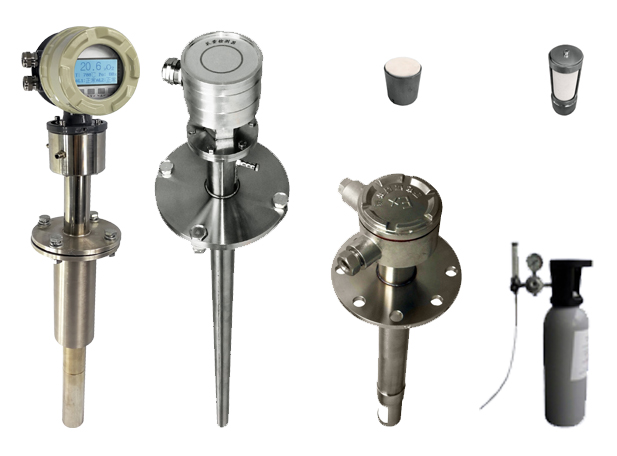
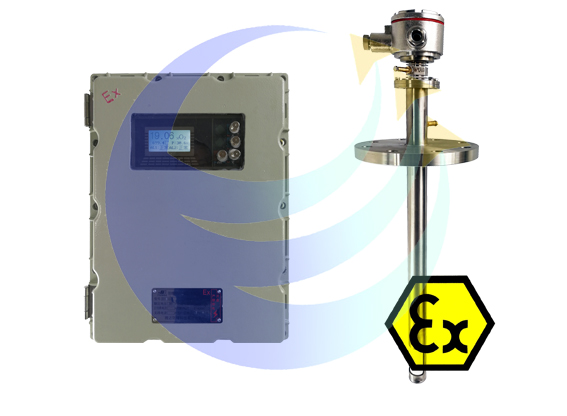
Intrinsically Safe High-Temperature Flow Diverting: With Explosion-Proof Box
询价单


