






- AllProduct Category
-
Water Level Sensing
Traffic Sensing
Weighing Instrument
Analytical Instruments
Flow Meters
Pressure Gauges
Material Level Instrument





详情描述
I. Product Overview
Orifice flowmeters are widely used due to their standardization, simple and sturdy structure, ease of replication, versatility, and low cost. However, they also have significant drawbacks due to inherent structural flaws, such as unstable discharge coefficient, poor linearity, low repeatability, accuracy affected by various factors, prone to fouling and wear, high pressure loss, limited range ratio, strict installation conditions, and the requirement for excessively long straight pipe sections.
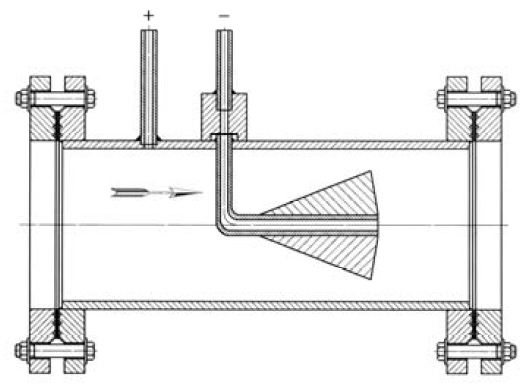
Ongoing optimization and improvements have been made to throttling devices that generate differential pressure, including their dimensions, the geometric form and parameters of the throttling elements, the inlet edge profile, pressure tapping and throttling methods, and the development of replaceable orifice plates. For instance, non-standard throttling devices developed for measuring the flow of contaminated fluids include round-notch orifice plates, eccentric orifice plates, wedge-shaped orifice plates, wear-resistant orifice plates, annular orifice plates, and elbows (bends). Such advancements and improvements only reached a qualitative leap until the mid-1980s, which was: fundamentally changing the concept of throttling fluid contraction to near the pipe's central axis by using a V-shaped sharp cone coaxially installed in the pipe to gradually throttle and contract the fluid to the inner pipe wall. Flow measurement is achieved by measuring the differential pressure before and after this V-shaped inner cone. This V-shaped inner cone flow meter opened a new chapter for differential pressure flow meters. The V-cone flow meter allows for more accurate and efficient flow measurement of clean or contaminated fluids under shorter straight pipe sections and with a wider range of measurement.
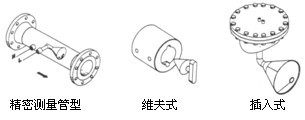
Section 2: Three Structural Types of V-Conical Throttle Devices
1. Measure tube dimensions, typically ranging from 15mm to 900mm in diameter.
2. Wafer style, also known as flanged mounted, with a diameter range from 15mm to 150mm.
3. Insertion (with top tube wall) style, with an aperture range of 150mm to 1800mm. Due to the inability to calibrate, the accuracy is poor, with an uncertainty between 3% to 5%. However, the repeatability of the measured values remains excellent.
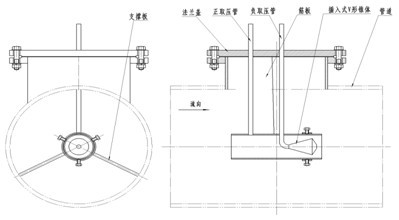
Three. Insertable V-cone
1. Uses and Features
The Insertable V-Cone is a new type of sensor developed based on the Pipe V-Cone, retaining the features of the Pipe V-Cone. Under the same conditions, it only incurs 5% of the pressure loss of a Venturi tube and 1% of a standard orifice plate. It offers a larger differential pressure and high system reliability, requiring minimal maintenance. It is particularly suitable for measuring large-diameter gas flows in thermal power plants, boiler ducts, and other applications. It requires a certain length of straight pipe section both before and after the installation.
2. Appearance and Structure
As shown in the image below, it is composed of a flange cover and a V-shaped cone.
3. Key Technical Specifications
a. Nominal Pipe Size for Circular Cross Section Pipe: DN = 300 mm to 6000 mm
Rectangular cross-section pipe height × width (mm): W×H = 300×300 ~ 6000×6000 (W and H values can vary continuously)
b. Nominal Pressure: PN ≤ 6 MPa
c. Operating Temperature: < 400℃
d. Differential Pressure: (0~100) KPa
e、Accuracy Grade: 0.5, 1, 1.5
f. Repeated Measurement Error (Stability): ±10 Pa
询价单


