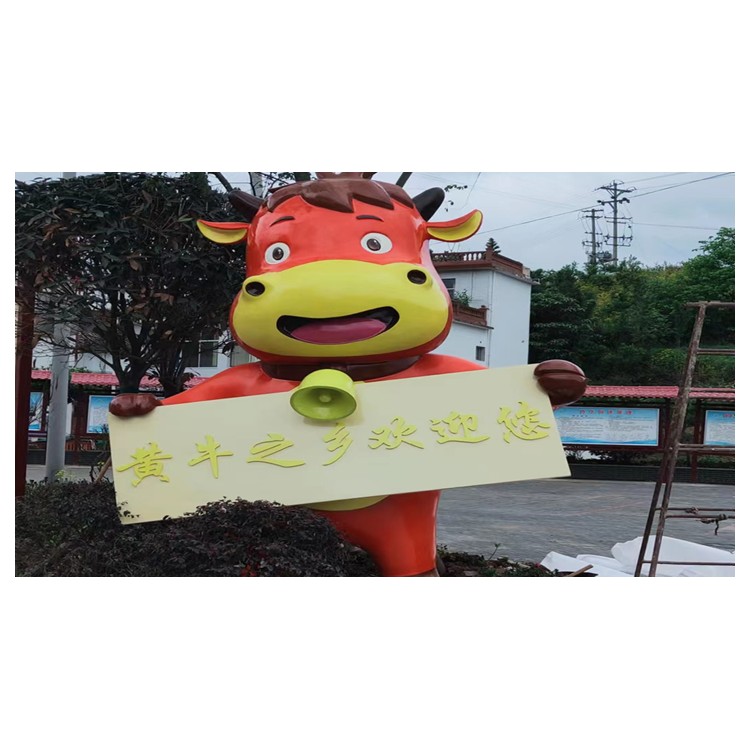

Fiberglass sculptures, fiberglass corrosion protection, fiberglass enclosures
13219000823


Product Recommendation
Introduction to Glass Fiber Relief Molding Technique
Step: Sculptures designed and molded by Step require a solid foundation in design. The design of fiberglass sculptures should consider the characteristics of the material and the craftsmanship. The fiberglass process is easy to shape into beautiful streamlined products, enhancing the modern and contemporary feel of the works. Designers can incorporate curved and streamlined shapes. Additionally, due to the lightweight and high-strength properties of fiberglass, it is possible to create works with strong dynamics and a small support area.
Sometimes, glass fiber reinforced plastic sculptures require a subsequent coating of gel coat. Due to the self-leveling nature of the gel coat, and its flattening effect under the surface tension during curing, it is not suitable for depicting intricate textures in this condition. This should be considered during the design process. The original mold for glass fiber reinforced plastic sculptures can be shaped with clay, while the standard molds are typically created by personnel. After the sculpture work is completed and it has dried naturally, gaining sufficient strength, the manufacturing of the glass fiber reinforced plastic sculpture mold can then be halted.
Step 2: Fiberglass Manufacturing Fiberglass sculptures are crafted using the hand-laid-up method. Before manufacturing, the mold is designed based on the sculpture's shape characteristics, considering ease of molding and demolding, which allows for the mold to be divided into several units for casting. The individual units are then shaped and assembled into a complete piece. The finished product is then treated and painted, marking the completion of a fiberglass sculpture.
Three Steps: Molding Manufacturing Molding manufacturing is the key to glass fiber reinforced plastic (GFRP) shaping, and gypsum is commonly used for GFRP sculpture molding. A better method for GFRP sculpture molding is to use silicone rubber and GFRP materials to create molds. The detailed molding process is as follows: apply the prepared silicone rubber in several layers onto the original mold, ensuring each layer is over 1mm thick. After the silicone rubber has cured, shape a layer of GFRP approximately 3mm thick on top of the silicone rubber. Once the GFRP has cured, cut the entire mold along the defined unit blocks, taking care to cut through both the GFRP and silicone rubber layers simultaneously.
To create connecting ribs between unit blocks, positioning slots should be set at the rib junctions to ensure the unit block molds can be assembled into a single unit through the ribs. After this work is completed, remove the glass fiber unit block from the mold, then detach the silicone rubber layer, and immediately place the detached silicone rubber block back into the glass fiber unit mold. Original mold dust removal → silicone rubber preparation → silicone rubber layer fabrication → fiberglass layer fabrication → mold sectioning → rib fabrication → demolding and assembly mold.
Four Steps: Molding and Manufacturing The glass fiber reinforced plastic sculptures are produced using the hand lay-up molding method. Before manufacturing, a molding route should be designed. Begin at one end of the sculpture, assemble a local mold, and then apply the molding. After the local area has cured, assemble the mold again and continue the molding process. Under the premise of facilitating molding operations, assemble as many mold units as possible in one go. Repeat this process, leaving one unit blank, which is pre-molded and then bonded to the overall sculpture. For parts of the glass fiber reinforced plastic sculptures that resemble animal horns, legs, tails, and are difficult to produce using the aforementioned method, they can be roughly shaped from corresponding metal materials, and then glass fiber is molded onto the metal, which is then polished to refine the shape. An important issue in the molding of glass fiber reinforced plastic sculptures is structural reinforcement, which commonly uses metal profiles, welded together to form the internal framework of the sculpture.
During the molding manufacturing process, the metal framework is gradually embedded within the sculpture. This enhances the stiffness and strength of the fiberglass sculpture, extending its service life. The process involves assembling the fiberglass sculpture with a metal framework → applying surface putty → laying short-cut mat → laying grid cloth → embedding the framework → and finally demolding the finished product. The sculpture's surface is typically complex, requiring special treatment in the process of laying layers. In areas where glass fiber mat is difficult to lay, a resin putty containing short fibers should be applied first, followed by the laying of glass fiber short-cut mat and grid cloth. The length of glass fiber in the resin putty for the sculpture's outer layer should be around 10mm, with the resin putty mixture consisting of polyester resin, glass fiber, CaCO3 filler, pigment, methyl ethyl ketone peroxide, and cobalt naphthenate in the ratio 1002010022-40.5-4.
Five Steps: Refine the local defects of the glass fiber relief products, focusing on the surface finish. Common surfaces include purple copper and bronze. The glass fiber sculptures are vibrant in color, with elegant lines and shapes. They can be crafted to resemble gold, copper, or stone, showcasing a distinct sense of the times. High-quality glass fiber sculptures require careful design, modeling, shaping, and processing to ensure that quality is maintained throughout all stages.
Contact us

Service Hotline
13219000823
Company Telephone
13219000823

WeChat Number
13219000823

Address
Chengdu, Pidu District, Juntong Town, Renyi Village, Group 6
www.114global.com © Zhongshang 114 Hebei Network Technology Co., Ltd.Address: Room 6009, Oriental New World Center, No.118 East Zhongshan Road, Qiaoxi District, Shijiazhuang City, Hebei ProvincePlatform Service Hotline: 4006299930