

Product Details






价 格Negotiable
最小起订0 Piece库存0 Piece
 Business Card
Negotiable

Negotiable

¥190000.00

¥190000.00
 Fully Automatic Viscosity Meter
¥190000.00/Piece
Melt Index Instrument
Negotiable
Fully Automatic Viscosity Meter
¥190000.00/Piece
Melt Index Instrument
Negotiable
 Fully Automatic Viscosity Meter
¥190000.00/Piece
Fully Automatic Viscosity Meter
¥190000.00/Piece
 Automatic Viscosity Meter
Negotiable
Automatic Viscosity Meter
Negotiable
 Fully Automatic Viscosity Meter
¥190000.00/Piece
Fully Automatic Viscosity Meter
¥190000.00/Piece
Fully Automatic Viscosity Meter
¥190000.00/Piece
Fully Automatic Viscosity Meter
¥190000.00/Piece
 Fully Automatic Viscosity Meter
Negotiable
Fully Automatic Viscosity Meter
Negotiable
 Fully Automatic Viscosity Meter
¥190000.00/Piece
Fully Automatic Viscosity Meter
¥190000.00/Piece
 Fully Automatic Viscosity Meter
Negotiable
Fully Automatic Viscosity Meter
Negotiable
 Melt Flow Rate Meter
Negotiable
Melt Flow Rate Meter
Negotiable
Automatic Determination (Method A, Method B) of Melt Flow Rate (MFR)
Automatic determination of melt volume flow rate (MVR)
Automatic determination of melt density ρ
Determine the melt flow rate ratio (FRR)
RL-Z1B1–Especially suitable for measuring the melt flow index of fluoroplastic
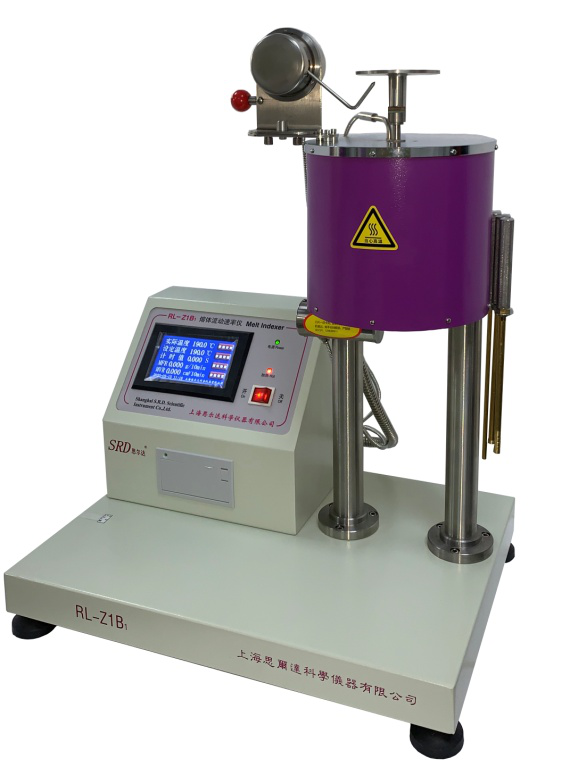
RL-Z1B1,RL-Z1B1–
Melt Flow Rate Meter Instruction Manual
(2019.07 Edition)
Automatic and Manual Determination of Melt Flow Rate (MFR)
Automatic Measurement of Melt Volume Flow Rate (MVR)
Automatic determination of melt density ρ
Determination of Melt Flow Rate Ratio (MFR) to FRR
Melt Flow Rate Tester (also known as Melt Index Tester) is a specialized instrument for measuring the melt flow rate of thermoplastic materials under specific conditions. The melt flow rate (melt index) of thermoplastic materials refers to the mass or volume of melt passing through a standard die capillary tube in 10 minutes at a certain temperature and load, represented by MFR (MI) or MVR values. It distinguishes the rheological properties of thermoplastic materials in the molten state. Ensuring the quality of raw materials, products, and other items for thermoplastic materials and synthetic fibers is of significant importance. This machine boasts high temperature control accuracy, nitriding treatment for critical components, high strength and hardness with minimal deformation, providing excellent conditions for accurately measuring the flow rate. RL-Z1B1–Barrels, piston rods, dies, and related components are made of special materials used in aviation engines, offering excellent corrosion resistance and can even be used for testing materials like F46 (polymer of tetrafluoroethylene and hexafluoropropene).
Various countries have established corresponding regulations for the accuracy of test temperature, with ASTM set at ±0.2°C, ISO at ±0.5°C, JIS at ±0.2°C, and China's regulation at ±0.5°C.
This instrument conforms to the technical specifications established by ISO 1133:1997(E), ASTM D1238-95, JIS-K72A, and other relevant standards, including National Standard GB 3682-2000, JB/T 5456, JJG 878, and others.
RL-Z1B1The melt flow rate meter is further improved in structure based on the RL-Z1B model.
I. Main Technical Parameters
1. Temperature Control
Range: 100 – 400℃
Accuracy: Not worse than ±0.2℃ (within 125℃ to 300℃)
International standard ISO 1133 and GB 3682 specified test temperatures: 125, 150, 190, 200, 220, 230, 250, 265, 275, 280, 300°C
Fluctuation not worse than ±0.1℃ (as per National Inspection Regulation JJG878, not exceeding ±0.5℃)
8-hour Bleach Shift ≤ 0.1℃ (As per National Verification Regulation JJG878, the shift within 4 hours must not exceed ±0.5℃)
Distribution ≤ 0.5℃ (As per the National metrological regulation JJG878, it must not exceed 1℃)
Resolution: 0.1℃
Error Correction Random
2. Recovery time for barrel temperature after addition ≤ 4 mins
3. Timing Clock
Range: 0~9.999s~999.9s~9999s
Resolution: 0.001s/0.1s/1s
4. Cutting Device
4.1 Automatic Cutting Device Cutting: Timer cutting 0-999s
Electric Cutting
4.2 Manual Cutting:
5. Molding Inner Diameter: Φ2.09 ± 0.005mm
6. Tube Inner Diameter: Φ9.550±0.020mm
7. Load:
Accuracy: Not less than ±0.5%
Combination Load:
325g, 1200g, 3800g, 5000g, 10000g, 12500g, 21600g (fully equipped according to ISO 1133, GB 3682)
8. National Standard Sample (PE)
Test:
Repeatability Precision ≤2% (as per National Calibration Specification JG828, not exceeding 8%)
Accuracy: ≤5% (as per National Inspection Regulation JJG828, not exceeding ±10%)
9. Measurement Range: 0.02~2000g/10min (During automatic testing)
0.03~2000cm3/10min (auto-test)
*Guaranteed no melt leakage during preheating and constant temperature.
Manual cutting tests are significantly affected by human response speed, particularly for high flow rate values.
10. Power Source: 220V, AC, 50Hz, 6A
11. Dimensions: 1×b×h = 520×380×685mm3
Weight: Main unit 30.5Kg, weight box 25Kg
13·Rated Power 0.75 kW
II. Main Structure
This instrument is primarily composed of five major parts: a computer system, a detection device, a load, an automatic testing mechanism, and an electric cutting device.
1. Detection Device (Illustration 1)
1.1 Material Tube*
Material: Nitrided steel, treated with nitriding process, HV≥700.
1.2 Material Rod (Piston Rod)*
Material: Nitriding steel, treated by nitriding process, HV≥600. The rod head diameter is uniformly smaller than the cylinder inner diameter by 0.075±0.015mm. Equipped with an insulating sleeve at the top to insulate the rod from the load. There are two刻lines spaced 30mm apart on the rod as reference marks. Their positions are: when the bottom edge of the rod head is 20mm from the die top, the upper marking line is level with the cylinder mouth (see Figure 2).
1.3 Molding Dies*
Φ2.095±0.005mm,HV≥700。
*RL-Z1B1–Corrosion-resistant, made from special materials used in the production of aircraft engines.
2. Computer System
2.1 Temperature Control System
This system utilizes platinum resistance as a temperature sensor, forming a precision temperature measurement bridge with precise resistors. It adjusts the heater's power using computer software and can automatically compensate for fluctuations in power supply voltage and the impact of ambient temperature on temperature control.
2.2 Timing and Automatic Testing Agencies
This computer timer system offers both manual and automatic timing (automatic operation) modes.
2.2.1 Automatic timing (automatic operation) overcomes the differences in reaction speed among operators from observing the timer to executing actions, and is extremely convenient. The machine is equipped with an automatic testing mechanism that detects the movement distance of the material rod with infrared rays, thereby measuring the time required for the material rod to descend 1", 1/4", or 1/8" in distance. With the input of material 2
The melt density is tested, followed by the travel time test, at which point the flow rate value is displayed and printed.
2.2.2 Manual timing; functions similarly to a stopwatch.
2.2.3 Integrated perpetual calendar.
3. Load
The load is the combined mass of the weight and beam assembly. The mass of the weights and the corresponding test loads are listed in Table 2:
| Weight (g) | Assortment (g) |
| 325 | T-type weight + beam assembly |
| 1200 | 325+875 |
| 2160 | 325+1835 |
| 3800 | 325+3475 |
| 5000 | 325+4675 |
| 10000 | 325+1450+1835+6390 |
| 12500 | 325+3475+4025+4675 |
| 21600 | 325+875+1835+3475+4025+4675+6390 |
The quality of the rod assembly does not include the quality of the guide sleeve.
4. Automatic Cutting Device
The automatic cutting device consists of a motor, a reducer, and blades, controlled by a computer, mounted at the bottom of the cylinder. It is compact in size and agile in movement.
Section 3: Working Conditions
1. Environmental Temperature: 10~35℃; (The instrument will automatically enter a protective state in an environment below 1℃.)
Relative humidity ≤ 80%
Horizontally placed, solid foundation, no vibration.
No strong air convection, no corrosive gases, and no strong magnetic field interference.
IV. Preparations and Parameter Selection
Instrument placement
1.1 Place the instrument on a stable workbench, position the level on the cylinder platform, and adjust the bottom bolts (i.e., the feet) until the level is level.
1.2 Remove the accessories: cleaning rod, pressure rod, mold through rod, and mold cleaning rod from the attachment, and place them upright on the accessory holder to the right of the instrument.
1.3 Insert the mold and rod into the material cylinder (already inserted at the factory).
1.4 Insert the instrument's power plug into the power outlet, ensuring that the power source has reliable grounding and leakage protection, and provides sufficient current supply.
2. Sample Preparation
The sample shape can be granular, flake, thin film, fragments, etc., or powdery. Prior to testing, according to the requirements of the plastic type, moisture removal and drying treatment should be carried out. When severe irregularly scattered phenomena appear in the test data, consider whether the instability of the sample properties requires the addition of a stabilizer (especially for powdered materials).
Based on the anticipated melt flow rate of the sample, weigh the sample according to the amount listed in the table (for reference only). For national standard sample experiments, follow the instructions provided for the standard sample.
Melt Flow Rate (MFR) | Sample Addition Amount (g) | |||
g/10min | ISO Standards | GB Standard | ASTM Method | JIS Standard |
0.1-0.5 | 3-5 | 3-5 | 2.5–3 | 3—5 |
>0.5-1 | 4-6 | 4-6 | 3—5 | |
>1-3.5 | 4-6 | 4-6 | 3—5 | 3—5 |
>3.5-10 | 6-8 | 6-8 | 5—8 | 5—8 |
>10—25 | 6-8 | 6-8 | 4—8 | 5-8 |
>25 | ||||
Note: When the material's density is greater than 1.0 g/cm³, it may be necessary to increase the sample quantity.
3. Test Condition Selection
The National Standard GB/T3682-2000 specifies the test conditions through Appendices A and B, and the Φ1.180 die specification mentioned in the old standard test conditions no longer appears in the current standard.
Appendix A Appendix B
(Standard Appendix) (Notified Appendix)
Test Conditions for Measuring Melt Flow Rate Test Conditions for Thermoplastic Materials
All test conditions shall be specified by the corresponding material naming or specification standards. Table B1 lists the test conditions that have been specified in the relevant standards. If necessary,
Column A1 lists the proven applicable test conditions. For certain special materials, other test conditions not listed may be used.
Table A1 Table B1
Conditions (Alphabetical Code) | Test Temperature θ, °C | Nominal Load (Combination) m nom,kg | Material | Terms (Alphabetical Code) | Test Temperatureθ ℃ | Rated Load (Combined) m nom,kg | |
A | 250 | 2.16 | PS | H | 200 | 5.00 | |
B | 150 | 2.16 | PE | D | 190 | 2.16 | |
D | 190 | 2.16 | PE | E | 190 | 0.325 | |
E | 190 | 0.325 | PE | G | 190 | 21.60 | |
F | 190 | 10.00 | PE | T | 190 | 5.00 | |
G | 190 | 21.6 | PP | M | 230 | 2.16 | |
H | 200 | 5.00 | ABS | U | 220 | 10.00 | |
M | 230 | 2.16 | PS-1 | H | 200 | 5.00 | |
N | 230 | 3.80 | E/VAC | B | 150 | 2.16 | |
S | 280 | 2.16 | E/VAC | D | 190 | 2.16 | |
T | 190 | 5.00 | E/VAC | Z | 125 | 0.325 | |
U | 220 | 10.00 | SAN | U | 220 | 10.00 | |
W | 300 | 1.20 | ASA、ACS、AES | U | 220 | 10.00 | |
Z | 125 | 0.325 | |||||
Note: If future testing requires conditions not listed in this table, such as for new thermoplastic materials, only the loads and temperatures used in this table can be selected. | PC | W | 300 | 1.20 | |||
PMMA | N | 230 | 3.80 | ||||
PB | D | 190 | 2.16 | ||||
PB | F | 190 | 10.00 | ||||
POM | D | 190 | 2.16 | ||||
MABS | U | 220 | 10.00 | ||||
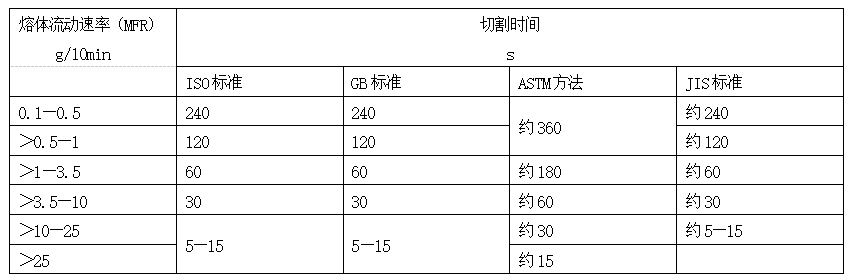
4. Cutting Time Selection
When testing by the cutting and weighing method, whether automatic or manual cutting, the required interval time for cutting samples must be anticipated. Too short an interval results in small sample strips, with increased impacts from weighing and cutting errors. The interval time should also not be too long; first, the quality of the sample within the effective segment of the material rod (i.e., between the second marks) is limited, and secondly, we also hope to obtain more than two strips for parallel comparison at the same time.
5. Mobile Itinerary Selection
The automatic testing function calculates the mass of the material discharged based on the downward displacement distance (i.e., stroke) of the material rod and the density of the melt inside the material cylinder. Within this instrument, three levels of material rod stroke are set: 1" (25.4mm), 1/4" (6.35mm), and 1/8" (3.175mm). It is recommended to select the stroke based on the expected material flow rate MFR, as shown in the table below:
| MFR(g/10minn) | Stroke Length (mm) |
| 0.01~0.5 | 3.175(1/8”) |
| 0.5~10 | 6.35(1/4”) |
| >10 | 25.4(1”) |
V. Test Melt Flow Rate (MFR) Using the Cutting-Weight Method
The cutting-and-weighing method is the most basic approach, which operates directly according to the standard's description (referred to as Method A in the National Standard GB3682-2000). Its fundamental principle is: cut a segment of molten material flowing from the die bottom, where the flow time of this segment is known. Weigh the molten material and convert it to the flow rate over 10 minutes, which is the Melt Flow Rate (MFR, also known as MI) of the material, with units of g/10min.
When using the cutting weighing method, first press the automatic test needle rod all the way down.
1. Select Temperature, Load
Based on the test material, the combination of test conditions, i.e., the test temperature and the nominal load, is obtained from Article 3 of Chapter 4. Some materials have multiple combinations of test conditions, which can be determined according to the agreed standards or the company's own standards. For materials with additives in the base material, the base material determines the conditions. Those that are new materials and not listed in the standard appendices, according to GB3682, the test conditions for these new materials can only be selected from the loads and temperatures used in the appendices.
2. Set Temperature
See Section 2.2 of Chapter 10.
Additive
Connect the instrument and turn on the power, set the specified temperature, insert the mouth mold and material rod. Generally, after 20-30 minutes, the temperature will stabilize. Place a certain amount of material in the feeder for later use.
Add material after temperature stabilization:
Remove the material rod and place it on a high-temperature-resistant object, avoiding any collision of the rod's tip with other hard objects.
b. Insert the hopper into the cylinder (try to avoid contact with the cylinder wall to prevent overheating and sticking), then pour the material slowly into the hopper using the feeder, while shaking the hopper to allow the material to fall quickly.
c. Once the material is added, use the pressure rod to compact it (while expelling bubbles as much as possible). Be cautious not to use the material rod (piston rod, for testing purposes) to tighten the material, as both the rod and the cylinder are very hard, which may cause damage. The pressure rod is made of copper, which will not harm the cylinder.
d. Insert the material rod, and place the weight pan on top (usually no need to apply weights at this point to prevent excessive material loss). When inserting the material rod, ensure the positioning sleeve on the rod fits into the cylinder to prevent the rod from tilting.
The steps a-d should be completed within one minute to ensure temperature recovery time and accuracy of the test data. After 4-6 minutes of temperature adjustment, the temperature will return to the preset value (±0.2℃ of the set temperature), and you may proceed with the subsequent testing procedures.
4. Automatic Cutting Test
4.1 Set the cutting interval time and number of cuts according to the cutting time selected under Article 4 of Chapter IV; see details in Article 2.7 of Chapter X.
4.2 Add weights (which can also be added immediately after adding material, depending on the material's characteristics), and quickly lower the material rod to the first scale line. If it cannot be quickly lowered, apply an external force to the weights (be sure to apply vertically, not horizontally, to avoid damaging the rod), allowing it to quickly lower. Alternatively, you can add the weights in advance during the next test.
4.3 Upon the material rod nearly descending to the lower marking line, activate the automatic cutting function (refer to Chapter 10, Section 2.4), and the automatic cutting device will then cut the sampling strips individually by time intervals.
When using the cutting blade, if the gap between the blade edge and the mold outlet is too large, it can cause the sample strips to be uneven or sticky; if the gap is too small to the point of jamming, it will not operate normally. At this point, you should adjust the gap between the blade and the outlet.
Loosen the two fixing screws of the blade and adjust the blade to the optimal position.
5. Hand-cut
In cases where certain materials may not be easily cut automatically due to issues like sticking, manual cutting can be tried instead. A wooden-handled cutting knife is provided in the drawer at the bottom of the instrument, specifically for this purpose. It's quite common in international use.
While cutting, simply hold the wood handle with your right hand and insert the curved blade tip from the bottom of the cylinder to the mouth by pushing it to the left.
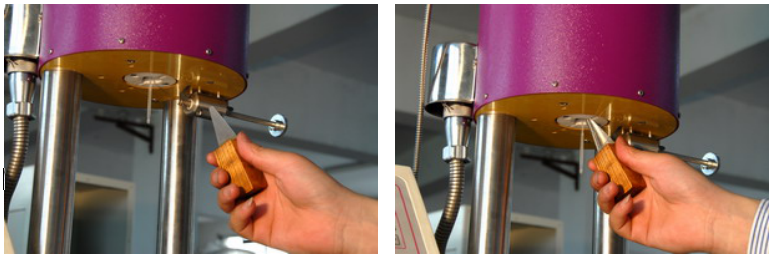
During hand cutting, the computer timer is used as a stopwatch (refer to Chapter 10, Section 1.12).
6. Weight Calculation
a. Discard strips with visible bubbles, and weigh the retained strips (preferably at least three) individually, accurate to 0.0001g, to calculate their average weight. If the difference between the maximum and minimum weights of individual samples taken at the same time interval exceeds 10% of the average, a retest should be conducted.
b. Calculation Result
Melt Flow Rate (MFR, MI) is expressed as the mass of melt that extrudes in 10 minutes (g).

In the formula: MFR - Melt Flow Rate (g/10min)
m — average quality of the sample bar (g)
t - Cutting time interval (s)
6. Automatic Melt Flow Rate Testing (Mass Flow Rate MFR, Volume Flow Rate MVR)*Operation method for )
The method of automatic testing is derived from the basic cutting and weighing method, and is now included in the new standard (GB3682-2000, Method B). Its basic principle is:
Knowing the stroke of the material rod, the volume of molten material flowing out is known. Knowing the melt density of the material, the mass of the material flowing out is known. By automatically measuring the time it takes to flow out the mass of the material with the instrument, the melt flow rate (MFR) of the material can be calculated.
Select temperature, load, and stroke
Based on the test material, the combination of test conditions, i.e., the test temperature and the test nominal load, is obtained from Article 3 of Chapter 4. Some materials have multiple combinations of test conditions, which can be determined according to the agreed standards or proprietary ones. For those with additives in the base material, the base material determines the conditions. For new materials not listed in the standard appendices, as per GB3682, the test conditions for these new materials can only be selected from the loads and temperatures used in the appendices. For the selection of stroke, please refer to Article 5 of Chapter 4.
2. Set Temperature
See Section 2.2 of Chapter X.
3. Set other parameters
3.1 Setting of melt density
Material density in molten state at a specific temperature (g/cm³)3It is a necessary condition for the automatic testing of melt flow rate to ensure melt quality. If only the volume flow rate is tested, it is unrelated to the melt density.
The following are the melt densities of two materials, which have been published according to international standards (ISO) and American standards (ASTM). These densities are constant at specific temperatures and are unrelated to the density at room temperature:
ρPE(190℃)=0.764g/cm3
ρPP(230℃)=0.739g/cm3
If the material is not as stated above or if the stated materials have been mixed with additives or fillers, testing can only be conducted after confirming the melt density of the material. The melt density can also be tested using this equipment; see Chapter 7 for details.
3.2 Trip Arrangement
See Chapter 10, Section 2.6. This is a mandatory item that can be selected in 1" (25.4mm), 1/4" (6.35mm), or 1/8" (3.175mm).
3.3 Sample Number Setting
See Section 10, Article 2.7. This is a default setting option, intended for printing purposes only.
3.4 Load Setting
See Section 10, Paragraph 2.7. The numerical setting for load is not related to the actual load applied. To ensure that the print parameters match the real situation, the numerical setting must be consistent with the actual load. This is also the default setting, intended only for use during printing.
3.5 Date Setup
The date is set at the factory, usually no further adjustment is needed. If adjustment is required, please refer to Chapter 10, Section 2.1.
Additive
Connect the instrument and turn on the power, set the specified temperature, insert the mold and material rod. Generally, the temperature will stabilize after 20 to 30 minutes. Place a certain amount of material in the hopper for use.
Once temperature stabilizes, add material.
Remove the material rod and place it on a high-temperature resistant object, ensuring the rod's tip does not collide with any hard surfaces.
b. Insert the hopper into the cylinder (try to avoid contact with the cylinder wall to prevent overheating and sticking), then pour the material slowly into the hopper using the feeding device while vibrating the hopper to facilitate quick material leakage.
c. Once filling is complete, use the pressure rod to compact the material (while extracting as many bubbles as possible). Be careful not to use the material rod (piston rod, for testing) to tightly compress the material; both the rod and the cylinder are very hard, which could cause damage. The pressure rod is made of copper and will not harm the cylinder.
d. Insert the material rod and place the weight tray over it (usually no need to press down on the weights to prevent excessive material loss). When inserting the material rod, ensure the locating sleeve on the rod is seated into the material cylinder to prevent the rod from tilting.
The steps a to d should be completed within one minute to ensure the recovery time of temperature and accuracy of test data. After a temperature adjustment of 4 to 6 minutes, the temperature will return to the preset temperature (within ±0.2℃ of the set temperature), at which point you may proceed with the following testing procedures.
5. Automatic Testing
5.1 Lift the pin rod of the travel device to the highest position and add the weights.
5.2 Click "Test Function," then select "Automatic Test." After that, click "Start." The automatic test will be activated, and the instrument will enter automatic test mode (refer to Chapter 10, Section 2.3). Once the instrument is in automatic test mode, you will not be able to modify other set parameters, including default parameters. If you need to modify them, you must click the "Interrupt Test" button.
5.3 As the weight moves down, the bottom of the weight slightly presses the plunger, and when the lowest line on the material rod (piston rod) reaches the starting position for automatic testing, the instrument automatically begins the timing test. If the material rod cannot quickly descenddiyiGroove lines are provided to apply external force to the weights (note: apply force vertically, not horizontally, to avoid damaging the beam). This allows for quick downward movement. Additionally, the weights can be pre-added for the next test.
5.4 The journey ends, the test concludes. The instrument automatically calculates the results and simultaneously displays the flow rates of mass and volume (MFR, MVR) on the screen while printing them out.
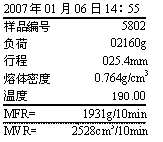
Section 7: Material Density Testing in Molten State*Operation Method for Melt Density
The principle of testing the density of material in a molten state is to measure the mass of the melt within a certain volume.
Select and set the temperature
The selection and setting of the temperature are consistent with that during the test of the melt flow rate.
2. Select and set the itinerary
Refer to Chapter 10, Section 2.6. Generally, a longer itinerary is preferable.
3. Select Load
Here, there are no specific requirements for selecting the load, also refer to Article 3 of Chapter 4.
4. Additives
Refer to Article 4 of Chapter 6
5. Testing
5.1 Lift the top rod of the travel device and add the weights.
5.2 Click "Test Function," then "Density Test." Click "Start" afterwards, and you will enter the melt density test mode.
5.3 As the weight is lowered, the bottom of the weight slightly depresses the plunger, and when the lowest line on the material rod (piston rod) reaches the automatic test starting position, the automatic cutting blade will automatically cut once, removing the previously extruded material. Once the material rod has completed its downward travel, the automatic cutting blade cuts again, and the cut material is then ready for use.
If the material rod cannot be issued quicklydiyiScore lines are available for applying external force to the weights (note: apply force vertically, not horizontally to avoid damaging the material rod), causing them to quickly descend.
5.4 Conduct at least three repetitions of the test, obtaining at least three sample strips.
5.5 Weigh the cut strips.jingqueDown to 0.0001g.
5.6 Calculate the melt density of the material according to the formula:
ρ=14·m/L(g/cm3)
Equation: m — average quality of the spline (g)
L - Length (25.4, 6.35, or 3.175mm)
Section 8: Determination and Calculation of Melt Flow Rate Ratio (FRR)*
The melt flow rate ratio is typically used to represent rheological properties, calculated as the ratio of melt mass flow rate or melt volume flow rate measured under two different test conditions.
FRR=MFR(t,m1)/MFR(t,m2)
Or FRR = MVR(t, m1) / MVR(t, m2)
Please refer to Chapter 5 and 6 of this book for the determination of MFR and MVR.
Section 9: Cleaning
After each test, apply pressure above the weights to expel excess material quickly, then remove the material rod. Use a clean cloth to wipe it clean while still warm, and then add material to the hopper on top of the cylinder.
Clean gauze (approx. 50×50mm, two layers), press the cleaning rod against the gauze and insert it into the inner wall of the material cylinder, repeatedly rotate and pull multiple times. Then, use the mold push rod to push the mold out of the cylinder from bottom to top, and clean the mold's inner and outer surfaces with the mold cleaning rod and gauze.
For materials that are difficult to clean, apply some lubricant, such as silicone oil, decamethylcyclopentadiene, or paraffin, while hot, to the areas needing cleaning (inside the barrel, mold interior and exterior, and extruder shaft). If necessary, mineral candles can also be used. Cleaning will then be much easier.
Ten. Overview of Test Function and Parameter Settings
1. Introduction to Test Features and Parameter Settings
1.1 Automatic Testing
The automatic test measures the downward distance (i.e., stroke) of the pre-set material rod using infrared detection, automatically records the descent time, logs and calculates the MFR and MVR, displaying the results on the screen, while simultaneously being printed out by a microprinter.
1.2 Automatic Cutting
After initiating the automatic cutting, the cutting device automatically cuts the strips at the set time intervals until the predetermined number of cuts is reached, at which point the cutting device stops. The cutting process can also be interrupted during operation.
1.3 Density Test
See Chapter 7.
1.4 Print Preview
After launch, click "Print" to re-print the previous test results.
1.5 Itinerary
There are three stroke options available for setting: 1" (25.4mm), 1/4" (6.35mm), and 1/8" (3.175mm). During automatic setting, the infrared detection sensor automatically records the time taken for the sample to move this distance, to calculate the automatic test results.
1.6 Sample ID
The digital number of the sample is up to 4 digits, which can be omitted.
1.7 Load
Total mass of the added weights during the test sample (unit: g, including the rod component).
1.8 Melt Density
Material density in the molten state at the corresponding temperature (unit: g/cm³)3It is a necessary condition for the automatic testing of melt flow rate to ensure melt quality.
1.9 Cut Timing
During automatic cutting, select the cutting interval time (0-999s).
1.10 Cut Times
During the automatic cutting process, select the number of cuts (0-99 times).
1.11 Temperature Adjustment
The temperature correction values corresponding to the set temperature points, for use in temperature calibration, see detailed methods in Chapter Eleven on temperature error correction.
1.12 Timer
During manual operation, the computer timer functions as a stopwatch: Click the manual timing button to reset and start the timer, and click the "Stop" button to halt the timing.
1.13 Automatic (Test Cutting)
Enable this option to perform tests for clauses 1.1 and 1.2 of this article simultaneously.
2. Parameter verification, settings
When setting parameters, click the numeric display of the parameter to pop up the keyboard, enter data, and press "OK" to complete the setup.
2.1 Set Year, Month, Day, Weekday, and Clock
Click the clock number at the lower left corner of the screen, the keyboard will pop up. Enter the correct time and press "OK."
2.2 Set Temperature
Click the original set temperature value, a keyboard will pop up on the screen. Enter the temperature value you wish to set and then press "OK."
2.3 Automatic Test Start and Stop
Initiate: Click the "Test Function" button, then click the "Start" button behind "Auto Test," and the auto test will initiate.
Note: To modify any parameters or make other settings after the automatic test has started, you must first interrupt the automatic test.
Close: Click "Interrupt Test" followed by "Confirm Interrupt," the automatic test will stop.
2.4 Automatic Cutting Start and Stop
Initiate: Click the "Test Function" button, then click the "Start" button after "Automatic Cutting," and the automatic cutting will begin.
Close: Click "Interrupt Test" and then click "Interrupt Test" again to automatically cut and close.
2.5 Density Test, Automatic (Test Cutting) On and Off
Just like the settings for automatic test start and stop, simply click the "Start" button on the action where the item is located to initiate it. To shut down, click "Interrupt Test" followed by "Confirm Interruption."
2.6 Itinerary Setup
Click "Parameter Settings," then click the number behind the travel. The screen will pop up a keyboard. Set the travel value (it can only be 3.175, 6.35, or 25.4) and press "OK."
2.7 Sample Number, Load, Melt Density, Cutting Time, Number of Cuts, Temperature Compensation Settings
The setup method is the same as the itinerary setup. To modify an item, click on the number in the row where the item is located, then enter the number on the pop-up keypad, and press "OK."
Eleven. Temperature Error Correction
1. Measurement of existing temperature error
Temperature is referenced to a standard mercury thermometer, which can be adjusted randomly (thermometer is sold separately). The machine can provide 11 types of specialized calibration thermometers in 125, 150, 190, 200, 220, 230, 250, 265, 275, 280, and 300°C specifications (including various domestic and international testing standards). Place the 10mm pad from the machine's accessories on top of the mold in the barrel, then insert the thermometer so that the bottom of the mercury bulb touches (if the mercury in the thermometer breaks and cannot be restored by shaking, place the thermometer in the freezer for a few minutes until the mercury retracts), and tightly塞 the gap above with gauze. Turn on the machine, heat up, and wait for the temperature to stabilize. The difference between the actual temperature value displayed by the instrument and the value read from the mercury thermometer (including its correction value) is the current temperature error. For example, if the instrument displays the barrel temperature as 190°C and the standard mercury thermometer temperature (including the correction value) is 190.25°C, then the temperature display deviation is -0.25°C. If using a different mercury thermometer for calibration, the diameter correction must be considered.
*1 According to standard procedures, the mold should be filled with sample material, then after melting, the thermometer should be inserted, maintaining a distance of 10mm above the die opening, and the molten material should at least envelop the entire mercury bulb. This method is quite麻烦. A simpler approach is to use a 10mm-high F4 material (suitable only below 250℃), placing it between the thermometer and the die, securing it tightly with cloth or similar materials to insulate. Although this method differs from the standard, the discrepancy is minimal, and it is easier to use.
*2 Our company-provided specialized thermometers (supplied separately) do not require dew point calibration. This unit can provide 125, 150, 190, 200, 220, 230, 250, 265, 275,
280, 300℃ thermometers in 11 different specifications, each with a precision of only 2℃ range, covering all test parameters of ISO and GB.
*3 The unit comes with two spare thermometers. In the absence of any other instructions from the user, they are set at 189-191℃ and 229-231℃ respectively.
2. Correction
The unit undergoes full system temperature linear error calibration at the factory. At any point within the range of 125℃ to 300℃, the standard error is no worse than ±0.2℃, with a maximum correction capability of ±9.99℃. After the instrument has been in use for a period, the temperature display may shift. In this case, it is necessary to calibrate the temperature display system. When making corrections, please follow the following procedures:
2.1 As per the first article of this chapter mentioned above, determine the temperature deviation.
2.2 Add the determined temperature deviation to the originally entered correction value to obtain a new correction value. For instance, if the original correction was +0.10℃ and the now determined temperature deviation is -0.25℃, the new correction to input into the computer would be +0.10℃ - 0.25℃ = -0.15℃.
2.3 Amend the temperature correction values as per Chapter 10, Section 2.7, and revise the correction value lines.diyiThe position is for the sign bit; it must be entered with either a "+" or "-" symbol.
2.4 The unit has a total of 12 correction points capacity, with 11 already set, leaving one empty slot. Users can set it themselves as per the previous method if needed.
Twelve. Safety Matters
Regularly inspect electrical grounding for integrity.
2. Always wear gloves during operation and cleaning to prevent burns.

Phone Consultation