

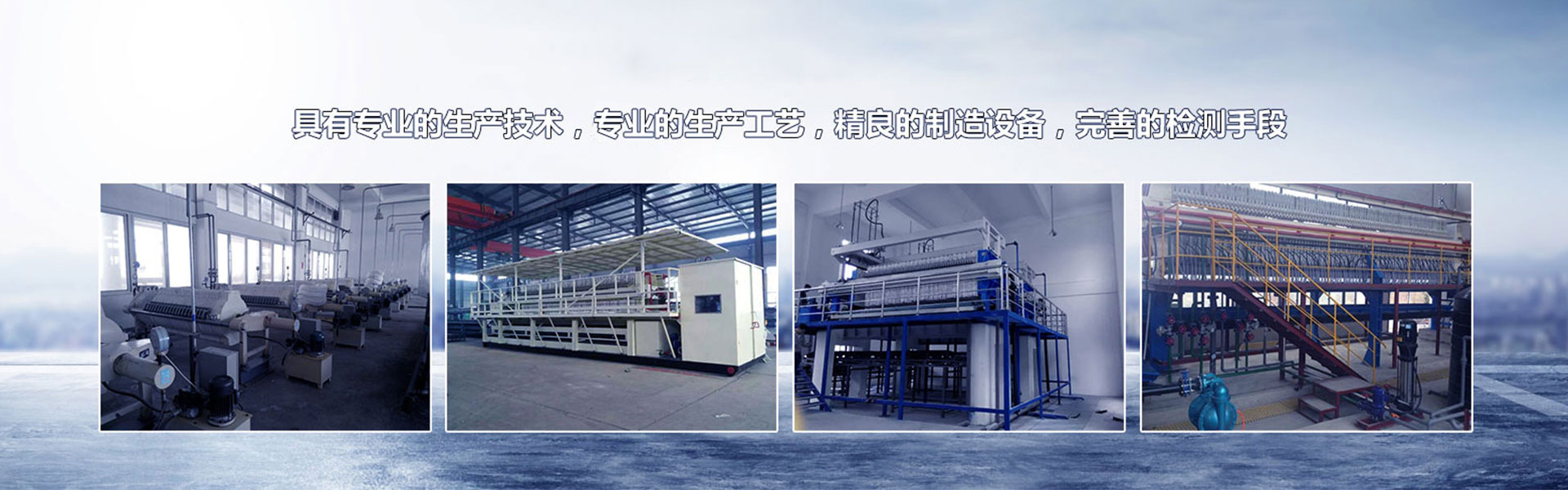
As equipment usage becomes more prevalent in everyday life, you might be familiar with filter presses. But do you know the different types of filter presses and what each one specifically entails? Today, our editor has meticulously compiled a detailed guide on the various types of filter presses.
The plate and frame press filter consists of a group of filter chambers composed of alternately arranged filter plates and frames. The surface of the filter plates has grooves, with the protruding parts used to support the filter cloth. The corners of the frames and filter plates have through-holes, which, when assembled, form a complete channel for introducing suspension, wash water, and extracting filtrate. Handles are supported on cross beams on both sides of the plates and frames, and are clamped by the clamping device. The filter cloth between the plates and frames acts as a sealing washer. The suspension is pumped into the filter chamber by a feed pump, forming a filter cake on the filter cloth until the chamber is full. The filtrate passes through the filter cloth and flows along the grooves of the filter plates to the corner channels, where it is discharged. After filtration, clean water can be introduced to wash the filter cake. Sometimes, compressed air is also introduced after washing to remove any remaining wash water. Subsequently, the press filter is opened to remove the filter cake, wash the filter cloth, re-tighten the plates and frames, and start the next work cycle.
The plate and frame press filter is suitable for suspensions with high compressibility of filter cake or nearly incompressible. The solid particle concentration of the suitable suspension is generally below 10%, and the operating pressure is typically 0.3 to 0.6 MPa, with special cases reaching up to 3 MPa or more. The filtration area can be adjusted by the number of plate and frame units used. The plates and frames are usually square, with the inner length of the filter frame ranging from 200 to 2000 mm, and the frame thickness from 16 to 80 mm, offering a filtration area of 0.5 to 1200 square meters. The plates and frames are secured using manual, electric, or hydraulic methods. They are manufactured from materials such as wood, cast iron, cast steel, stainless steel, polypropylene, and rubber.
3. Box Type Press Filter
The box filter's structure and working principle are similar to those of a plate and frame filter, differing in that the filter plates have indented sides, forming a box-shaped filter chamber with two plates combined. It eliminates the need for a filter frame, with a circular hole in the center of the filter plate allowing the slurry to flow into each chamber. This type of filter is suitable for suspensions that require filtration under high pressure but do not need washing of the filter cake.
Vertical Pressure Filter
The vertical pressure filter features filter plates that are horizontally and vertically stacked to form a filter chamber, occupying less floor space. It utilizes a continuous filter belt, which, after filtration, can be moved for sludge discharge and belt cleaning, with automated operation. The pressure filter has a wide range of applications and a simple structure. The clamping and releasing of plates and frames, as well as sludge discharge and filter cloth cleaning, can all be automated, promoting the large-scale development of pressure filters. With the addition of elastic rubber diaphragms in the filter chamber, the filter cake can be further pressed and dewatered at the end of filtration using high-pressure water or compressed air, compressing the filter cake through the rubber diaphragm. This creates a membrane squeezing filtration process with variable chamber volume and compressed filter cake, achieving pressures of up to 1 to 2 MPa.
4. Belt Filter Press
The Belt Press Filter is widely used in sludge dewatering across various industries, including urban wastewater treatment, chemicals, oil refining, metallurgy, papermaking, leather processing, food, coal washing, and dyeing. The machine operates continuously, boasts high automation, energy efficiency, and ease of use and maintenance, making it the ideal equipment for sludge dewatering.
Above are four different types of filter presses, hoping they can assist you. If you have any further questions, feel free to consult our website, where we have dedicated staff to explain to you.


通过中商114认证