







I. Overview
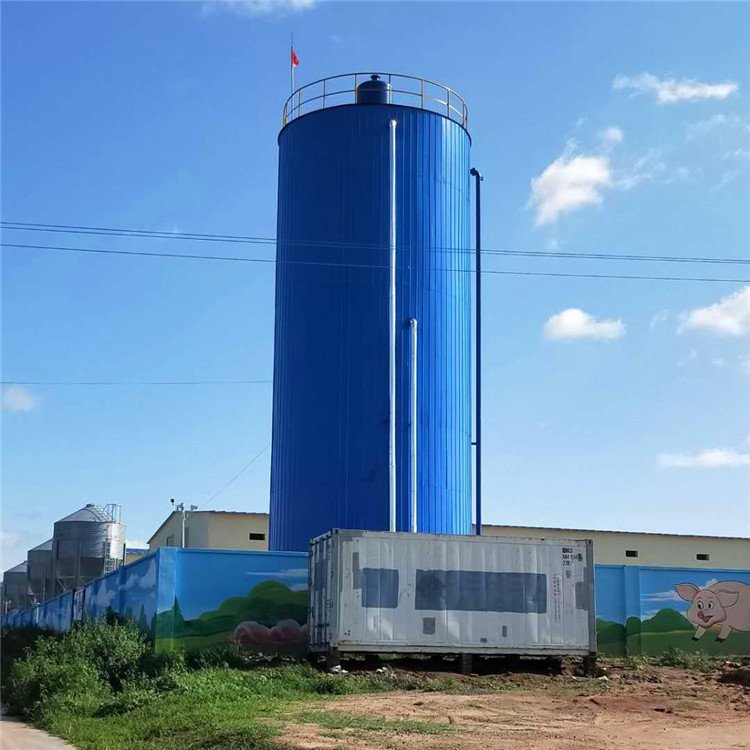
The IC (internal circulation) reactor is a new generation of anaerobic reactor, also known as an internal circulation anaerobic reactor, which is similar to a series of two UASB reactors. It consists of two reaction chambers, upper and lower. Wastewater flows upwards in the reactor, where pollutants are adsorbed and degraded by bacteria, and the purified water exits from the upper part of the reactor.
Section II: Working Principle
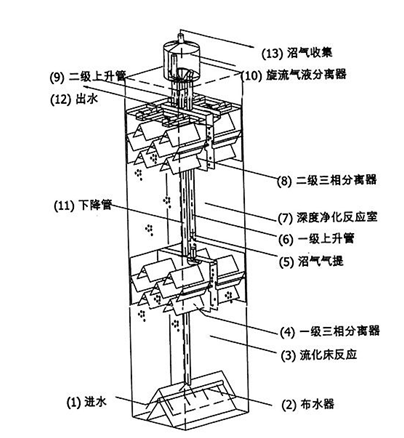
It is similar to a series of 2 UASB reactors. Functionally, the reactor is divided into 5 sections from bottom to top: mixing zone, 1st anaerobic zone, 2nd anaerobic zone, sedimentation zone, and gas-liquid separation zone.
Mixed zone: The mixture of sludge water from the bottom of the reactor, granular sludge, and the回流 from the gas-liquid separator is effectively mixed in this zone.
Zone 1: The sludge-water mixture formed in the mixing zone enters this area, where, under the action of high-concentration sludge, most of the organic matter is converted into biogas. The vigorous upflow of the mixed liquid and the disturbance of the biogas enhance the sludge's expansion and fluidization within the reaction zone, strengthening the surface contact between sludge and water, thus maintaining high activity of the sludge. As the biogas production increases, part of the sludge-water mixture is lifted to the top gas-liquid separation zone by the biogas.
Gas-liquid separation zone: The沼气 from the elevated mixture is separated from the slurry here and discharged to the treatment system, while the slurry mixture flows back through the recycle pipe to the lower mixing zone, where it is thoroughly mixed with the sludge at the bottom of the reactor and the incoming water, achieving an internal circulation of the mixed liquid.
Zone 2 Anaerobic Area: After treatment in Zone 1 Anaerobic Area, the wastewater, with a portion upgraded to biogas, the rest enters Zone 2 via a three-phase separator. This zone has a lower sludge concentration, and most of the organic matter has been degraded in Zone 1. Thus, less biogas is produced. The biogas is introduced into the gas-liquid separator through biogas pipes, causing minimal disturbance to Zone 2, which provides favorable conditions for sludge retention.
Settling Zone: The sludge-water mixture from the second anaerobic zone undergoes solid-liquid separation in the settling zone. The supernatant is discharged through the outlet pipe, while the settled particulate sludge is returned to the sludge bed in the second anaerobic zone.
From the working principle of the IC reactor, it can be seen that the reactor achieves SRT > HRT through two-stage three-phase separators to obtain high sludge concentration; through a large amount of biogas and intense mixing from internal circulation, the sludge and water are fully contacted, resulting in excellent mass transfer efficiency.
Section 3: Equipment Structure
IV. Advantages
High volumetric loading: The sludge concentration in the IC reactor is high, with a large amount of microorganisms and an internal circulation, resulting in excellent mass transfer. The influent organic loading can exceed that of a standard anaerobic reactor by three times or more.
(2) Save Infrastructure Investment and Land Area: The volume load rate of IC reactors is about 3 times higher than that of ordinary UASB reactors, with a volume approximately 1/4 to 1/3 of the ordinary reactors, significantly reducing the infrastructure investment for reactors. Moreover, the aspect ratio of IC reactors is very high (usually 4-8), so they are particularly space-saving, making them highly suitable for new and expansion projects in tight industrial and mining enterprises.
(3) Strong Impact Load Resistance: The IC reactor achieves its internal circulation, with the circulating flow reaching 10-20 times the incoming water volume. Due to the thorough mixing of a large amount of circulating water and incoming water at the bottom of the reactor, the organic matter concentration at the bottom is reduced, thereby enhancing the reactor's resistance to impact loads. Additionally, the large water volume ensures uniform distribution of sludge at the bottom, guaranteeing sufficient contact and reaction between organic matter in the wastewater and microorganisms, thereby increasing the treatment load.
(4) Strong resistance to low temperatures: The impact of temperature on anaerobic digestion is primarily on the digestion rate. Due to the large number of microorganisms, the impact of temperature on anaerobic digestion in IC reactors is no longer significant or severe. Typically, anaerobic digestion in IC reactors can be carried out under normal temperature conditions (20-25 °C), which reduces the difficulty of digestion insulation and saves energy.
(5) Excellent effluent stability: As the IC reactor operates in series like two UASB reactors, the lower reactor handles high organic loading for "rough" treatment, while the upper reactor has lower loading for "fine" treatment, ensuring good and stable effluent quality.
(6) Short Start-up Cycle: The sludge activity inside the IC reactor is high, and the biological proliferation is fast, providing favorable conditions for rapid start-up. The typical start-up cycle for an IC reactor is 1 to 2 months, whereas the start-up cycle for a conventional UASB can last up to 4 to 6 months [7].
IC reactors are currently widely used in the papermaking industry by paper companies that use various waste papers as raw materials. The purposes of treatment include achieving general compliance with emission standards and reusing treated wastewater, thereby achieving the dual objectives of water conservation and pollution control.
Section 6: Applicable Scope
The IC anaerobic reactor is a multi-stage internal circulation reactor, representing a type of the third-generation anaerobic reactor (with UASB representing the second generation). Compared to the second-generation anaerobic reactors, it features less land requirement, higher organic load, stronger shock resistance, more stable performance, and simpler operation and management. It is suitable for high-concentration organic wastewater with a COD of 10,000-15,000 mg/L; the second-generation UASB reactor typically has a volume load of 5-8 kgCOD/m³; the third-generation IC anaerobic reactor can achieve a volume load rate of up to 15-30 kgCOD/m³. The IC anaerobic reactor is applicable to high-concentration organic wastewater, such as corn starch wastewater, citric acid wastewater, beer wastewater, potato processing wastewater, and alcohol wastewater.