



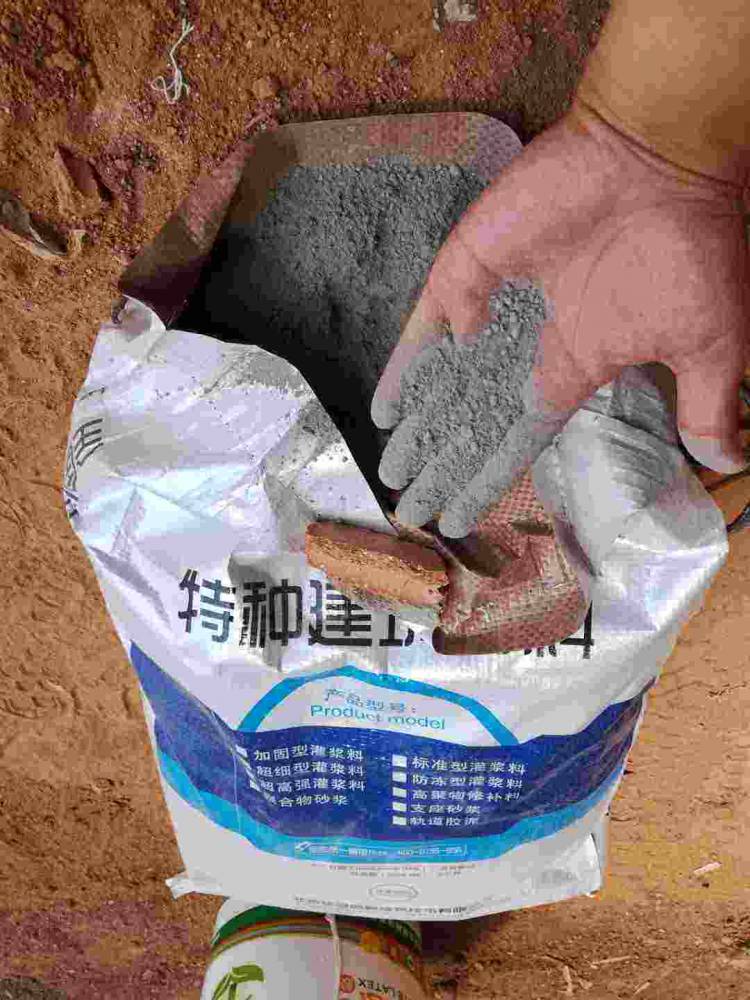











Winter construction
When the daily average temperature is below 5 ° C, winter construction should be carried out and meet the following requirements:
1. Before grouting, measures should be taken to preheat the foundation surface, keep its temperature above 100 ° C, and remove accumulated water.
Before being frozen, the compressive strength of cement-based grouting materials shall not be less than 5MPa.
High strength non shrinkage grouting material quality guarantee, Wuhe section enlarged grouting material

Promoting the industrialization of housing is a complex systematic project. The development of a wall system that can be mechanically constructed is the fundamental work for realizing the industrialization of residential buildings. At present, the main residential building systems in China include brick concrete structure residential system, reinforced concrete structure residential system, and steel structure residential system. Among them, the steel structure residential system is convenient for achieving standardization and componentization, and organizing industrial production is in line with the direction of residential industrialization development. Steel structure residential buildings have the characteristics of high load-bearing capacity per unit volume, convenient production and installation, short construction period, good seismic performance, easy reconstruction and demolition, and high material recycling and reuse rate. They are a green industry for harmonious and sustainable development between humans and nature.
Construction in high temperature climate environment
If the temperature of the grouting site is greater than 35 ° C, construction should be postponed according to the high temperature climate and meet the following requirements:
Measures should be taken 24 hours before grouting to prevent direct or other thermal radiation from the grouting area.
2. Take appropriate cooling measures, and the temperature of the concrete foundation and equipment base plate in contact with the cement-based grouting material should not exceed 35 ° C.
3. The injection temperature of the slurry should not exceed 30 ° C.
4. Moisturizing and curing measures should be taken promptly after grouting.
High strength non shrinkage grouting material quality guarantee, Wuhe section enlarged grouting material

The K-value of a thermistor. Thermistor (R value) is the reciprocal of L (1/liter) used as a thermal resistor for any material or composite material. The value of r can be defined as providing a simple heat flow calculation for any specific resistive material. Good insulation materials will have a high R-value. For other thicknesses exceeding 1 meter, the R value increases proportionally with the increase of insulation material thickness. This is x/liter, where x represents the material thickness in meters. The heat transfer coefficient (U) is the overall coefficient of heat transfer in any section of the symbol (H-1C-1 of M-2 in kilocalories) or in composite materials. The SI unit for U is the temperature difference between indoor and outdoor air, measured in kilocalories per degree Celsius, per square meter, and per hour.
The maintenance free construction conditions are as follows
When the construction temperature is above 5 ℃ and below 35 ℃, there is no need for maintenance after foundation grouting. If the temperature exceeds the range, the grouting material construction and maintenance methods should be followed for maintenance.

Marble is relatively soft stone, and on the Mohs hardness scale (MOHS), the grade of marble is approximately 3 (1). Marble, like teeth, is made of calcium. If you bite on something too hard, your teeth will break, and if you eat too much sugar, your teeth will become perforated. The same goes for stone. If the reagents used on the surface of the stone are not appropriate, the stone will start to rot and form pores. Below is the famous Mohs hardness table. This standard was established in the early 19th century to help identify the strength and hardness of the stone used, in order to take appropriate measures when applied. Stones with lower hardness require softer reagents and more frequent mopping.















