















International practical logistics and supply chain consulting planning and operation services
In the era of accelerated change, relying too much on organizational conventions or inherent experience will seriously hinder the pace of enterprise development, and may even lead to the decline of the enterprise. Developing a clear and executable strategy is an essential measure for enterprises to win in competition and achieve long-term development. Strategy is a comprehensive planning and strategy based on the future development of the enterprise, aimed at seeking and maintaining competitive advantages. It is a key factor determining the success or failure of the enterprise's operations.
As a trusted strategic consulting firm, Chuangtan Consulting will build a vision for enterprise development, develop strategic plans, redefine the dynamic changes between enterprise value continuity and creation, create a high operational organizational structure, enhance the flexibility and efficiency of enterprise management, strengthen the operability and controllability of strategic goal implementation, assist clients in implementing strategies, and gain competitive advantages in industry competition.
Service Content
Business Strategy: Creating and Realizing Business Value
According to changes in the market environment, selecting suitable business fields and products based on one's own resources and strength, forming one's own core competitiveness, and winning in competition through differentiation are the essence of enterprise development.
What can we bring to the enterprise?
1. Choose the appropriate target market
2. Clear and competitive product line combination
3. Help enterprises find a balance between relative scale and economies of scale
4. Develop strategies and implementation plans for entering new domestic markets, regions, or international markets
Operational Strategy: Improve Efficiency and Productivity
By optimizing business process design, improving customer value chain models, optimizing cross departmental business collaboration relationships and business rules, and unleashing customer enterprise value. Deeply understand the strategic intent of the enterprise and its requirements for organizational control, redesign the organizational management system of the enterprise to achieve and enhance its innovation capabilities.
What can we bring to the enterprise?
1. Diagnosis and design of organizational structure
2. Control mode and process design of the group company
3. Identify the key support points of IT for business and obtain strategic performance improvements
4. Help enterprises adapt to significant changes in processes, job roles, innovative technologies, etc. with high efficiency
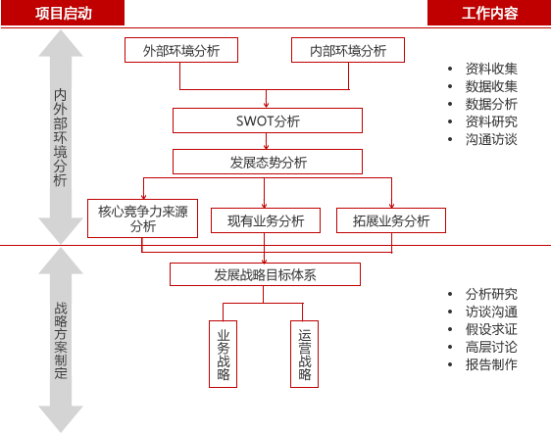
Strategic consulting project framework structure
work phase
Phase 1: Evaluate the environment in which the enterprise operates
1. Examine the internal and external business environment of the enterprise to obtain information that may have an impact on its future business development plans, organizational structure, operational processes, etc.
2. Through interviews and due diligence, describe the various personnel structures of the organization, such as management personnel, general employees, suppliers, customers, banks, * * departments, competitors, etc.
3. Analyze the current organizational structure, corporate culture, management system, etc. of the company to identify existing problems and deficiencies.
4. Clarify the main business processes of the enterprise and identify the processes that need improvement.
5. Evaluate the technical adaptability of business application systems and management architectures.
Phase 2: Conduct top-level design
1. Deeply understand the strategic intent of the enterprise and its requirements for organizational control, and design business development plans.
2. Define the rules for controlling and allocating organizational resources, redesign the company's organizational management system, and establish a clear control mode.
3. Through analysis, determine how to support key business processes and expand business capabilities through IT.
4. Identify key positions closely linked to the strategy and derive the ability requirements for core talents.
Phase Three: Implementation and Implementation
1. Redefine the direction and layout of enterprise business development based on industry trends.
2. Implement measures to promote more flexible organizational structures and business processes.
3. Establish a market-oriented performance identification and incentive mechanism for key positions, establish a capability oriented core talent training system, and establish a systematic core talent retention mechanism.
4. Clarify the required technical and IT management skills, and streamline key IT processes.
5. Establish the necessary management infrastructure to monitor the execution of the master plan.
Specific work steps
1. Interviews with customer management, including senior, middle, and core employees.
2. Industry research, including the upstream and downstream industry chain, market size, and future development trends of the customer's industry.
3. Research on benchmark enterprises, including industry peers, cross industry benchmark enterprises, competitors, etc.
4. Conduct research visits, including customers, suppliers, peers, industry associations, * * officials, university scholars, and other objects that can be contacted.
5. Expert interviews and strategic discussions, conducting research and exploration on strategic development trends with senior experts in the industry.
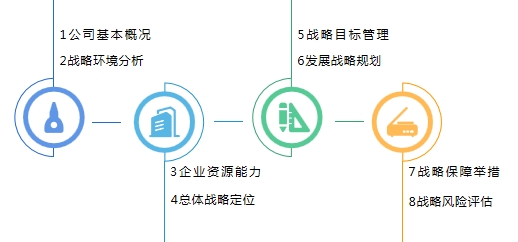
6. Write a strategic planning consulting report.
7. Strategic planning assists in implementation.
Catalog of Strategic Consulting Reports