














Air tightness in buildings refers to one of the crucial indicators that ensure a constant temperature within the building envelope under the influence of wind pressure and thermal pressure. It directly relates to heat loss caused by the infiltration of cold or hot air indoors, which is essentially indoor energy loss. The higher the air tightness grade, the less heat loss. In this context, the bold experiment of applying waterproof and breathable membrane, vapor barrier membranes, which have proven successful in metal roof applications, resulted in unexpectedly effective air tightness.
Passive houses require a pressure test to determine the air change rate, i.e., air tightness n50 ≤ 0.6h-1. Higher air tightness significantly reduces indoor-outdoor air exchange. During winter heating, it minimizes heat loss caused by cold winds penetrating indoors, lowering heating energy consumption. Similarly, during summer cooling, it reduces the infiltration of outdoor hot air, decreasing air conditioning energy consumption. Of course, air tightness is not the sole indicator of energy reduction; it also includes the thermal transfer of components such as doors, windows, and walls.
Traditional construction methods cannot solve the air tightness issues of windows. Kodebond's self-adhesive waterproof breathable film and self-adhesive vapor barrier film, through actual application and tracking experiments, can significantly improve the air tightness of windows and reduce thermal loss and heat conduction.
1. Gasket Design Considerations
1.1 Location and representation of airtight layer
The airtight layer is primarily composed of the building's envelope structures, including doors, windows, walls, roofs, and floors, typically located on the interior side of the outer walls and continuously wrapping the entire building. In design drawings, the airtight layer is usually indicated by a red thick line on the interior side of the building envelope. However, some designs omit the airtight layer, leading to construction personnel being unable to clearly identify its location and causing construction oversights that affect the passive house's performance, as shown in Figure 1.
1.2 Commonly Sealed Areas
Passive External Doors and Windows
The Ministry of Housing and Urban-Rural Development issued the "Guidelines for Passive Super Low Energy Consumption Green Building Technology" in October 2015.
Regulation: "External doors and windows should have good air tightness, water tightness, and wind resistance, with an air tightness grade not lower than level 8." Compared to traditional buildings, passive house doors and windows are all installed in an external hanging manner. At the same time, measures such as waterproof vapor barrier (on the inside) and waterproof breathable membrane (on the outside) should be adopted at the connection between the door and window frames and the walls to prevent the risk of air or water leakage between the frame and the wall, as shown in Figure 2.
Figure 1: Illustration of Airtight Layer Labeling Figure 2: Design Nodes of Doors and Windows
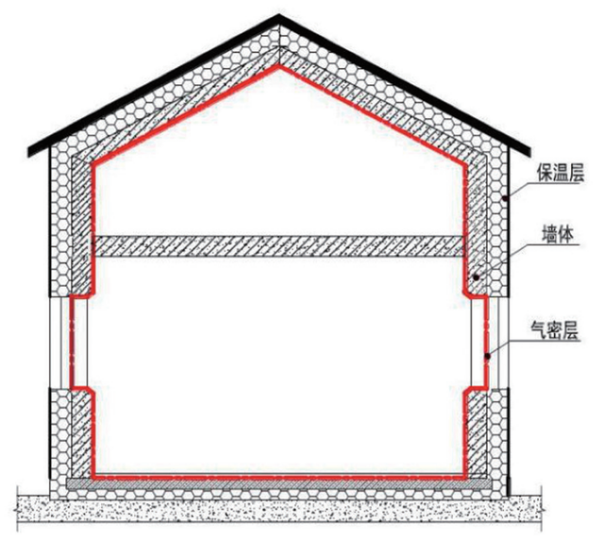
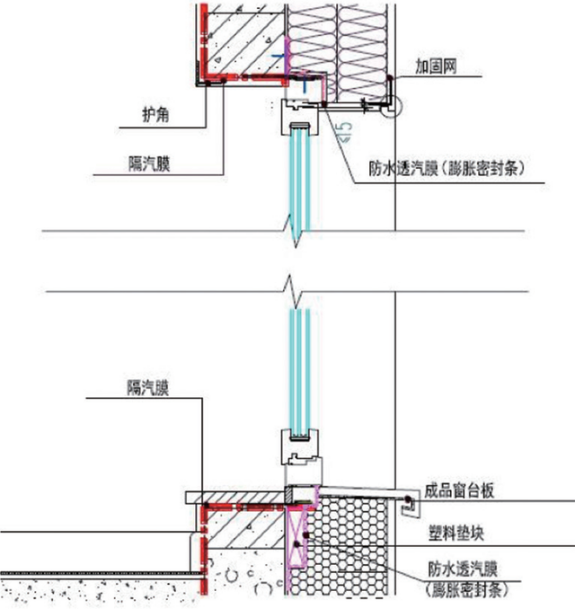
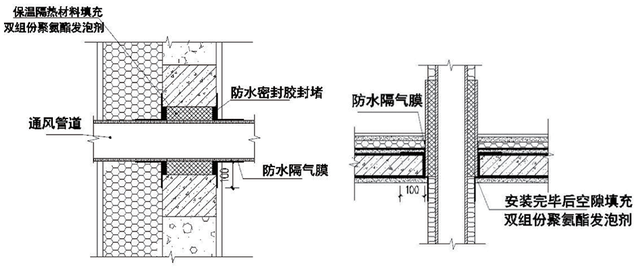
Figure 3: Illustration of application for self-adhesive waterproof and breathable membrane, vapor barrier in airtightness treatment
The "Code for Acceptance of Quality of Construction Quality of Decorative and Refurbishment Engineering" GB50210-2001 issued by the Ministry of Housing and Urban-Rural Development stipulates in Article 4.2.4: "The plastering work should be carried out in layers. When the total thickness of the plastering is greater than or equal to 35mm, reinforcement measures should be taken. Reinforcement measures to prevent cracking should be adopted for the surface plastering at the junction of different material substrates," and it explicitly states in the explanation: "Due to inconsistent water absorption and shrinkage, the surface layer of the plastering at the junction of different material substrates is prone to cracking, and reinforcement measures should be taken to ensure the quality of the plastering work." Therefore, in the design of passive houses, both the masonry and plastering of walls should adopt airtightness protection measures to prevent cracking of the walls or the plastering layer due to uneven settlement or shrinkage of the walls, especially in the design of masonry plastering, it is necessary to clearly specify the anti-cracking measures in the design and ensure that the airtightness measures are firm and reliable. 1.2.2 Masonry and Plastering
1.2.3 Integrity of the Enclosure Structure
To ensure the integrity of the airtight layer of the building envelope, during design, air-sealing measures should be taken for any penetration through the exterior wall, roof, floor piping, or pre-buried pipes, as shown in Figure 3.
2. Sealing Construction Precautions
As the saying goes, "Three parts design, seven parts construction." The precision of the construction plays a decisive role in whether a passive house can achieve energy-saving goals.
2.1 Window and Door Installation Project
Passive house exterior doors and windows are all installed in an external-hanging manner. The outer side is secured using wood blocks and angle codes. The inner and outer sides are sealed with waterproof vapor barriers and waterproof breathable membranes, respectively. The complex process can lead to potential air-tightness issues, so attention should be paid to the following:
When applying the waterproof membrane on both the interior and exterior sides, it is difficult to adhere at the corners of doors and windows, as well as at the corner brackets and wooden blocks. Therefore, a reinforcing layer is required at these areas. The exterior waterproof membrane should be pasted from bottom to top, ensuring that the overlapping joints have the opening facing down to minimize the risk of water leakage.
(2) When applying the waterproof membrane, ensure the base is completely dry to prevent the membrane from not adhering properly due to damp walls.
(3) During the rainy season, it is advisable to use waterproof mortar to level the exterior walls, especially around door and window openings, to prevent prolonged rain from washing against the walls and seeping into the waterproofing membrane, affecting the adhesion quality.
(4) For non-self-adhesive vapor barrier and waterproof breathable membranes, the construction method can be simply summarized as "stick, paint, scrape, press." This means first attaching the vapor barrier to the window frame, then applying the adhesive in an "S" shape on the wall, followed by smoothing the adhesive evenly and sticking the membrane, pressing it firmly. It is worth noting that when scraping the adhesive, ensure it remains continuous without any breaks.
2.2 Concrete Construction
During concrete pouring, ensure the concrete is properly compacted to avoid defects like honeycomb or rough surfaces. After demolding, seal the template tie bolt sleeves with air tightness, as there are many tie bolts, it's easy to overlook. Therefore, make sure to seal all sleeves to prevent losing the big picture over small details.
2.3 Masonry and Plastering Work
During masonry construction, factors such as shrinkage cracks and cracking in the masonry should be fully considered, and strict control should be exercised over the selection of masonry units, age, mortar density, and masonry height. For example, with autoclaved bricks and concrete bricks, due to their significant early shrinkage values, they should not be used until 28 days after curing. Defects such as damage or cracks in the masonry units can adversely affect the strength of the masonry, leading to cracking. During construction,严格控制 the thickness and density of the masonry mortar, as well as the daily masonry height and the time for diagonal laying at the gap between the top of the filled wall and the main structure.
The plastering layer can form an airtight seal and also compensate for defects in wall masonry. Therefore, preventive measures against cracking should be taken during plastering, especially at the junctions of two materials, where measures such as mesh hanging are required to prevent cracking.
Due to the significant impact wall cracking can have on the overall airtightness of the building, it is crucial to thoroughly consider wall cracking factors during the masonry and plastering processes, in order to minimize the risk of cracking. This ensures the airtightness of the maintenance structure.
2.4 Installation Engineering
Passive houses require attention to airtightness issues during both the design and construction phases, but the airtightness concerns during the usage phase are often overlooked. Taking the floor drain and lavatory sink as examples, air leaks may occur at these locations during the airtightness final test after the renovation of a passive house project. Article 4.5.9 and 4.5.10 of the national standard GB50015 "Code for Design of Building Water Supply and Drainage" stipulate that the water seal depth of floor drains with water seals must not be less than 50mm and that water seals with anti-drying functions should be preferably used. However, the author believes that due to the water seals drying out over time and the reduced rebound function of anti-drying floor drains after long-term use, unpleasant pipe odors can still enter the indoor space. Therefore, permanent and force-resistant airtightness measures are necessary.
3. Airtightness Testing and Assessment
The "baffled door method" is used to assess a passive house or a passive house unit, along with reverse pressure testing. A fan is installed in a door or window opening of the exterior protective structure, and other non-permanent openings indoors are sealed. A micro-positive and micro-negative pressure of 50 Pa is sequentially established, and the air volume flow rate of the fan's suction under this wind pressure is measured. It's worth noting that larger buildings are more likely to meet the requirement of n50≤0.6h-1. In fact, large buildings with n50 reaching 0.6 may still have significant air leakage issues. Therefore, for large passive buildings where Vn50≥4000m³, both the air change rate per hour (n50) and the building's permeability (q50) should be tested, with q50 being less than or equal to 0.6 m/(h.m).