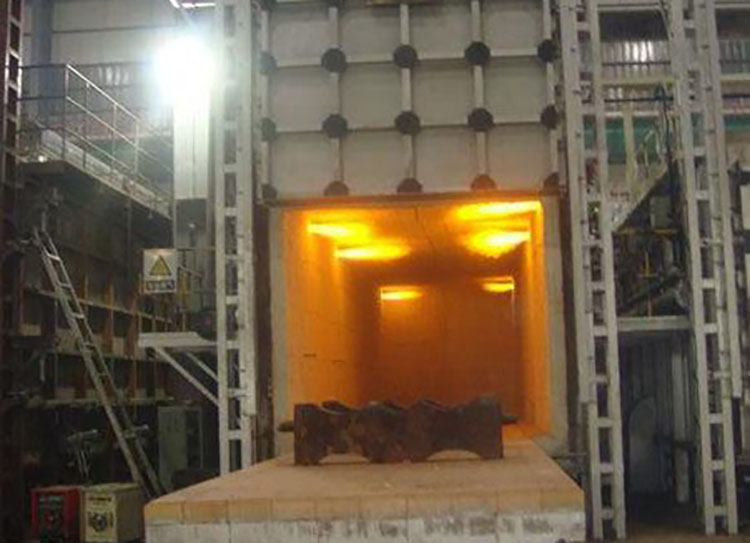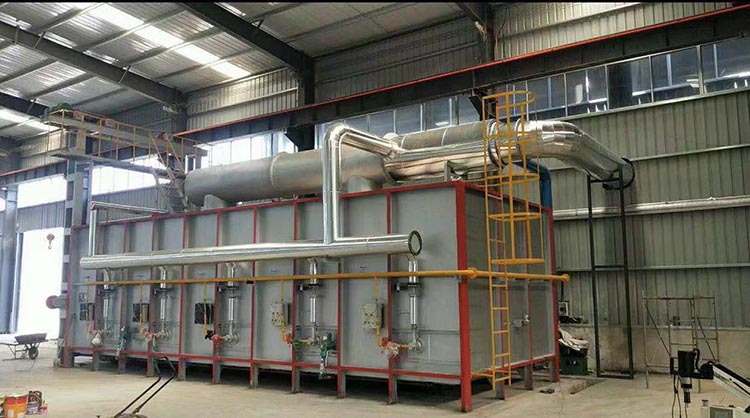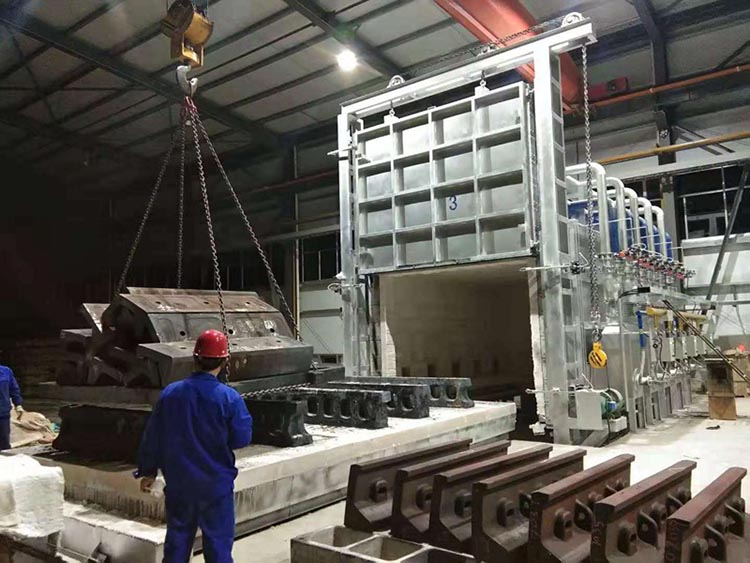






The gas powered trolley furnace is a standard energy-saving periodic operation furnace with a super energy-saving structure and an energy-saving effect of 65%. The trolley adopts anti-collision sealing bricks, and the furnace door adopts a spring type compression mechanism, which automatically seals the trolley and furnace door. It is integrated with rails and does not require foundation installation. It can be used on a horizontal ground. Mainly used for quenching, annealing, aging, and heat treatment of various mechanical parts such as high chromium, high manganese steel castings, ductile iron, rolling rolls, steel balls, 45 steel, stainless steel, etc. 1. The equipment uses various combustion gases as the medium and heats up through various burners at a temperature of 1200 ℃. 2. The furnace body skeleton is composed of various large and medium-sized steel sections welded on site, and the outer shell sealing plate is made of color steel plate. The high aluminum full fiber refractory spinning blanket module is used as the furnace lining, and the sealing energy-saving effect is obvious. 3. The trolley frame is composed of various large I-beams, channel steels, angle steels, and thick steel plates welded together. 4. The trolley transmission adopts all wheels as driving wheels, which is reliable. The transmission system adopts a "three in one" motor reducer installation method, which is shaft mounted. The structure is compact, the assembly is firm, the entry and exit are flexible, the operation is simple, and the maintenance is convenient. 5. The refractory masonry of the trolley adopts high alumina shaped brick structure, which has good sealing effect with the furnace body and high compressive strength. Place the pad iron on the trolley surface for stacking workpieces. All the car body panels are made of poured parts to ensure that the car body does not deform and is durable. The sealing between the furnace car and the furnace lining adopts a refractory fiber sealing block electric push rod automatic compression structure. The opening and closing of the side seal are interlocked with the entry and exit of the furnace truck. 6. The furnace door adopts a combination frame structure of high aluminum full fiber refractory spinning blanket and steel section, with an electric hoist for lifting and lowering. The furnace door sealing mechanism adopts a long and short lever spring type automatic compression cam mechanism and a soft edge sealing device. Ensure frictionless up and down, effortless, safe and reliable. 7. The chimney is equipped with automatic furnace pressure control, butterfly valves, etc., which can adjust the cooling speed. 8. Heating adopts high-speed burners, evenly distributed on both sides. Continuous proportional adjustment combustion. The actuator adjusts the size of the air volume, and the gas volume is adjusted through a proportional valve to achieve air-fuel ratio combustion. The gas and air volume have lower limit limits, and each burner is equipped with a control solenoid valve on the gas pipe. Each burner is equipped with an independent and complete combustion controller, which has automatic ignition, flame detection, fire alarm, and automatic gas cut-off. This fully ensures the stability and safety of the combustion temperature control system. 9. The characteristics of a high-speed burner are that the fuel and combustion air are basically completely burned in the combustion chamber, and the high-temperature gas after combustion is sprayed out at a speed of 100m-150m/s, thereby enhancing convective heat transfer, promoting air flow circulation in the furnace, and achieving uniform furnace temperature, making the insulation uniform at ≤± 10 ℃. The burner has a small combustion chamber volume, a high combustion gas outlet velocity, a large burner adjustment ratio of 1:10 d, automatic ignition and flame monitoring, fault alarm function for each burner, low-pressure protection for each combustion air, interlock safety control for the size of each burner, combustion status display and fault alarm display, temperature curve design and modification, saving and printing, operation prompts and fault prompts, combustion air fan control (switch), furnace door control (switch), air-fuel ratio control, process safety interlock control. The preheater adopts a GC type tubular inserted turbulence heat exchanger to increase the preheating temperature of the air. When the furnace temperature is 1000 ℃, the air temperature is preheated to 300-350 ℃. The sentence is:. GC type insert heat exchanger, under the same heat transfer coefficient, the air side pressure loss is lower than that of ordinary insert heat exchange, its value is about 1500Pa, so the power consumption is reduced. When the flue gas temperature is 600 ℃, the comprehensive heat transfer coefficient is above 45W/M2 ℃. When the flue gas temperature is ≥ 900 ℃, the comprehensive heat transfer coefficient is above 55 W/M2 ℃. Heat exchangers are designed with heat-resistant steel and stainless steel according to different temperatures, and are arranged with temperature homogenization and thermal stress relief measures. 11. The control system mainly adjusts and controls the flow rate of gas pipelines, flue gas, and dilution air volume of each furnace through temperature and pressure detection, and is equipped with a rapid cut-off device for the natural gas main. The high or low furnace pressure has a significant impact on the effectiveness of the heating furnace. When the furnace pressure is high, the furnace gas will rush out of the various sealing gaps of the furnace body, forming air flow erosion, which has a significant impact on the pressure of the furnace door and bottom sealed with fiber materials. At the same time, high-temperature air flow will also have an impact on the surrounding environment and control devices of the furnace body. When the furnace is lowered, cold air is drawn in from the sealing gap, which not only increases the oxidation of the workpiece, but also causes the high temperature inside the furnace to be quickly extracted by negative pressure, resulting in fuel waste. To this end, the furnace pressure measuring point is installed on the exhaust duct to control the electric adjustment of the flue gas valve, keeping the furnace pressure in a slightly positive state. The furnace adopts zone furnace temperature control, with one thermocouple in each zone. The measured temperature enters a multi-point recorder, which tracks and records the temperature inside the furnace in a centralized manner. 12. The safety interlock system between the trolley and the furnace door locks the trolley in and out when the furnace door is not opened to a certain position, and locks the trolley in and out when the trolley seal is not opened. When the air, gas pressure, and compressed air pressure do not meet the specified requirements, the combustion of the burner will not start. If it is still burning, it should be safely shut off. 13. Main features of the equipment: 1. Good energy-saving effect: The furnace lining of this equipment is made entirely of high alumina refractory fibers, which have a lower thermal conductivity and smaller heat capacity compared to refractory bricks. Therefore, the thickness of the refractory layer is smaller and the heat absorption is greatly reduced. This equipment adopts a high-speed temperature regulating burner system with a high spraying speed of up to 100m/s, which can effectively stir the furnace gas and achieve uniform furnace temperature. The burner system burns completely, allowing the fuel to be fully utilized. By adopting furnace pressure zero position control and fully sealed technology, the joint surface (sealing surface between the furnace car and the furnace body) is at zero furnace pressure, preventing furnace gas from leaking out and cold air from infiltrating, so that the heat energy generated by combustion can be effectively utilized. 2. High degree of automation: All furnace doors and carts are electric, with an operation console, allowing operators to easily control the operation of the furnace doors and carts. The furnace door and furnace car have stroke control, and can automatically stop running when they reach the limit position to ensure safety. The combustion system has a complete set of ignition, high and low flame operation, detection, shutdown alarm, shutdown cut-off and reignition functions, and each burner has an independent control box that can be controlled separately. Each control box interface can be connected to a temperature controller between instruments, enabling the entire system to achieve automatic control. The pipeline parameters are automatically controlled. The pipeline pressure of combustion air and fuel can be set and automatically adjusted to control the optimal ratio of combustion air and fuel, ensuring high combustion efficiency and eliminating black smoke. Automatic control of furnace pressure, comparing the furnace pressure signal with the set value through a pressure transmitter, transmitting the signal to the chimney actuator, and automatically controlling the pressure inside the furnace by changing the chimney opening. The temperature control inside the furnace adopts an intelligent digital temperature controller, which forms a closed-loop control with temperature measuring elements and automatic control burners. It has high precision, high flexibility, anti-interference ability, and high reliability. The temperature control system can automatically calculate, operate, display, and store the heat treatment production process curve, achieving full process control. The instrument cabinet is equipped with temperature, furnace pressure, operating value displays for various burners and pipeline parameters, as well as abnormal situation alarms and emergency protection measures to ensure operational safety.