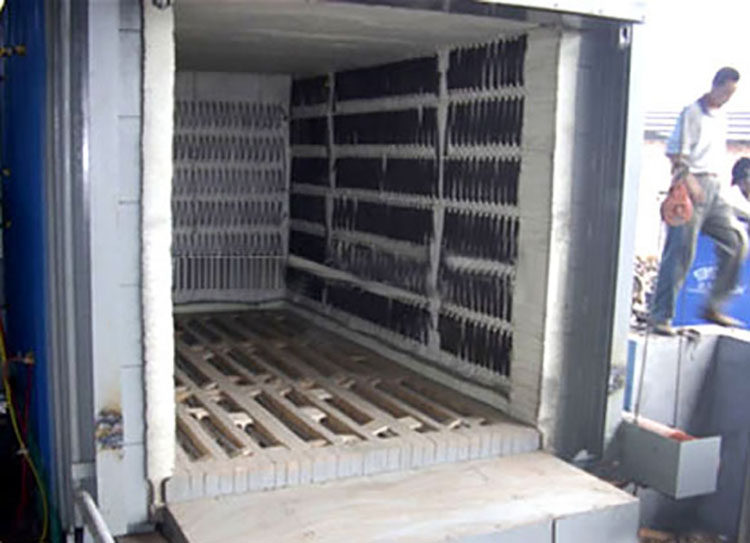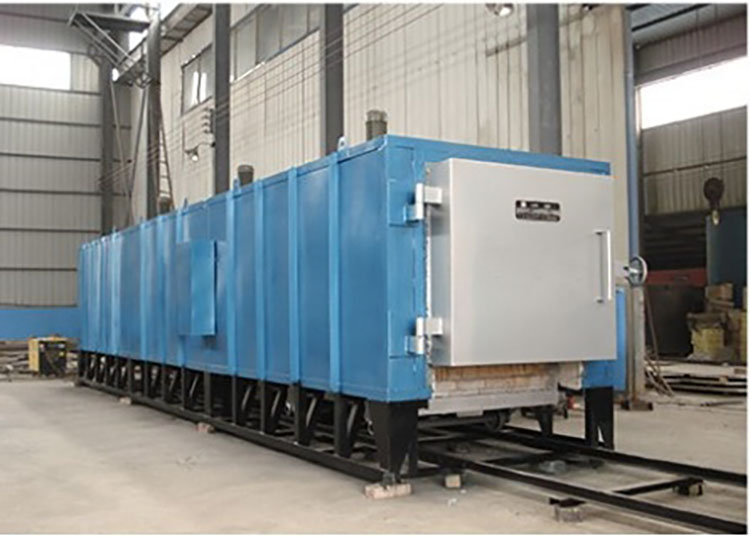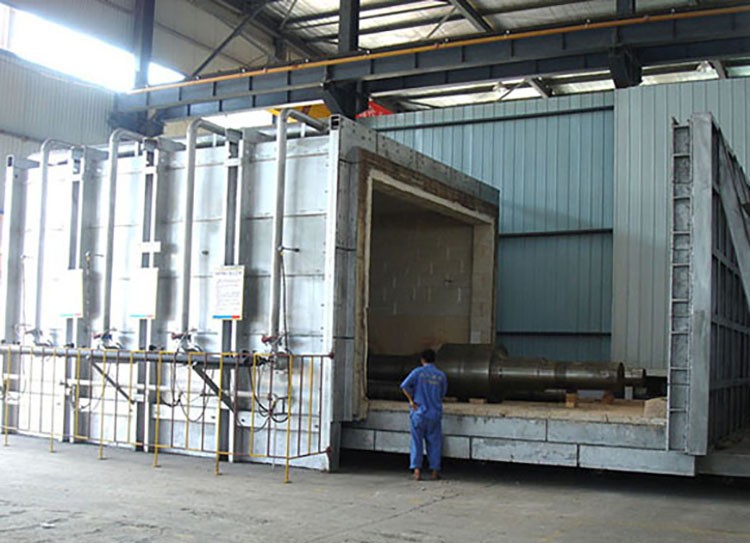






The trolley type resistance furnace is a standard energy-saving periodic operation furnace, with a super energy-saving structure and fiber structure, saving up to 60% electricity. The production adopts a composite high aluminum porcelain nail group, with anti-collision sealing bricks for the trolley, automatic sealing of the trolley and furnace door, integrated rail connection, no need for foundation installation, and can be used on a horizontal ground. Mainly used for quenching, annealing, aging, and heat treatment of various mechanical parts such as high chromium, high manganese steel castings, ductile iron, rolling rolls, steel balls, 45 steel, stainless steel, etc. The trolley type resistance furnace is made into large sections with a certain amount of compression during the processing to ensure that each ceramic fiber block expands in different directions after the module is built, so that the modules are squeezed into a seamless whole, achieving good heat storage effect. Moreover, the product is easy and fast to construct, and can be directly fixed to the stainless steel anchor round nails of the furnace shell steel plate. Compared with other products, the advantages are low thermal conductivity, low heat capacity, excellent corrosion resistance, excellent thermal stability, thermal shock resistance, insulation, and the anchor is set on the cold surface of the furnace body, which improves the high temperature resistance strength of the fiber.
The heating element is made of high-temperature resistance alloy wire wound into strips and spirals, which are hung on the furnace side, furnace door, rear wall, and wire support brick of the placement trolley, and fixed with high aluminum porcelain nails for safety and simplicity. [1]
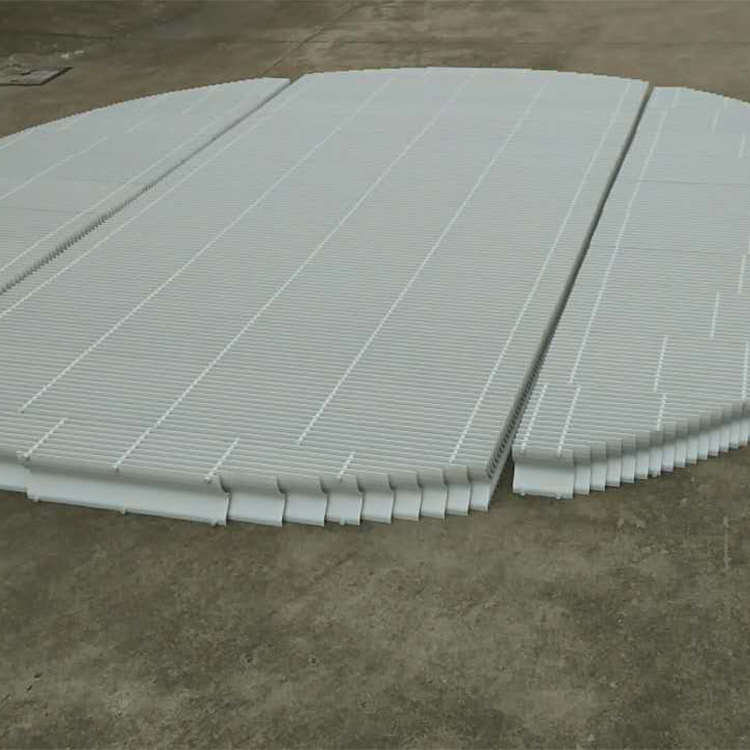
The trolley is equipped with a pressure resistant and high-temperature resistant cast steel furnace bottom plate for carrying workpieces. In order to prevent the oxide scale generated after heating the workpiece from falling around the heating element through the gaps between the furnace bottom plates and causing damage to the heating element, an insertion type contact is used at the contact between the furnace bottom plate and the furnace body. To ensure normal use, it is necessary to frequently blow the oxide scale under the furnace bottom plate of the trolley, usually once a week. When blowing, lift the furnace bottom plate and use compressed air to blow the oxide scale in the resistance wire groove clean. Be careful to prevent the oxide pickup from causing a short circuit inside the furnace wire.
The furnace door device consists of a furnace door, a furnace door lifting mechanism, and a furnace door clamping device. The furnace door shell is made of welded steel and sheet metal to form a sturdy frame structure, with refractory fiber pressed modules stacked inside. It is required to have good insulation performance and light weight. The lifting device of the furnace door adopts an electric device, mainly composed of a furnace door frame, a furnace door lifting crossbeam, a reducer, a sprocket, a transmission shaft, and bearings. The lifting of the furnace door is driven by the forward and backward transmission of the reducer. The furnace door lifting reducer is also equipped with a brake device, which can effectively prevent displacement of the furnace door during the lifting process. The furnace door clamping device adopts a domestic spring type clamping structure. When the furnace needs to be lifted, the self weight of the furnace door is automatically released by a lever, and it moves horizontally out of a certain distance before rising. When the furnace door is lowered into place and needs to be clamped on the pulley on the trolley, the elastic force of the spring is used to move the furnace door horizontally into a compressed and sealed state through the lever. This structure of the clamping device ensures that there is no friction between the fiber plane on the furnace door and the cotton at the furnace mouth, and has the characteristics of good safety performance and long service life.
The trolley frame is formed by welding steel sections, and its rigidity ensures that it will not deform under full load. The interior is built with refractory bricks, and the collision prone and load-bearing parts are built with heavy bricks to enhance the strength of the furnace lining structure. The trolley adopts a self-propelled structure, driven by a reducer sprocket to move on the track. The sealing of the trolley adopts an automatic labyrinth structure and soft contact double sealing. The trolley enters the furnace through the action of a cam and roller slope, and automatically rises for sealing. When the trolley is driven out, the sealing groove automatically falls down, and the sealing sand in the sealing groove does not need to be added frequently after being filled up. The trolley is driven out and the furnace door is raised and lowered by electric control, equipped with electromagnetic brakes to prevent inertia from hitting the furnace body. It is also interlocked control, that is, when the furnace door is slightly opened, the heating element is automatically cut off and the power supply of the trolley walking mechanism is restored. After the furnace door is closed in place, the power supply of the trolley walking mechanism is automatically cut off, and the power supply of the heating element is restored at the same time..
In order to shorten the cooling process time, the top of the trolley type resistance furnace can be equipped with an exhaust device for accelerating cooling. The device is turned off when heated, and turned on and off when cooled to a certain temperature by the operator on one side of the furnace through manual or automatic control.
The trolley type resistance furnace is a standard energy-saving periodic operation furnace, mainly used for quenching, annealing, aging of high chromium, high manganese steel castings, ductile iron, rolling rolls, steel balls, crusher hammers, wear-resistant lining plates, and heat treatment of various mechanical parts