

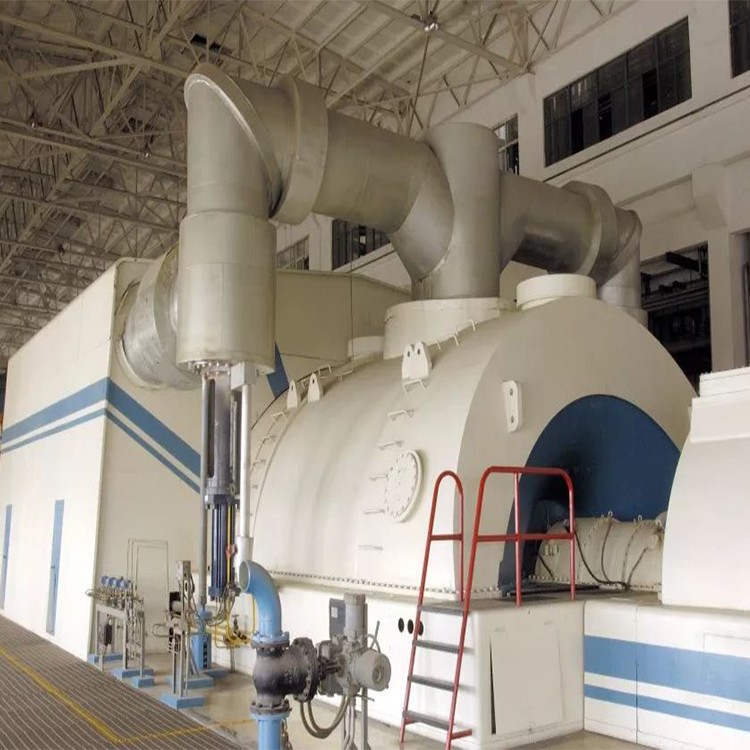















A condensing steam turbine refers to a turbine where, after steam expands and does work inside the turbine, almost all of it enters the condenser to condense into water, with only a small portion escaping through the shaft seal.
During the process of steam condensing into water in the condenser, the volume of the steam in the turbine decreases abruptly, creating a vacuum in the previously steam-filled enclosed space. This reduces the exhaust pressure of the turbine, increases the ideal enthalpy drop of the steam, thereby improving the thermal efficiency of the unit. Non-condensable gases (mainly air) in the turbine exhaust are removed by a vacuum pump to maintain the necessary vacuum level.
The most commonly used condenser for steam turbines is a surface-type one. Cooling water is discharged into a cooling pond or tower to be cooled before being recycled. For power plants near rivers, lakes, or reservoirs with abundant water supply, the cooling water discharged from the condenser can be directly released into the water bodies, known as runoff cooling. However, this method may cause thermal pollution to rivers and lakes. In severely water-scarce areas, power plants can use air-cooled condensers. But due to their large structure and high consumption of metal materials, they are rarely adopted by general power plants except for locomotive power stations.
Primarily composed of the turbine body, condensate pump, condenser, and circulating water pump, it refers to the process where steam, after doing work in the turbine, enters the condenser and is cooled into liquid water, which is then returned to the boiler by the condensate pump.
The vacuum pump's function is to establish the necessary vacuum between the turbine and condenser before the turbine starts up. During the operation of a condensing turbine, it promptly extracts air and other non-condensable gases from the condensing equipment continuously, ensuring the heat exchange efficiency of the condenser's heat exchange tubes and maintaining the vacuum level. The performance of the vacuum equipment directly determines the exhaust pressure of the condensing turbine, which in turn affects the size of the unit's enthalpy drop and the amount of steam consumed. Different vacuum extraction methods can impact the equipment investment cost, the complexity of operation, and the system's complexity of the turbine unit, making the vacuum equipment quite crucial for condensing turbines.
Performance Features
A condensing steam turbine set is a multi-stage condensing steam turbine with high steam cycle utilization. It can extract steam for use in production processes or heating systems. The turbine's exhaust is condensed into water in a condenser, which is then recycled back to the boiler for heating. The pressure of the turbine's exhaust is below atmospheric pressure. The operation is stable and it is widely used in industries such as thermal power, oil, chemicals, dyeing and printing, textiles, cement, sugar production, and papermaking.
Structure Form: Quick Assembly Double-Support Impulse Multi-Stage Small Steam Turbine
Arrangement: Single or Double Layer
Speed Control System: Hydraulic Actuator with 505 Digital Speed Controller, German Electro-Hydraulic Converter, and Siemens Technology.
Over-speed Protection: Two sets of mechanical hammer type with electromagnetic valve electronic intelligent control
Steam sealing form: Stainless steel blade labyrinth steam seal
Primary Steam Valve: Integrated Automatic Primary Steam Valve (Combination Regulating Valve)
Main shaft assembly: multi-speed impeller blades, sleeve fit rotor and impeller set, embedded blade design for impeller
Lubrication System: Forced oil lubrication, equipped with oil tank, oil separator, and cooler.
Thermal Expansion Compensation: Front bearing support with sliding thermal compensation
Electrical Configuration: Complete control cabinets, protection cabinets, main control cabinets, and matching Siemens generators
Wheeling Device: Electric Wheeling Machine